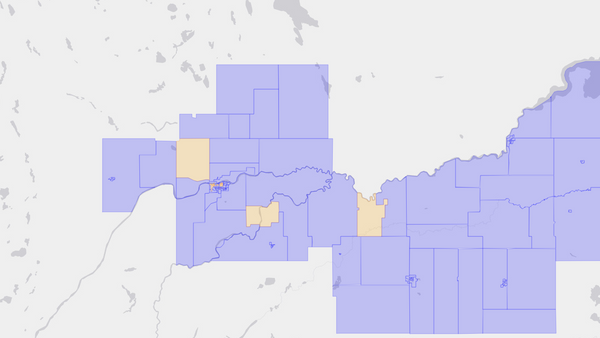
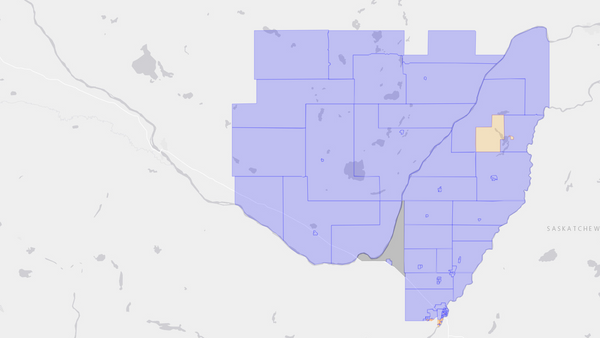
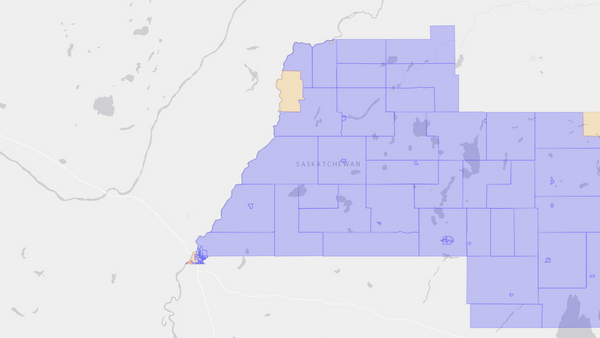
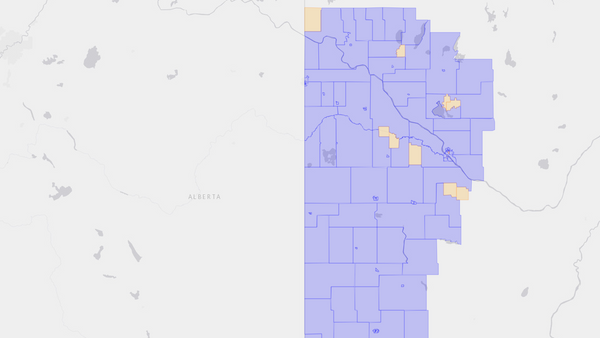
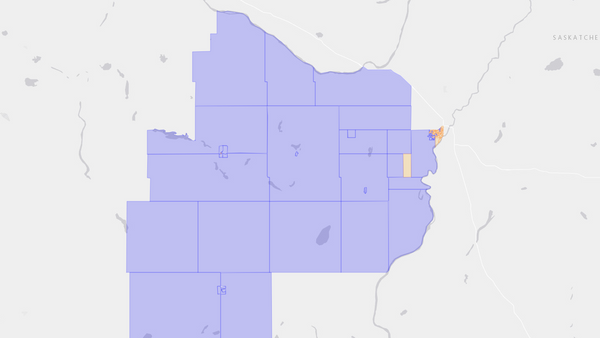
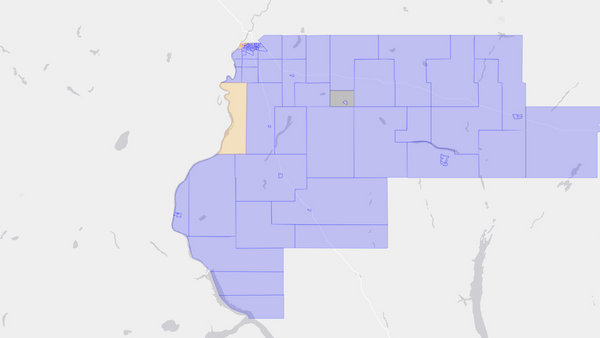
Desnethé—Missinippi—Churchill River, SK — 2008 Federal Election Results Map
Desnethé—Missinippi—Churchill River — 2008 Election Results
📌 The Canadian federal electoral district of Desnethé—Missinippi—Churchill River was contested in the 2008 election.
🏆 Rob Clarke, the Conservative candidate, won the riding with 8,964 votes (46.7% of the vote).
🥈 The runner-up was David Orchard (Liberal) with 5,816 votes (30.3%), defeated by a margin of 3,148 votes.
📊 Other notable candidates: Brian Morin (NDP-New Democratic Party, 18%).
Riding information
Auto generated. Flag an issue.Desnethé—Missinippi—Churchill River
The northern half of Saskatchewan forms a single constituency, roughly 800 kilometres deep, running from the farmland around Meadow Lake through boreal forest and Canadian Shield to the Northwest Territories boundary. Winter roads and float planes serve communities that highways never reached. The seat had changed hands twice in a little over two years by the time the 2008 campaign began, and both the Conservative incumbent and his Liberal opponent had arrived by unusual routes.
Candidates
Rob Clarke (Conservative) — Clarke was born at Kitimat, British Columbia, in 1967 and belongs to the Muskeg Lake Cree Nation. He spent 18 years in the RCMP, all of them in Saskatchewan, reaching the rank of sergeant, and was the officer in charge of the Spiritwood detachment in July 2006 when two of its constables were shot and fatally wounded during a pursuit. He won the seat at the by-election of 17 March 2008, called after Liberal Gary Merasty resigned in 2007 for family reasons, and so entered the general election with roughly six months in the House of Commons. He lived at Warman.
David Orchard (Liberal) — Orchard farms at Borden and became known nationally in the 1980s as a co-founder of Citizens Concerned About Free Trade and the author of a book arguing against continental economic integration. He contested the Progressive Conservative leadership in 1998, finishing second to Joe Clark on the final ballot, and again in 2003, when he placed third and then delivered his support to Peter MacKay on the final ballot in exchange for a written undertaking not to merge the party with the Canadian Alliance — a commitment set aside within months. He joined the Liberals in 2006 and brought his delegates to Stéphane Dion at that year's leadership convention. Passed over for the March by-election, when Dion appointed Joan Beatty, he won an open nomination vote for the general election.
Brian Morin (NDP) — A carpenter from Buffalo Narrows, Morin ran for the New Democrats, a party with deep roots in the northern communities.
George Morin (Green Party) — Self-employed and living at Muskoday, Morin stood for the Greens.
Rob Ballantyne of Air Ronge ran for the First Peoples National Party, founded in 2004.
About the Riding
About seven in ten residents are Indigenous: Dene in the far north and northwest, Cree and Métis through the centre and south. Meadow Lake, La Ronge and Air Ronge, La Loche, Buffalo Narrows, Île-à-la-Crosse, Pinehouse and Creighton are the larger settlements; dozens of reserves and northern villages are smaller still, and many have no all-weather road.
Resource extraction supplies most of the wage employment. The uranium mines of the Athabasca Basin, run by Cameco and Areva, are among the largest in the world and pay the best wages in the north. Cigar Lake, flooded in October 2006 before it ever produced, was still shut and its start-up had already slipped by two years. Forestry, the other pillar, was in trouble: the closure of the Prince Albert pulp mill at the beginning of 2006 put hundreds out of work and hollowed out the woodlands operations that fed it, and the sawmill and oriented strand board plant at Meadow Lake were operating under pressure as North American housing demand collapsed. Commercial fishing, wild rice, trapping and outfitting round out the economy.
The federal issues that mattered here differed sharply from the rest of Saskatchewan. Housing shortages and boil-water advisories on reserve, the funding formula for band-operated schools, medical coverage in remote communities and resource revenue sharing were the recurring subjects. The residential schools apology delivered in the Commons in June 2008 and the launch of the Truth and Reconciliation Commission that same month were fresh in memory throughout the campaign.