On Friday, I sent out an email to the tens of thousands on the Rally for Canada email list asking them to participate in a small survey concerning the upcoming federal budget. I asked people four questions concerning the government spending and their public policy priorities. Over three thousand people responded on Friday and over the weekend. I will be passing on the results to the office of the Minister of Finance as promised.
Q: On the question of Canada’s upcoming federal budget to get us through the economic crisis, which balance within the following options do you think is best for the government to implement? (n=3003)

Q: Which issues are most important to you from a government policy point of view? (n=3051)

Here is the same graph sorted in descending order (n=3051):

Q: What should be done with the Senate? (n=3007)

Q: What should be done with funding for the CBC? (n=2998)

Some notes: “n” is the number of respondents to each question. Data was gathered from 8am Friday through midnight Sunday night. Sample data is gathered from a population set that registered on the anti-coalition website RallyforCanada.ca between December 4th 2008 and January 9th 2009. Answers were not randomly cycled.
That said, this data gives us insight into the priorities of Canadians who are against the concept of a Bloc-supported NDP-Liberal coalition government. The first question was a careful balance on both sides of the spending vs. taxes debate. On one hand, the answer set does not include an option to decrease spending and on the other, four out of five answers prompt at least some tax relief. Most analysts believe that the federal budget will include some tax relief and stimulus in the form of government spending. The largest group believed a balance spending/tax relief approach would be best while the second largest group favours substantial tax relief and no new spending (given the options presented).
The second question had 24 options. Each option was a yes/no checkbox to pick public policy priorities. There was little surprise on the distribution of public policy interests as the generally right-of-centre respondents selected jobs, economy, crime, tax cuts, healthcare choice, and military spending as priorities while passing on foreign aid, culture and arts, and native affairs. Wheat board reform is generally a conservative priority yet this question is likely too regional for a national survey.
On the specific questions, it is of particular interest that 90% of respondents believe that the Senate in it’s current form must change. Only 10% of respondents thought that the Senate ought to be left as it is. On the question of spending for a particular budget item, respondents indicated that funding for the CBC should be decreased (61%) while only 6% thought it should be increased.
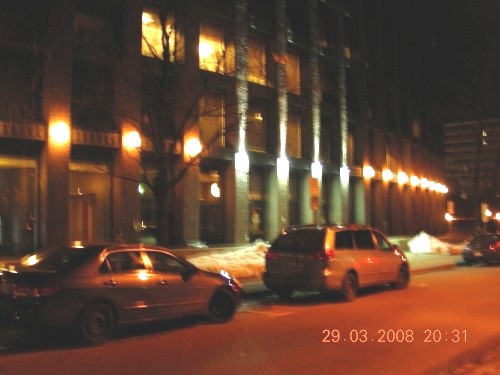
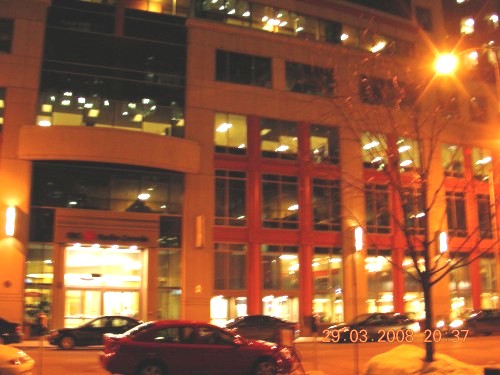
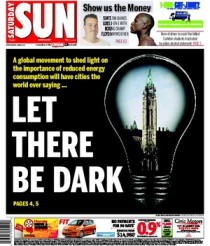 Earth Hour was ‘celebrated’ worldwide on Saturday in order to raise “awareness” of climate change and our wasteful consumption of energy. I was made aware of this event by the huge (approx) 50 ft full colour banner hanging from Ottawa city hall, the countless full colour flyers taped to lamp posts downtown, the wall to wall TV network coverage that has been burning up the microwaves, the buckets of black ink used to print clever ‘lights out’ themes on the front pages of newspapers produced from dead trees. Ironically, one Earth Hour promoter suggested sitting in the dark and burning candles instead of having the lights on. Alas, burning wax is a much less efficient method of producing light, and a process that produces more CO2, than using fluorescent (or even incandescent bulbs) that have been produced as a result of industrial progress, and market-based innovation. Indeed, the net result of industrialization was to create more efficient processes for achieving the same or better end results for less energy cost and less energy waste.