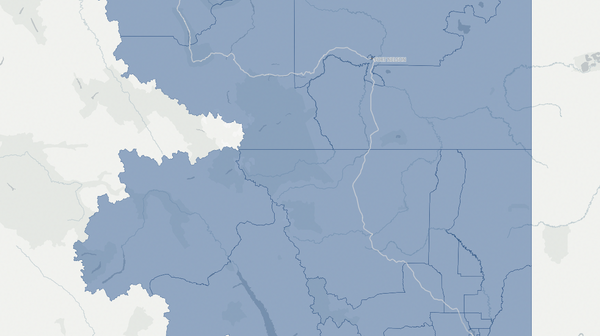
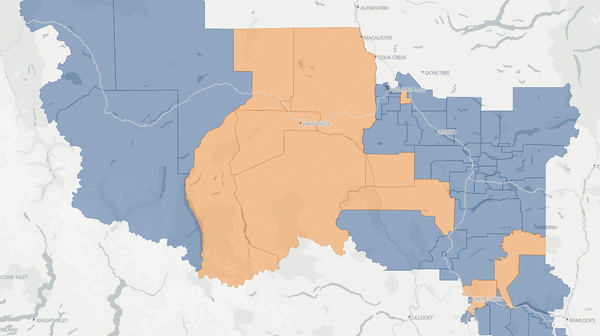
Prince George-Mackenzie — 2024 British Columbia Provincial Election Results Map
Prince George-Mackenzie — 2024 Election Results
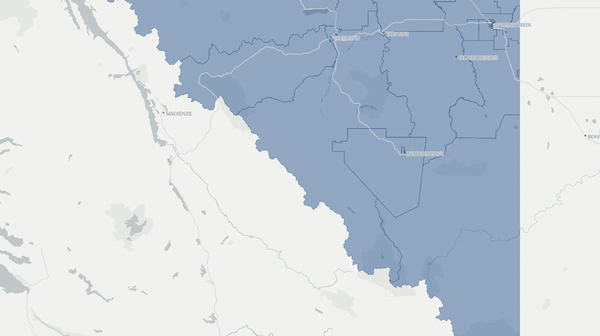
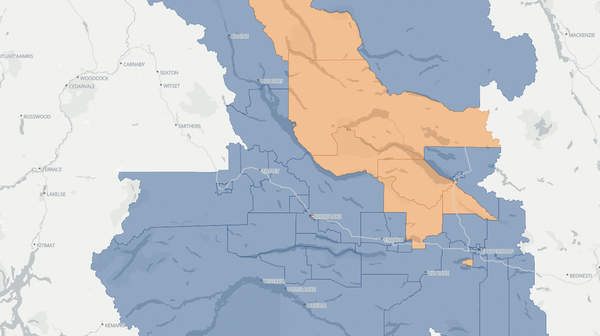
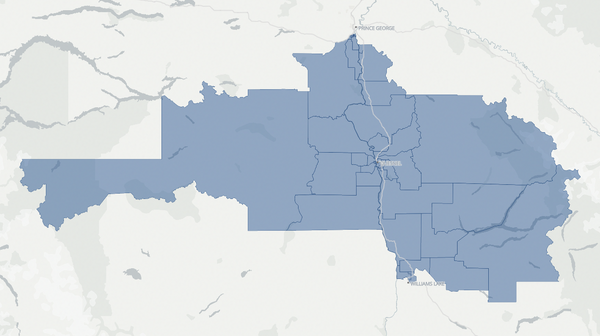
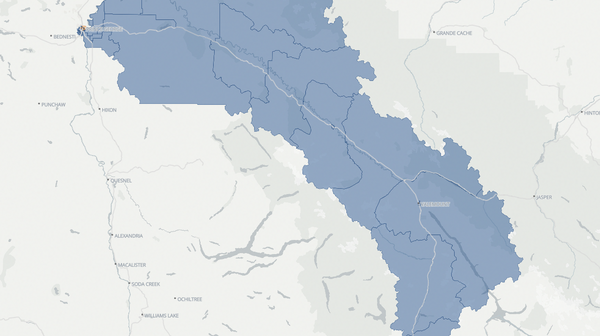
Poll-by-poll results for Prince George-Mackenzie in the 2024 British Columbia election. The Conservative Party candidate won this riding. Explore detailed voting data, candidate results, and turnout statistics at the poll level.
Riding information
Auto generated. Flag an issue.Prince George—Mackenzie
Prince George—Mackenzie covers a vast expanse of central-northern British Columbia, from the eastern neighbourhoods and commercial corridors of Prince George — the province's largest city north of Kamloops — northward roughly two hundred kilometres to the small forestry-dependent community of Mackenzie on the southern shore of Williston Lake. Highway 97 links the two population centres through terrain shaped by the legacy of the mountain pine beetle epidemic, which over two decades killed more than eighteen million hectares of BC forest and left behind a landscape of dead and recovering timber. Prince George functions as the economic and institutional anchor, home to the University of Northern British Columbia and the University Hospital of Northern BC.
The riding had been held by Mike Morris, a former RCMP superintendent, for the BC Liberals since 2013. Morris did not seek re-election in 2024, and the contest drew a former BC United candidate who switched to the Conservatives, an NDP school trustee, a Green Party forestry advocate, and a former Conservative nominee running as an Independent.
Candidates
Kiel Giddens (Conservative Party) — Giddens had held senior political staff roles in previous BC governments, including chief of staff to the Minister of Environment and chief of staff to the Minister of Transportation and Infrastructure. He had spent nearly a decade working with TC Energy on the Coastal GasLink pipeline project, serving as a liaison and public affairs manager. He served as president of the Prince George Chamber of Commerce and sat on the board of the Spirit of the North Healthcare Foundation. Originally the BC United candidate, he was nominated as the Conservative candidate in September 2024 after BC United suspended its campaign.
Shar McCrory (BC NDP) — McCrory was a school trustee with Prince George School District 57 who had lived and worked in northern British Columbia for over three decades. She had worked at a sawmill for ten years, spent a decade with Northern Health, and had served as chair of the Coast Mountains School Board. She was acclaimed as the NDP candidate in August 2024.
James Steidle (BC Green Party) — Steidle grew up on a cattle ranch near Prince George and held a Master's degree in public policy from Simon Fraser University. He was the founder of Stop the Spray BC, an organization opposing herbicide spraying on Crown forests, and operated Steidle Woodworking, a handcrafted furniture business. He had worked in the BC Legislative Assembly and in policy research for the labour movement.
Rachael Weber (Independent) — Weber was a School District 57 trustee who had been initially chosen as the BC Conservative candidate before being replaced by Giddens. She continued her campaign as an Independent.
Local Issues
The forestry sector's contraction had deepened since 2020, and the impacts were felt acutely in both Prince George and Mackenzie. Canfor's permanent closure of the Isle Pierre sawmill in 2020, the curtailment of operations at its Mackenzie facility, and reduced production at the Prince George Pulp and Paper and Intercontinental Pulp mills had eliminated hundreds of jobs in the region. The mountain pine beetle's legacy meant that the allowable annual cut across the central interior was expected to continue declining for years, and the transition from an economy built on abundant timber to one grappling with scarcity had no straightforward path. For Mackenzie — a community whose existence was almost entirely dependent on forest products — the mill curtailments raised questions about the town's long-term viability.
The opioid crisis continued to devastate Prince George. The city recorded some of the highest illicit drug overdose death rates in the province, and the intersection of addiction, mental health, homelessness, and poverty was acutely visible downtown. The NDP government had expanded naloxone distribution and overdose prevention services, but the death toll continued to climb, and access to residential treatment beds and supervised consumption sites in the north lagged far behind what public health advocates said was needed. The debate over decriminalization — launched in January 2023 and partially reversed in May 2024 — was particularly charged in northern communities where public safety concerns competed with harm reduction imperatives.
Health care capacity at the University Hospital of Northern British Columbia was a concern that crossed party lines. Physician recruitment and retention in the north remained a persistent challenge despite the Northern Medical Program at UNBC — a partnership with UBC that had been producing graduates since the mid-2000s. Emergency department pressures, specialist wait times, and burnout among existing staff were chronic problems that the COVID-19 pandemic had intensified. The broader question of whether northern British Columbia received a fair share of provincial health investment shaped campaign conversations across all three Prince George ridings.