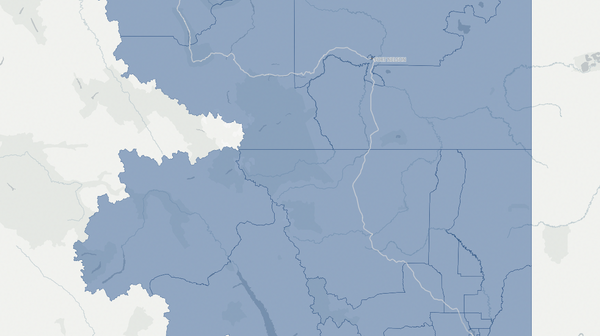
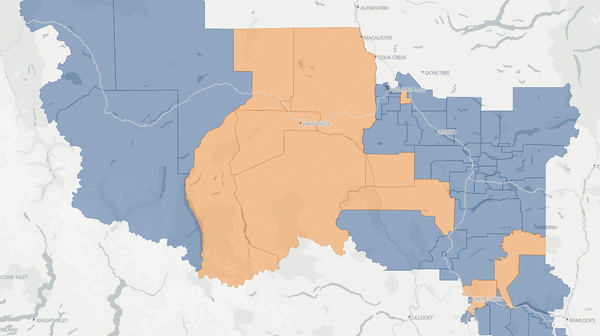
Peace River South — 2024 British Columbia Provincial Election Results Map
Peace River South — 2024 Election Results
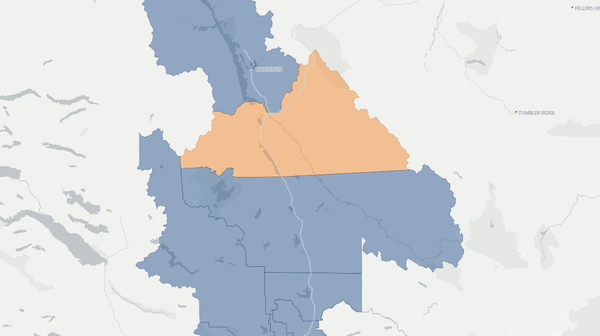
Poll-by-poll results for Peace River South in the 2024 British Columbia election. The Conservative Party candidate won this riding. Explore detailed voting data, candidate results, and turnout statistics at the poll level.
Riding information
Auto generated. Flag an issue.Peace River South
Peace River South spans the communities of Dawson Creek, Chetwynd, Tumbler Ridge, and Pouce Coupe in the northeastern corner of British Columbia, where the Rocky Mountain foothills meet the boreal plain. Dawson Creek — population roughly 13,000 — serves as the region's commercial centre and marks Mile Zero of the Alaska Highway, a designation that anchors the local tourism economy alongside agriculture, forestry, and natural gas extraction. The riding's smaller communities each carry distinct economic identities: Tumbler Ridge was built as a coal-mining town in the 1980s and later pivoted toward tourism around its UNESCO Global Geopark designation, while Chetwynd depends on forestry and its position as a railway junction.
Mike Bernier had held the seat since 2013, first as a BC Liberal and then under the renamed BC United banner. When BC United suspended its campaign in August 2024, Bernier announced he would run as an Independent, citing concerns about some Conservative candidates' views on women's rights, climate change, and Indigenous relations. His decision set up an unusual three-way contest pitting a well-known local incumbent against the Conservative wave sweeping the northeast and a little-known NDP candidate.
Candidates
Larry Neufeld (Conservative Party) — Neufeld was a professional engineer and business leader who grew up as the eldest son of a first-generation farmer in northern Saskatchewan. He earned a Bachelor of Applied Science in Engineering and pursued graduate studies before being appointed vice president of Western Canada's largest environmental remediation contractor at age twenty-nine. He also served as a Reserve Infantry Platoon Commander. He campaigned on reducing regulatory barriers to resource sector investment.
Mike Bernier (Independent) — Bernier brought two decades of public service to the contest, having served as a Dawson Creek city councillor from 2005 to 2008 and then as mayor from 2008 to 2013 before winning the provincial seat. In the BC Liberal government, he took on the education portfolio as Minister of Education in 2015 and held it through the 2017 election. As a three-term MLA, he chose to run as an Independent rather than join the Conservatives after BC United folded.
Marshall Bigsby (BC NDP) — Bigsby was a student advocate and cook who had worked in kitchens across the region. He campaigned on affordability, education, and health care improvements for the Peace country.
Local Issues
The forestry sector's structural decline continued to reshape the South Peace economy between 2020 and 2024. The mountain pine beetle epidemic had devastated the region's timber supply over more than two decades, and reduced allowable annual cuts left mills operating with diminished fibre supply. Chetwynd's economy was particularly vulnerable, with its two mills generating a significant share of municipal tax revenue. The broader pattern of mill curtailments and closures across the BC interior — including Canfor's permanent closure of its Isle Pierre mill near Prince George in 2020 — sent ripple effects through communities that depended on forestry for employment and government revenue. Tumbler Ridge, which had already navigated the decline of its coal industry, offered a cautionary example of how resource-dependent towns could struggle to diversify.
The caribou habitat protection controversy that had dominated local politics during the previous term remained unresolved. The 2020 partnership agreement between the federal and provincial governments and the West Moberly and Saulteau First Nations had established roughly 7,500 square kilometres of protected and managed habitat for endangered southern mountain caribou herds, including restrictions on industrial activity in critical zones. Ranchers, forestry operators, and energy companies continued to push back against what they viewed as insufficient consideration of economic impacts, and the tension between conservation commitments and resource-sector livelihoods remained a defining fault line in South Peace politics.
Health care access was a persistent concern across the riding's scattered communities. Dawson Creek's hospital served as the primary facility for the South Peace, but physician recruitment and retention remained difficult, and residents of Tumbler Ridge — roughly 120 kilometres to the south — faced long drives for routine medical care. The NDP government's investment in primary care networks had not yet produced visible improvements in northeastern communities, and the region's distance from specialist services in Prince George and Vancouver compounded frustration. The opioid crisis and associated mental health challenges were felt across the riding, with limited harm reduction and treatment infrastructure available outside of Dawson Creek.