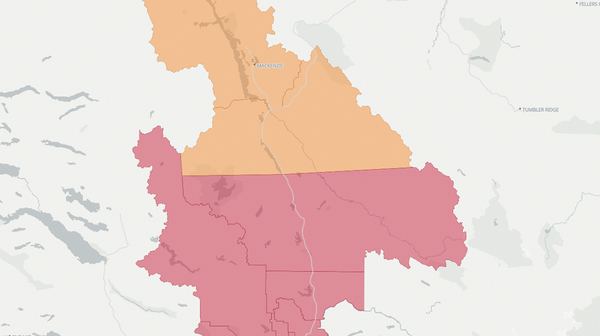
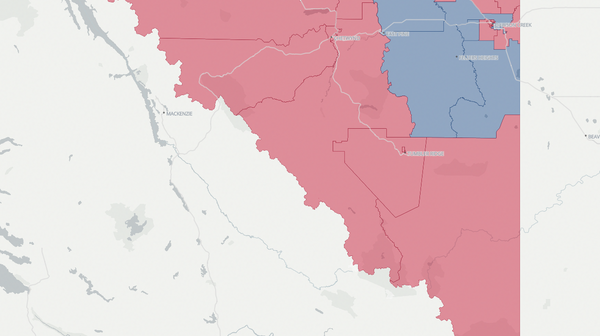
Stikine — 2020 British Columbia Provincial Election Results Map
Stikine — 2020 Election Results
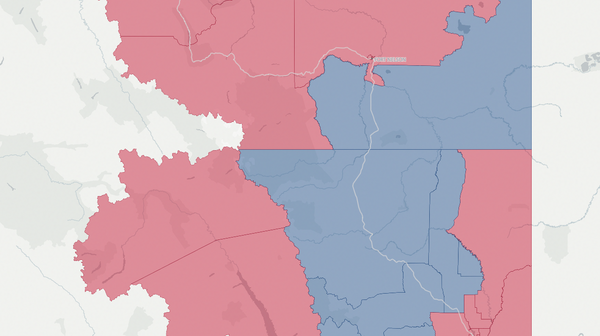
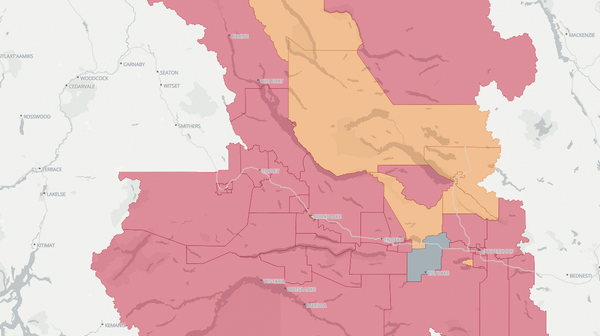
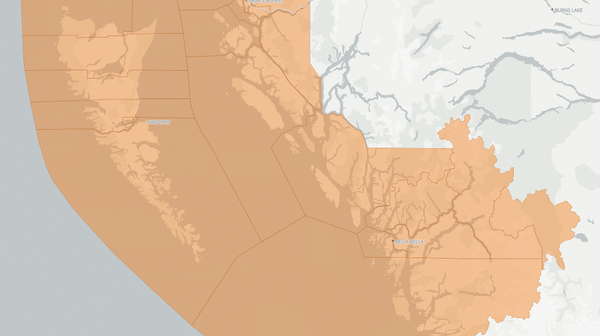
Poll-by-poll results for Stikine in the 2020 British Columbia election. The BC NDP candidate won this riding. Explore detailed voting data, candidate results, and turnout statistics at the poll level.
Riding information
Auto generated. Flag an issue.Stikine
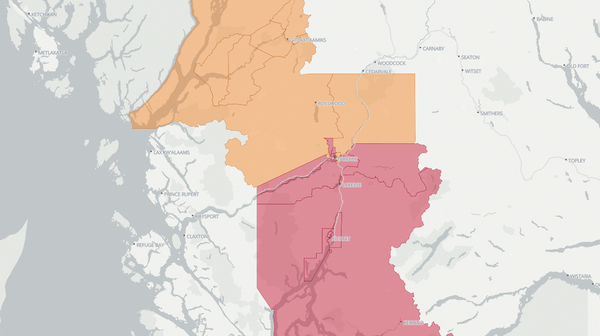
Stikine is one of British Columbia's largest and most remote ridings, stretching across the northwest interior from Smithers and Telkwa through Hazelton and the Stikine River watershed to the Yukon border. Roughly a third of the riding's electorate identifies as Indigenous, and the communities of the Gitxsan, Wet'suwet'en, and Tahltan Nations are central to its political and cultural fabric. Despite covering an area eight times the size of Vancouver Island, the riding's population numbered barely twenty thousand, with an economy tied to forestry, mining, and the public sector.
The NDP had held Stikine since 2009, winning three consecutive elections by growing margins. The 2020 contest was an open-seat race after the three-term incumbent announced he would not seek re-election, and the riding attracted national attention both for the high-profile NDP nomination contest — which raised questions about the party's equity policies — and for the Coastal GasLink pipeline dispute, which had thrust the riding's Wet'suwet'en territory into the centre of a nationwide debate over Indigenous governance and resource development.
Candidates
Nathan Cullen (BC NDP) — Born and raised in Toronto, Cullen worked on community economic development projects in Central and South America during the 1990s before settling in Smithers. He served as the federal NDP Member of Parliament for Skeena-Bulkley Valley from 2004 to 2019, winning five consecutive elections and finishing third in the 2012 federal NDP leadership race. After leaving federal politics, he transitioned to provincial politics, bringing high name recognition and an extensive network across the northwest.
Gordon Sebastian (BC Liberal Party) — A hereditary chief of the Gitxsan Nation holding the name Luutkudziiwus, Sebastian was a lawyer who had served as executive director of the Gitxsan Treaty Society since 2003. He also held positions as a director on the Regional District of Kitimat-Stikine and as a trustee on the Coast Mountains School District 82 board. He campaigned on economic recovery through resource development, green energy initiatives, and attracting the film industry to the region.
Rod Taylor (Christian Heritage Party of B.C.) — The national leader of the Christian Heritage Party of Canada, Taylor was based in Telkwa and had been a recurring candidate in the riding.
Darcy Repen (Rural BC Party) — The former mayor of Telkwa and co-founder of the Rural BC Party, Repen built his platform around ICBC rate reform, voter rights, and resource revenue sharing with rural communities.
Local Issues
The Coastal GasLink pipeline dispute dominated the Stikine campaign and had thrust the riding into national headlines. In January 2019, RCMP officers enforced a BC Supreme Court injunction and arrested fourteen people at the Unist'ot'en checkpoint, where Wet'suwet'en hereditary chiefs had been controlling access to their territory to block pipeline construction. The confrontation intensified in early 2020, when a renewed enforcement action prompted solidarity rail blockades and protests across Canada. By the time of the October election, approximately two hundred pipeline workers were employed in the Burns Lake area, and nearly forty per cent of the right-of-way south of Burns Lake and north of Francois Lake had been cleared. The dispute raised fundamental questions about the relationship between hereditary governance systems and the elected band council structures that had signed benefit agreements with the pipeline company, dividing communities along lines that did not always correspond to party affiliation.
Forestry remained the economic backbone of many Stikine communities, but the sector had deteriorated sharply during the NDP's term. The wave of mill closures that struck the BC interior in 2019 — driven by the collapse of the mountain pine beetle salvage harvest, rising stumpage costs, and weak lumber prices — hit towns like Houston and Burns Lake with particular force. The wood pellet industry, which had expanded as a green energy export product, provided some alternative employment but could not offset the scale of job losses in traditional lumber production. Donaldson's tenure as forests minister had placed him at the centre of these tensions, and his retirement left the riding without a direct voice in the portfolio that most directly shaped its economic future.
The NDP government's launch of BC Bus North in June 2018 addressed one of the riding's longest-standing transportation gaps. The twice-weekly intercity bus service connecting Prince George to Prince Rupert via Highway 16 — with stops in Vanderhoof, Burns Lake, Smithers, and Terrace — replaced the Greyhound Canada service that had been cancelled earlier that year, leaving remote communities without passenger transportation. Fares were set at thirty-five to forty-five dollars per route segment, and ridership grew from three hundred passengers in the first month to four hundred fifty in the second. Residents welcomed the service but called for expanded schedules, more frequent departures, and connections to communities off the main highway corridor, noting that many Indigenous communities along Highway 16 — long associated with the crisis of missing and murdered Indigenous women and girls — still lacked safe and reliable transportation options.
Health care access in the riding's remote communities remained a persistent challenge. The nearest specialist care required travel to Prince George or Vancouver, journeys that consumed entire days and imposed significant costs on families. The pandemic intensified concerns about the vulnerability of small northern health facilities, where a single COVID-19 outbreak could overwhelm limited capacity. The opioid crisis was devastating northwest BC communities, and the riding's remoteness made access to harm reduction services and treatment programs particularly difficult for residents in smaller centres without dedicated health infrastructure.