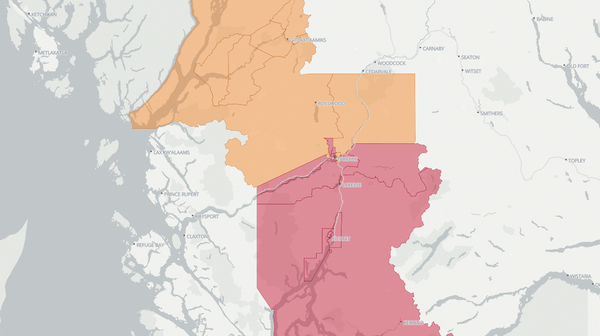
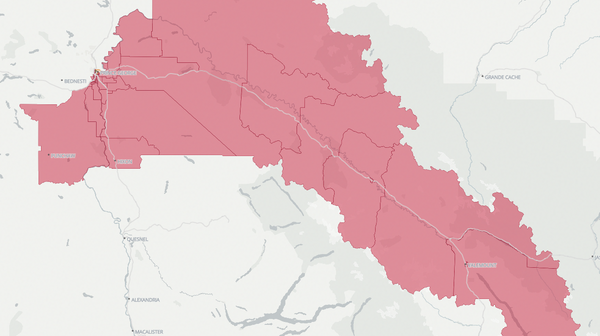
Peace River North — 2020 British Columbia Provincial Election Results Map
Peace River North — 2020 Election Results
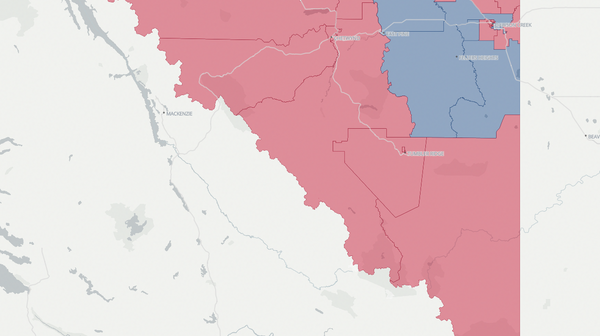
Poll-by-poll results for Peace River North in the 2020 British Columbia election. The BC Liberal Party candidate won this riding. Explore detailed voting data, candidate results, and turnout statistics at the poll level.
Riding information
Auto generated. Flag an issue.Peace River North
Peace River North centres on the city of Fort St. John and the surrounding communities of the upper Peace River region in British Columbia's northeast. The riding sits at the crossroads of the province's natural gas industry and the massive Site C hydroelectric dam project on the Peace River, making it one of the most resource-dependent constituencies in the province. Politically, the seat has been a right-of-centre stronghold for decades—neither the NDP nor any centre-left party has ever won it.
The 2020 snap election arrived amid particular frustration in the northeast, where residents felt disconnected from the priorities of a government based in Victoria and the Lower Mainland. The BC Liberals had held the seat since 2017, and the central question was whether the emergence of the BC Conservatives as a credible alternative would split the right-leaning vote enough to threaten Liberal dominance in a three-candidate race.
Candidates
Dan Davies (BC Liberal Party) — Davies had served twelve years on Fort St. John city council before entering provincial politics in 2017. He held a Master of Arts in Leadership from Gonzaga University and a Bachelor of Education from Simon Fraser University. Outside of politics, he was a teacher with School District 60 and was active in the Canadian Armed Forces Cadet Instructors Cadre and the Royal Canadian Legion.
Trevor Bolin (Conservative) — Bolin was the leader of the BC Conservative Party, having been elected to the position in April 2019. A Fort St. John city councillor since 2008 and a real estate agent, he had been a fixture in local politics for more than a decade and positioned his party as a right-wing alternative to the BC Liberals on issues of resource development and government spending.
Danielle Monroe (BC NDP) — Monroe was a ministerial assistant who carried the NDP banner in a riding where the party had historically struggled to gain traction.
Local Issues
Induced seismicity from hydraulic fracturing operations near Fort St. John emerged as a serious public safety concern during the NDP's first term. In November 2018, a Canadian Natural Resources fracking operation triggered a magnitude 4.5 earthquake that shook Fort St. John and forced the evacuation of the Site C dam construction site, followed by aftershocks of magnitude 3.5 and 4.0. Between 2017 and 2018, industry operations triggered over 6,500 earthquakes greater than magnitude 0.8 in the region surrounding the dam. In May 2018, the BC Oil and Gas Commission issued a special project order requiring operators near Site C to suspend hydraulic fracturing if they triggered a magnitude 3.0 event, but residents and independent geologists warned that the fracture-riddled geology south of the Peace River posed risks that existing mitigation measures might not adequately address. Internal BC Hydro documents later revealed that officials had warned senior provincial bureaucrats that fracking near the utility's dams could have consequences as severe as outright dam failure.
The Site C project itself was plagued by escalating cost overruns and geotechnical problems that dominated regional debate. After the NDP government decided in December 2017 to proceed with construction despite the BC Utilities Commission review, the project's budget ballooned well beyond its original $8.8 billion. By June 2019, government officials learned the project had nearly exhausted its $858 million contingency fund, and by September 2019, BC Hydro's internal weekly status reports classified the main civil works as critical. The total cost was projected to reach $12 billion by late 2020—yet British Columbians did not learn of many of these problems for more than a year after officials became aware of them. Locally, the dam continued to bring construction employment but deepened frustration over the flooding of agricultural land in the Peace River valley and impacts on Treaty 8 First Nations.
The replacement of the aging Taylor Bridge over the Peace River remained a pressing infrastructure concern. Built in 1960, the bridge carried roughly 7,500 vehicles per day on Highway 97 between Fort St. John and Dawson Creek, thirty percent of which was commercial truck traffic. In 2019, the Ministry of Transportation and Infrastructure began examining three options—including a new two-lane structure estimated to cost at least $250 million—and launched public and First Nations consultations in spring 2020. The Coastal GasLink pipeline, under construction to carry natural gas from the northeast to the LNG Canada export terminal in Kitimat, offered some economic optimism, but the broader frustration of northeastern residents—feeling ignored by Victoria while bearing the costs of provincial environmental and energy policy—shaped the tenor of the campaign.
The natural gas sector, the traditional engine of the local economy, experienced an uneven trajectory during the NDP's first term. While LNG Canada's final investment decision in October 2018 provided a significant confidence boost, the day-to-day reality for many workers and service companies remained one of depressed drilling activity and uncertain commodity prices. The Wet'suwet'en blockades of the Coastal GasLink pipeline route in early 2020—and the solidarity protests that followed across Canada—further unsettled the northeast, where many residents viewed the pipeline as essential to the region's economic future and resented what they saw as a disconnect between Victoria's stated support for the project and its handling of the dispute.