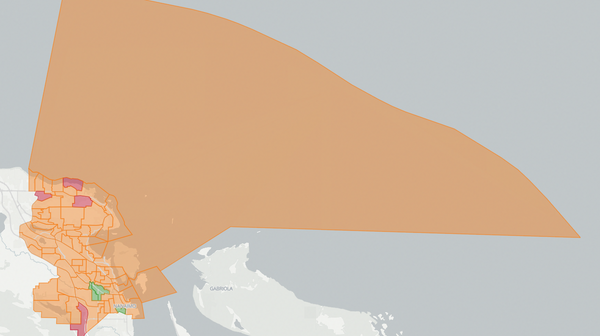
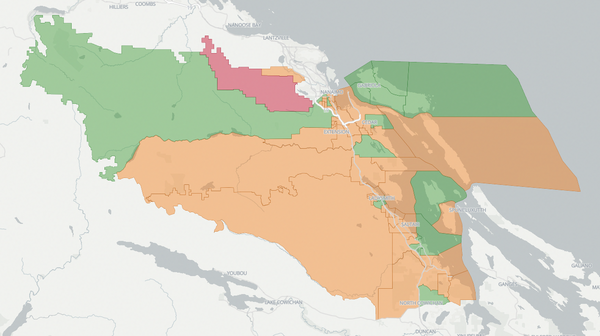
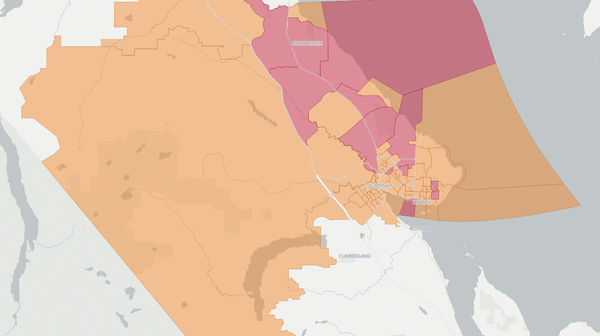
Parksville-Qualicum — 2020 British Columbia Provincial Election Results Map
Parksville-Qualicum — 2020 Election Results
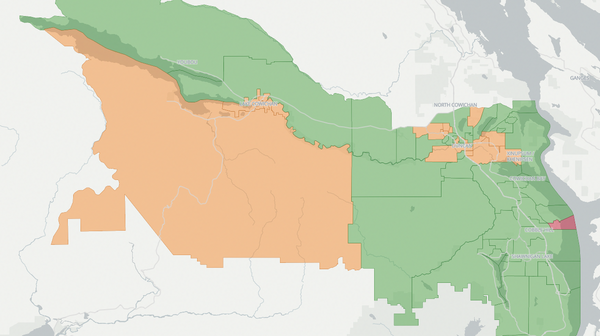
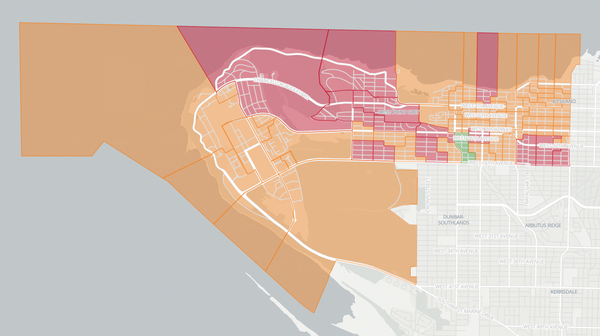
Poll-by-poll results for Parksville-Qualicum in the 2020 British Columbia election. The BC NDP candidate won this riding. Explore detailed voting data, candidate results, and turnout statistics at the poll level.
Riding information
Auto generated. Flag an issue.Parksville—Qualicum
Parksville—Qualicum stretches along the east coast of Vancouver Island, anchored by the retirement communities of Parksville and Qualicum Beach and extending into the surrounding Oceanside corridor. The riding has one of the oldest median ages in Canada, with a large retiree population drawn by the mild coastal climate and small-town character. Its economy depends on tourism, hospitality, and services for an aging population, and the area's physician shortage had reached crisis proportions by 2020. Politically, the seat had been held by the BC Liberals or their Social Credit predecessors for nearly a quarter-century, making it the last right-of-centre holdout on Vancouver Island.
Heading into the snap 2020 election, the riding was a key test of whether the NDP's steady advance across Vancouver Island could breach this final Liberal stronghold. The incumbent, Michelle Stilwell, was seeking a third term, while demographic shifts and the broader provincial trend toward the NDP made the outcome less certain than in previous cycles. The pandemic-era election call drew particular criticism in a riding with so many elderly and vulnerable residents.
Candidates
Adam Walker (BC NDP) — Walker was born in Comox and raised in Qualicum Beach, where he operated a technology business. Elected to Qualicum Beach town council in 2018, he was a first-time provincial candidate who ran a campaign focused on health care access and affordability for the riding's aging population.
Michelle Stilwell (BC Liberal Party) — Stilwell was an internationally celebrated Paralympic athlete who had competed for Canada at four Summer Paralympic Games between 2000 and 2016, winning gold medals in both wheelchair basketball and wheelchair racing—the only female Paralympic athlete to win gold in two separate summer sports. First elected in 2013, she served as Minister of Social Development and Social Innovation from 2015 to 2017 and was seeking a third term as MLA.
Rob Lyon (BC Green Party) — Lyon was a retired naval officer who had served twenty-five years in the navy, spending twenty of those years programming missile control systems as a weapons officer, before founding Pacific Passive House, a construction company specializing in energy-efficient homes. He described himself as a lifelong conservative whose views on environmental stewardship had drawn him to the Green Party. He had also volunteered in Cubs, Scouts, and Ventures for twenty-five years.
Don Purdey ran for the BC Conservative Party and John St John as an Independent, both receiving limited support.
Local Issues
The family physician shortage reached crisis proportions during the NDP's first term. By 2019, an estimated six thousand to eight thousand Oceanside residents lacked a primary care practitioner, and community health leaders reported that the area should be served by approximately thirty family physicians and nurse practitioners but had fewer than twenty-five. The problem was structural as much as demographic—a 2017 recruitment study found that newer medical graduates were deterred by the small-clinic model prevalent in Parksville and Qualicum Beach, along with limited employment opportunities for their partners. The NDP government's pledge to expand team-based primary care through Urgent and Primary Care Centres had not yet produced a facility in the Oceanside corridor, and residents seeking specialist appointments continued to travel to Nanaimo or Victoria. The COVID-19 pandemic compounded the strain, raising fears about the vulnerability of long-term care facilities where outbreaks across British Columbia had caused significant loss of life among elderly residents.
The construction and opening of the Orca Place supportive housing complex at 222 Corfield Street in Parksville became one of the most divisive local issues of the NDP's first term. In March 2018, Housing Minister Selina Robinson announced $6.9 million in provincial funding for a 52-unit modular affordable housing and shelter project on the site. The proposal triggered fierce community opposition—a petition submitted to council collected roughly 1,380 signatures against the project, and a group of residents and a retirement community operator launched a court challenge against the City of Parksville over the rezoning approval. The lawsuit was settled out of court in June 2019, and the $8.4 million facility opened in July 2019 under the operation of the Island Crisis Care Society. The episode exposed deep tensions in Oceanside communities between the urgent need for housing options for vulnerable populations and neighbourhood resistance to social housing infrastructure.
The riding's tourism and hospitality sector—the economic backbone of the Oceanside corridor—entered the pandemic in a weakened position and faced an uncertain recovery. The COVID-19 border closures and public health restrictions devastated seasonal businesses that depended on visitor traffic from the Lower Mainland and Alberta. Small operators in accommodation and food services looked to the provincial government for targeted recovery support beyond the broader emergency benefit programs. Meanwhile, the completion of the Englishman River Water Service treatment plant in late 2019 addressed a long-standing infrastructure need, providing treated potable water to Parksville and the Nanoose Bay Peninsula Water Service Area, but the project's costs underscored the ongoing capital pressures facing smaller Vancouver Island municipalities.
Housing affordability was an escalating pressure point as the riding attracted both retirees and younger families seeking alternatives to the Lower Mainland's pricing. The NDP government's speculation and vacancy tax, introduced in late 2018, was aimed primarily at Metro Vancouver, but its reach into Vancouver Island communities sparked debate about whether provincial housing interventions were adequately addressing smaller markets where vacancy rates remained low and rental stock was scarce. The Regional District of Nanaimo reported growing demand for supportive and complex-care housing options across the Oceanside area, reflecting the intersection of an aging population, rising homelessness, and limited mental health and addiction services outside of Nanaimo.