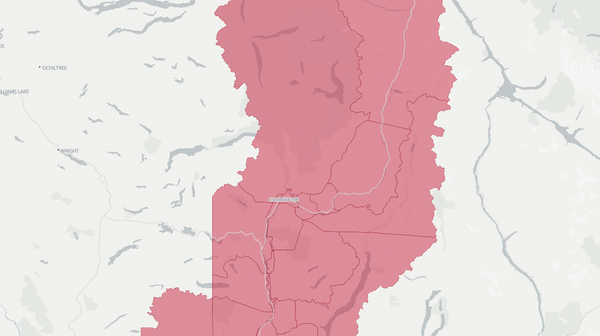
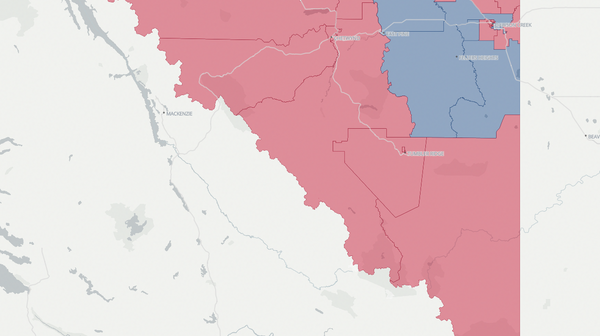
Cariboo North — 2020 British Columbia Provincial Election Results Map
Cariboo North — 2020 Election Results
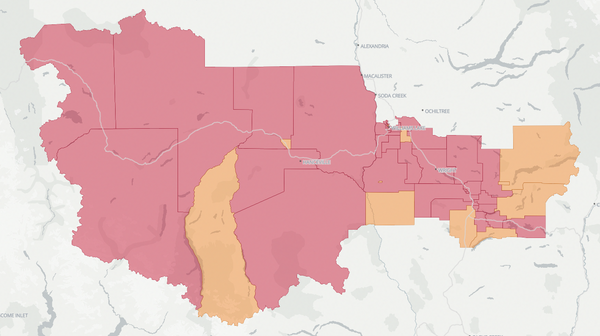
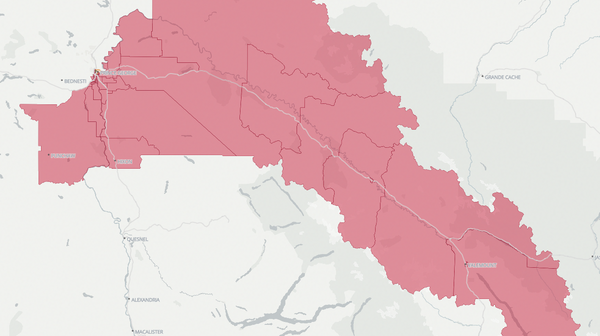
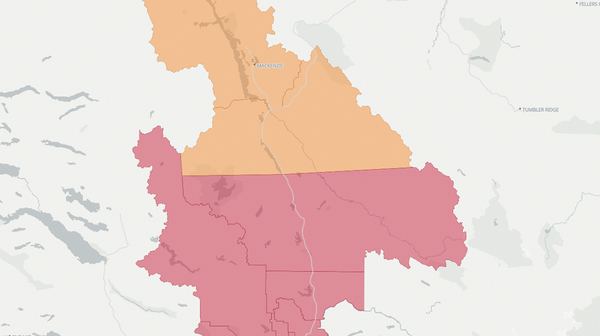
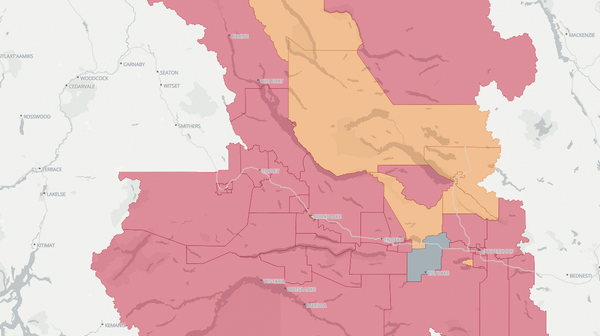
Poll-by-poll results for Cariboo North in the 2020 British Columbia election. The BC Liberal Party candidate won this riding. Explore detailed voting data, candidate results, and turnout statistics at the poll level.
Riding information
Auto generated. Flag an issue.Cariboo North
Cariboo North is centred on the mill town of Quesnel, a community of about 12,000 people situated at the confluence of the Quesnel and Fraser Rivers in British Columbia's central Interior. The riding extends into the surrounding ranching and forestry country, where the mountain pine beetle epidemic had devastated the timber supply and triggered a wave of mill closures and curtailments that shook the regional economy. Tolko Industries permanently closed its Quest Wood sawmill in Quesnel in August 2019, displacing roughly 150 workers, and West Fraser Timber curtailed operations at its Cariboo Pulp and Paper facility the same year. The opioid crisis had deepened in the community, with the Thompson Cariboo region recording some of the highest per-capita overdose rates in British Columbia.
Cariboo North had been one of the most competitive Interior ridings for decades, with every election except 2001 decided by a thin margin. The two-term BC Liberal incumbent sought a third term in 2020, and a four-candidate field tested whether forestry-sector job losses and the opioid crisis would shift a riding that had historically swung between the NDP and the Liberals by narrow margins.
Candidates
Coralee Oakes (BC Liberal Party) — Oakes was the incumbent MLA seeking a third term. Before entering provincial politics, she served two terms as a Quesnel city councillor and was executive director of the Quesnel and District Chamber of Commerce. She had also been a director of the BC Chamber of Commerce and the Cariboo Chilcotin Tourism Association, and was named BC Chamber of Commerce Executive of the Year in 2009. During her time in the legislature, she had served in cabinet as Minister of Community, Sport and Cultural Development and as Minister of Small Business and Red Tape Reduction.
Scott Elliott (BC NDP) — Elliott was a Quesnel city councillor who had served two terms at city hall. He had also run as the NDP candidate in Cariboo North in the 2017 election and was a government liquor store employee.
Kyle Townsend (Conservative) — Townsend grew up in Topley, BC, and had spent 15 years working in logging and mining. He held a Mine Supervision Certification and had served as a first responder and volunteer firefighter for ten years. He managed a publicly traded junior mining company and was a member of the Cariboo Mining Association.
Douglas Gook (BC Green Party) also contested the riding.
Local Issues
The forest industry's contraction had hit Cariboo North harder than almost any other riding in British Columbia. In August 2019, Tolko Industries permanently closed its Quest Wood sawmill in Quesnel, putting approximately 150 workers out of jobs and sending ripples through contract logging, trucking, and supply-service businesses that depended on the mill. The city estimated a financial impact of roughly $400,000 in lost revenue from the decommissioning. Tolko cited an economic fibre shortage as the cause — the mountain pine beetle epidemic had destroyed an estimated fifty-eight per cent of the Interior's merchantable pine, and the salvage harvest that had sustained operations was running out. Adding to the blow, West Fraser Timber curtailed operations at its Cariboo Pulp and Paper facility in Quesnel beginning in April 2019. Across the province, an estimated 3,900 forest-sector workers were affected by closures and curtailments that summer, driven by declining timber supply, rising stumpage costs, and soft lumber markets. Candidates debated how the provincial government could support displaced workers, attract new investment, and diversify the local economy beyond its historical dependence on forestry.
The opioid crisis had deepened in Quesnel and across BC's Interior since the 2017 election. Fentanyl or its analogues were detected in approximately eighty-seven per cent of illicit drug overdose deaths province-wide in 2018, and the Thompson Cariboo region recorded some of the highest per-capita overdose rates in British Columbia. In Quesnel, community-led overdose prevention services had emerged through provincial crisis innovation grants, with peers taking active roles in delivering front-line harm reduction. But access to residential addiction treatment remained limited compared to larger urban centres, and residents called for expanded provincial resources. The social consequences of the crisis — rising homelessness, property crime, and public drug use — were frequent topics at candidates' forums, and the tension between harm reduction approaches and calls for more enforcement-oriented responses divided community opinion.
Rural healthcare access remained a perennial concern. The G.R. Baker Memorial Hospital in Quesnel was the main healthcare facility for the region, and physician recruitment in the community lagged behind demand. The NDP government had increased medical school seats and launched primary care networks across the province, but rural communities like Quesnel continued to struggle to compete with urban centres for medical staff. The pandemic added pressure to an already stretched system, and candidates discussed how to attract and retain healthcare professionals in communities that lacked the amenities and lifestyle attractions of larger centres.
The NDP's broader economic record in the Interior was on trial. The employer health tax, which replaced MSP premiums for individuals with a payroll levy on businesses exceeding $500,000, had eliminated a household cost but introduced a new expense for mid-sized employers in a region where margins were already thin. Candidates debated whether the NDP's forest-sector transition supports — including retraining programs and community economic development funds — were adequate for a region confronting structural economic change, and whether the government's climate policies, including land-use decisions related to caribou habitat protection that restricted logging in some areas, were compounding the timber supply crisis.