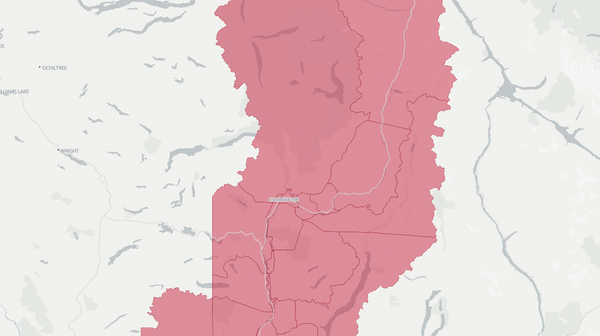
Cariboo-Chilcotin — 2020 British Columbia Provincial Election Results Map
Cariboo-Chilcotin — 2020 Election Results
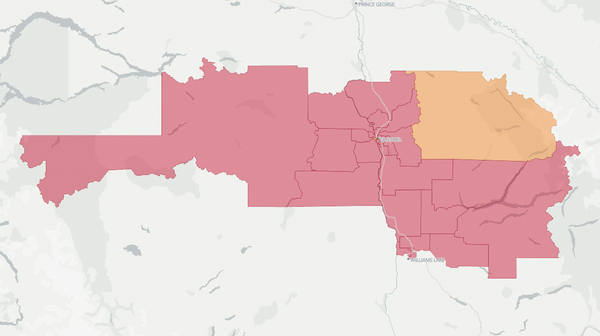
Poll-by-poll results for Cariboo-Chilcotin in the 2020 British Columbia election. The BC Liberal Party candidate won this riding. Explore detailed voting data, candidate results, and turnout statistics at the poll level.
Riding information
Auto generated. Flag an issue.Cariboo—Chilcotin
Cariboo—Chilcotin is one of British Columbia's largest and most sparsely populated ridings, stretching from the ranching country around Williams Lake and 100 Mile House westward through the Chilcotin Plateau to the approaches of the Coast Mountains. The riding's economy depends on forestry, ranching, mining, and tourism, and the three years before the 2020 election had been among the most turbulent in the region's history: the record-breaking 2017 and 2018 wildfire seasons burned hundreds of thousands of hectares of Chilcotin rangeland and forest, forced the evacuation of Williams Lake, and destroyed homes, fences, and livestock infrastructure across the ranching country. The mountain pine beetle epidemic had devastated the timber supply, triggering mill closures and curtailments that rattled communities built around forestry.
The BC Liberals had held the seat comfortably for decades, and the retirement of three-term incumbent Donna Barnett made it an open riding in 2020. A five-candidate field contested a seat that the NDP had rarely been competitive in, testing whether resource-sector anxiety and wildfire recovery frustrations could shift the political calculus in one of the Interior's most conservative-leaning ridings.
Candidates
Lorne Doerkson (BC Liberal Party) — Doerkson was a long-time Cariboo resident who had spent 20 years in the newspaper industry as a publisher with Black Press. After leaving publishing, he transitioned to financial consulting with Investors Group. He had served at the executive level of the BC Liberal Party and cited land use, long-term care for seniors, and childcare availability as the top issues for the riding.
Scott Andrews (BC NDP) — Andrews, 36, had co-founded an international non-profit in southwest Uganda in 2008 focused on education, public health, and economic opportunity, and in 2012 co-founded a Vancouver-based organization offering Canadian university students hands-on experience with international development work. He had also worked for more than seven years managing programs that support adults with disabilities and in technical sales for a BC engineering company. His family connections to the Cariboo dated to the 1970s.
David Laing (BC Green Party) — Laing was an organic farmer and co-principal of the non-profit People Power Society for Healthy Communities, which had been providing healthy vegetables to low-income residents for three years. Raised in Hamilton, Ontario, he studied ecosystem management technology at Sir Sandford Fleming College and had been a regular visitor to the South Cariboo since 2006 before moving permanently to the area.
Katya Potekhina (Independent) and James Buckley (Libertarian) also contested the riding.
Local Issues
The back-to-back record wildfire seasons of 2017 and 2018 had left a lasting mark on the riding. The 2017 fires burned roughly 545,000 hectares on the Chilcotin Plateau alone, forcing the evacuation of the entire city of Williams Lake and destroying homes, fences, and livestock infrastructure across the ranching country. The 2018 season was even larger province-wide, with more than 1.35 million hectares burned across British Columbia, and the Cariboo region was again heavily affected. By 2020, communities were deep into recovery: the City of Williams Lake and the Cariboo Regional District had completed an updated Community Wildfire Protection Plan in cooperation with Williams Lake First Nation and Xat'sull First Nation, and the province had funded the treatment of roughly 1,200 hectares of interface land in and around Williams Lake to reduce fuel loads. Williams Lake First Nation received nearly $1.4 million in provincial funding for Douglas fir forest resiliency treatments, creating twenty jobs. But residents questioned whether the scale of investment matched the scope of the threat as climate projections pointed to longer and more intense fire seasons.
The ranching industry — a pillar of the Cariboo—Chilcotin economy — was still recovering from the wildfires' agricultural impact. The fires had destroyed hay stockpiles in stack yards, burned seed, and forced ranchers to bring cattle home to pasture prematurely because the range was inaccessible during the fire emergencies. The resulting hay shortage persisted into subsequent seasons, and while the federal-provincial AgriRecovery program provided payments to wildfire-affected producers, some ranchers reported that the disbursements arrived slowly and fell short of covering their full losses. Lower pregnancy rates in herds that had been disrupted during the fire evacuations compounded the financial strain for operations that were already operating on thin margins.
Forestry and the declining timber supply were the riding's foremost economic concerns. The mountain pine beetle epidemic had killed an estimated fifty-eight per cent of the merchantable pine across the BC Interior, and the salvage harvest that had temporarily sustained mills was diminishing. In the summer of 2019, West Fraser Timber announced it was eliminating a shift at its 100 Mile House sawmill and permanently closing its Chasm sawmill near Cache Creek, displacing 210 workers. These closures were part of a broader wave that affected an estimated 3,900 forest-sector workers across the province that summer, driven by declining fibre supply, rising log costs from provincial stumpage increases, and weak North American lumber prices. Candidates debated diversification strategies, including value-added wood manufacturing, mining exploration, and expanded tourism.
Rural healthcare access was a persistent challenge in a riding where small communities like 100 Mile House, Alexis Creek, and Anahim Lake were separated by vast distances from hospitals and specialist care. Physician and nurse recruitment in rural areas continued to lag behind urban centres, and the pandemic underscored the fragility of the region's health infrastructure. Doerkson's emphasis on long-term care for seniors reflected an aging population's anxiety about close-to-home health services, and the NDP's record on rural health spending was scrutinized by voters who felt their communities had been left behind in favour of urban priorities.