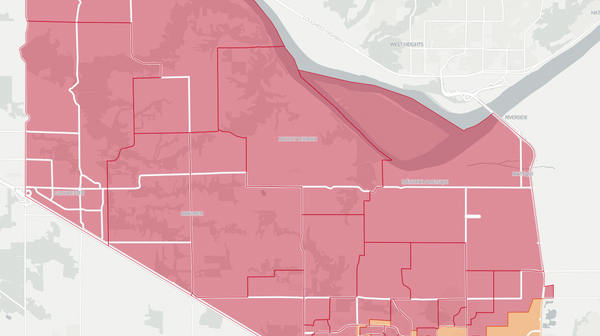
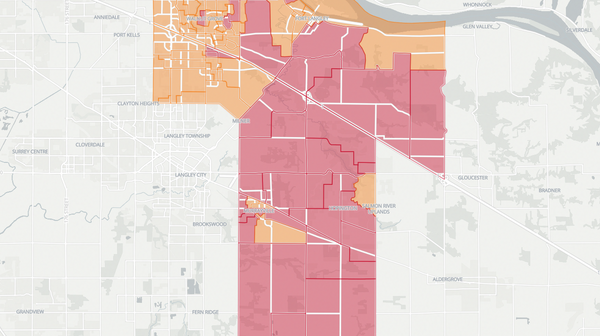
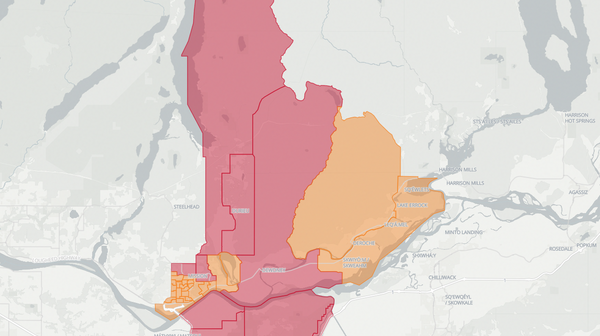
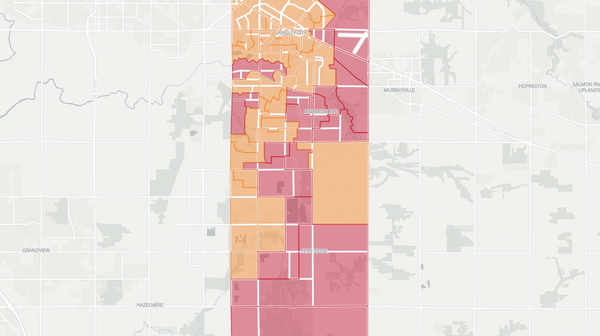
Abbotsford South — 2020 British Columbia Provincial Election Results Map
Abbotsford South — 2020 Election Results
Poll-by-poll results for Abbotsford South in the 2020 British Columbia election. The BC Liberal Party candidate won this riding. Explore detailed voting data, candidate results, and turnout statistics at the poll level.
Riding information
Auto generated. Flag an issue.Abbotsford South
Abbotsford South encompasses some of British Columbia's most productive agricultural land, centred on the fertile Sumas Prairie where dairy operations, berry farms, and poultry producers form the backbone of a region that generates more than half the province's agri-business income. The riding extends south toward the Sumas—Huntingdon border crossing into Washington State, and its economy bridges agriculture, food processing, and the cross-border commercial traffic that connects the Fraser Valley to Whatcom County. Highway 1 congestion and the long-awaited freeway widening through the Valley had been perennial concerns for the riding's many commuters.
The seat was open for the first time since its creation after the outgoing MLA, who had been expelled from the BC Liberal caucus in 2017 for accepting the NDP government's nomination as Speaker, chose not to seek re-election. The BC Liberals sought to reclaim the seat, and a four-candidate contest tested whether the party could reassemble its centre-right coalition in a riding where the unusual circumstances of the previous term had scrambled traditional loyalties.
Candidates
Bruce Banman (BC Liberal Party) — Banman was a chiropractor and small business owner who had served as mayor of Abbotsford from 2011 to 2014, following earlier service as a city councillor. He attended Fraser Valley College before transferring to Western States Chiropractic College in Portland, Oregon, where he graduated in 1997. He won a competitive BC Liberal nomination contest, defeating two challengers in a vote that drew more than 1,400 party members.
Inder Johal (BC NDP) — Johal held a Bachelor's degree in Community Criminal Justice and an Associate's degree in Criminology from Kwantlen Polytechnic University. She had previously run as the BC NDP candidate in Langley East in the 2017 provincial election. Johal campaigned on issues including affordability, workers' rights, and workplace safety.
Aird Flavelle (BC Green Party) — Flavelle was the founder of MSA Computers Ltd. in Abbotsford and a repeat candidate who had run for the Green Party provincially in 2013 in the neighbouring riding of Abbotsford—Mission. He had sought election to Abbotsford city council on multiple occasions and was active in the Rotary Club, the Abbotsford Hospice Society, and the city's environmental advisory committee. He served as treasurer of the BC Green Party.
Laura-Lynn Thompson (Christian Heritage Party of B.C.) — Thompson was the leader of the CHP-BC, having been elected to that position in September 2020. She had previously run as a candidate for the People's Party of Canada in the 2019 federal by-election in Burnaby South.
Local Issues
The NDP government's overhaul of agricultural land policy through Bill 52 in late 2018 had a direct impact on Abbotsford South, one of British Columbia's most productive farming regions. The legislation reunified the Agricultural Land Reserve into a single zone, reversing a 2014 BC Liberal decision that had created two zones with different development rules. It also imposed new restrictions on the size of residences permitted on ALR land — capping primary homes at 500 square metres — and introduced penalties of up to $1 million for illegal dumping of construction fill on farmland. In a riding where the fertile Sumas Prairie supported dairy operations, berry farms, and poultry producers, the reforms drew a mixed reaction: some farmers welcomed the strengthened protections against urban encroachment, while others viewed the house-size limits as an unwelcome intrusion into property rights.
Highway 1 congestion and the long-awaited highway widening through the Fraser Valley remained pocketbook issues for commuters. The NDP government had completed a new interchange at 216th Street in Langley in September 2020 and widened four kilometres of roadway west of the interchange, but residents in Abbotsford South pressed for expansion eastward. Fraser Valley mayors had taken a unified request to the Union of BC Municipalities convention, calling on the province to extend the widening at least as far as Whatcom Road in Abbotsford. For a riding where many households depended on the daily commute to Metro Vancouver, transportation infrastructure was raised at every all-candidates forum.
The pandemic added a layer of uncertainty to the election. Local businesses dependent on cross-border traffic through the Sumas—Huntingdon border crossing and agricultural supply chains were adjusting to COVID-19 restrictions that had curtailed the flow of goods and shoppers between Abbotsford and Whatcom County, Washington. The closure of the international border to non-essential travel since March 2020 had disrupted a cross-border economic relationship that many businesses in the riding's southern reaches depended on. Candidates were asked how the provincial government could support recovery in a region whose economy bridged agriculture, retail, and commuter-driven growth.
The NDP's broader affordability agenda was also on the ballot. The elimination of MSP premiums — completed in January 2020 after a two-year phase-out — had removed a cost that had burdened families by up to $1,800 annually. The employer health tax that replaced it applied only to businesses with payrolls exceeding $500,000, meaning the large majority of small agricultural operations and family-run enterprises in the riding were exempt. At the same time, the NDP's ICBC reforms promised to lower auto insurance costs by roughly twenty per cent through the new Enhanced Care no-fault model, a change that was controversial in a riding where many residents viewed the elimination of the right to sue for injury damages as a troubling trade-off.