David Onley is Ontario’s new Lieutenant-Governor

An inspirational choice:

Ontario’s incoming lieutenant-governor said Tuesday he will play an “activist” role over the next five years aimed at improving the lives of people who, like him, live with physical disabilities.

Stricken with polio when he was three, Onley grew up to become one of Canada’s first on-air personalities with a physical disability when he joined CityTV in Toronto in 1984 as a science and weather reporter.

In his long career with the station, he has also been an education reporter, a science and technology reporter, news anchor and producer.

Outside of his journalistic endeavors, Onley has been high-profile advocate for people with disabilities

Some may look at this appointment and shrug as another media personality is named to another ceremonial role. However, the more I’ve thought about these sorts of appointments, the more that the nominations of people such as Clarkson, Jean, and now Onley make sense.

These roles haven’t any real power and they are largely ceremonial, meaning the most important parts of the job description are to visible, a good speaker and yes, telegenic. Onley is also a highly accomplished Canadian in his own right and Ontario will draw upon his professional talents in his new job.

The other types who may fit well in these sorts of roles are sports personalities, actors, and maybe former politicians. Since most sports stars can barely utter that there’s a “home… run… deal… at… Bob’s… Chev… olds” with any authority, that leaves actors, former politicians, and media personalities. Former politicians bring partisan baggage to a role that is supposed to represent Canada’s apolitical head of state, our queen. Actors can deliver a good speech, however, media personalities can do this and bring a professional credibility to the job that most can appreciate.

As said, these roles are purely ceremonial and the technical responsibility of these people are to represent the Queen in Canada. We are long past being ruled by a monarch, thus these positions simply afford an opportunity to put a good face – a face that can deliver a speech, with credibility and on television – forward to represent Canada.

Prime Minister Harper made the appointment and Dalton’s man Kinsella seems to appreciate the decision. Therefore, this shouldn’t make for any rough political waters.

UPDATE: Some readers have, of course, pointed out the constitutional importance of GGs and LGs! I would respond by saying that advice and recommendations on constitutional matters are never in short supply to these people when such advice is needed for such a situation. Presumably and hopefully, all GGs and LGs make those decisions under much advisement. Further, this also speaks to the appropriateness of journalists to take up the role as they are generally more versed in political matters than most people.

A constitutional scholar on the other hand may not be able to fulfill the de facto responsibilities of these figures because while they may be versed in the legal function of their role, they may not be ideal for lacking the qualities I outline above.
Press shuts down blogger

A couple of weeks ago, I headed down the street to Parliament Hill to cover the budget for my blog and for Blogging Tories. You can see the product of that effort here, here, here, and here. I have a Hill pass that indicates that I have been pre-screened by security and allows me access to a variety of places in the Parliamentary district. While hovering on the periphery of a budget-day scrum with Jack Layton, I was spotted by Elizabeth Thompson of the Montreal Gazette. She scolded me and expressed to this lowly blogger that he wasn’t allowed to scrum with Layton. Largely ignoring her, I continued to mind my own business and started to needlessly check my camera settings. Thompson alerted Parliamentary Press Gallery President Richard Brennan to my presence and minutes later, security asked me to leave the foyer area.

I left the hallway outside of the foyer and walked over to the railway room to interview some ‘stakeholders’ of the budget. This went off without incident and during that time, I cheerfully chatted with some reporters that were in the same room.

Having completed my interviews with the stakeholders, I left and headed on over to the Rotunda where I had a friendly chat with Jack Layton. Elizabeth May and her assistant were also hanging around chatting when I saw Gilles Duceppe of the Bloc walk by. Having heard that his party was the lone opposition party supporting the budget, I asked him for an interview. He agreed. After the interview something ugly happened.

An official from the Press Gallery walked over and informed me that he had received “complaints” about me. “Thompson?” I inquired. “Complaints”, he seemed to acknowledge. I pointed out that we were currently in the Rotunda of Parliament and that my pass allowed me to be there. “But you have a camera” he informed me. He called over a security guard to escort me from Parliament.

Unbelievable!

Yes, the Parliamentary Press Gallery, with no powers granted to it by constitution or statute, used security to remove somebody who had the right to be present on the Hill granted to him by the Speaker of the House.

A similar incident happened recently when two female staffers from the Conservative Resource Group were similarly removed from the Hill by security when the Liberals complained to the Gallery.

After the incident, the Prime Ministers office called the sergeant-at-arms (who works on behalf of the Speaker on Hill security) and was told that the Gallery and Liberals were wrong to ask for the ouster of the CRG staff from Dion scrums (and scrums in general).

Of course, this brings up a few questions. If security on the Hill is the responsibility of the Speaker, and if I have been granted access to most non-privileged areas of the Hill by the Speaker, what authority does an official of the PPG have in calling in the guard to have me removed from perhaps the most public area of the Hill? Elizabeth May was also present in the Rotunda, yet she is not an elected member, nor is she associated with an elected party in Parliament. She has also been granted security clearance to the Hill by the Speaker. So, is it the camera? What is so offensive about my camera? Since I am cleared to be present on the Hill, is it because I haven’t been cleared to use one of the Press Guild’s many tools? Would May be ejected by the Gallery if she was in possession of a camera? What if I am invited by a politician to use my camera on the Hill? Is this forbidden? Was this interview with Jack Layton in the NDP leader’s office violating some unwritten rule of the media powers that be? Does the CRG/Dion Hill incident (and the aftermath) set a precedent for my presence (with camera) on the Hill? Again, why does the power reside in a largely unelected, unaccountable body of Parliament that is not defined by statute? I’ve made a sport out of taking on institutions with artificial and inflated senses of entitlement, maybe the Press Gallery is next.

Or, you may ask, why don’t I just suck it up and join this all-powerful guild as some of the friendlier gallery-folk have suggested? I’ve always been unsure about this move as I am a declared partisan, yet I am not employed by the Conservative Party. Still, should partisan media exist? Should it be allowed? Since this blog is de facto media and it already operates in a partisan manner, should the CRTC or Elizabeth Thompson shut it down? Frankly, I can understand reasons against ‘official’ recognition of my media status in the Parliamentary precinct. After all, couldn’t I flood Conservatives with long and friendly press conference questions to waste time? (yes). Would I? (no). Would I sell out my media brethren and sign up for ‘the list’? (yes).

But then again, the game is changing and bloggers are becoming a new category in a variety of forums they intersect. Will the next evolutionary phase be a smooth one or will it require direct action?

As the concept of “press” is being redefined to include bloggers, perhaps we shouldn’t be so surprised that some of the “officials” that are trampling on our rights include members of the “dead tree” division of the guild we wish to complement.

UPDATE: I’ve been told that I am ineligible for membership in the Parliamentary Press Gallery because I am not employed as a journalist by any organization. Do you think that the evolution of media and reporting should change some of the traditions and practices on parliament hill?

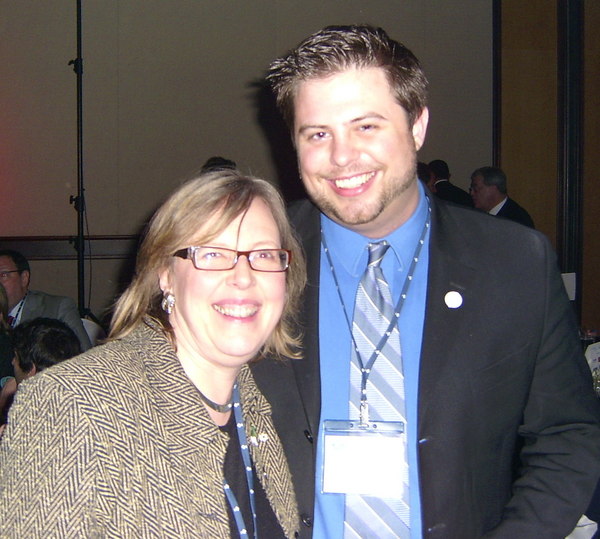
That time when I met Elizabeth May

This week I also met Elizabeth May. The leader of the Green Party was in high spirits that day despite Garth Turner’s betrayal of everyone (conservatives, constituents, May and the Greens) just a few hours earlier. Turner campaigned for May in London North Centre, teased us all by telling us that he was considering “going Green”. He even turned his back on his constituents, which during a townhall in Halton, about 1 in 4 told Garth to go Green while not one told him to go Liberal.

Anyway, this post is about Elizabeth May. Unfortunately, we didn’t have too much time to chat.

Stephen Taylor and Elizabeth May

It would be interesting to see May in a debate with party leaders during an election. However, should a party have at least one elected (or sitting) MP in order to have such a platform? What is your opinion?

If I remember correctly, Reform was allowed to debate only after Deb Grey won a by-election. If Turner had gone Green, he would have been a sitting, yet unelected Green MP. What should the threshold be? Also, consider that the laws governing the identity of a “party” have changed since 1989 when Grey became the first Reform MP.

You’ll find Liberals advocating that May should be allowed to debate because the Green vote is thought to cut into NDP support. NDPers thus are less likely to support the idea. Since Conservatives are depending on the NDP to split the left, they’re more likely to support the NDP position.

What may be certain though, is that we ought to have clear guidelines for Green Party inclusion in a televised debate.

BUT… this brings us to another topic to consider. The national networks are largely in charge of debate format and the participants invited and their decisions are largely subjective and outside of parliamentary review and jurisdiction. If a debate were held in a different forum (and medium — say… online) who would accept an invitation to debate and on what terms? If Harper, Dion, Duceppe and May accepted an invitation, would Layton turn down the opportunity to debate?

Is there such thing as an “official” debate?