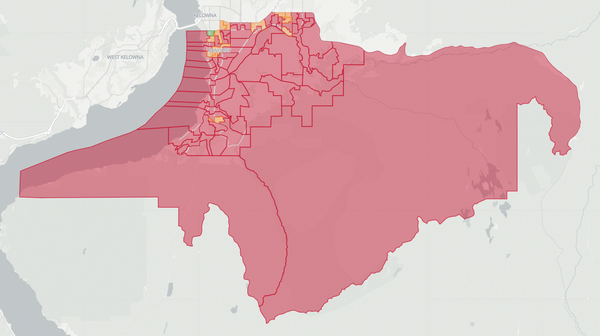
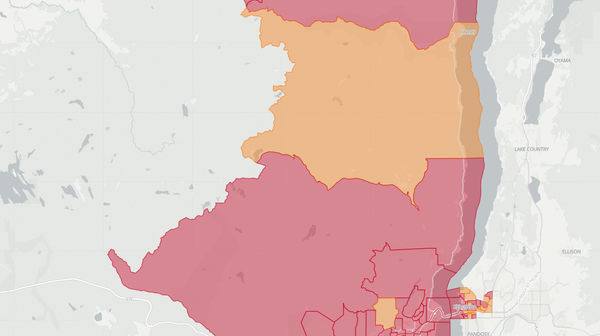
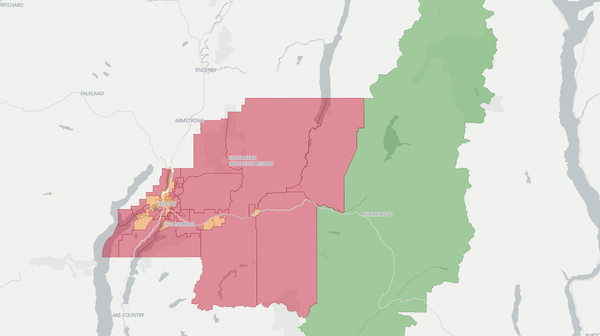
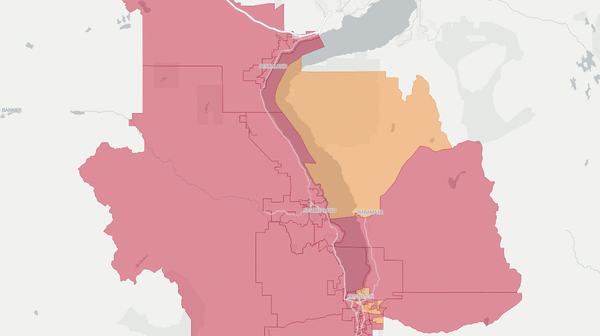
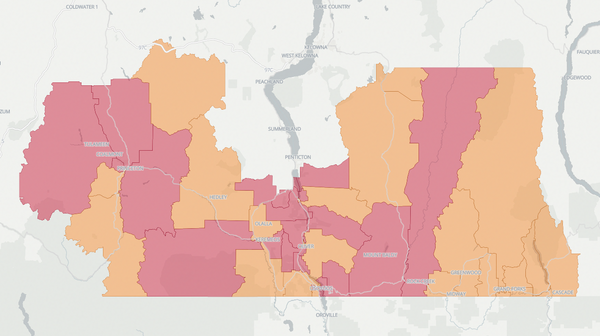
Kelowna-Lake Country — 2020 British Columbia Provincial Election Results Map
Kelowna-Lake Country — 2020 Election Results
Poll-by-poll results for Kelowna-Lake Country in the 2020 British Columbia election. The BC Liberal Party candidate won this riding. Explore detailed voting data, candidate results, and turnout statistics at the poll level.
Riding information
Auto generated. Flag an issue.Kelowna—Lake Country
Kelowna—Lake Country stretches from the eastern neighbourhoods of Kelowna through the orchards and vineyards of Lake Country to the shores of Okanagan Lake, encompassing one of the fastest-growing corridors in the BC Interior. Lake Country, with its proximity to UBC Okanagan, the Kelowna airport, and the Highway 97 corridor, was among the fastest-growing municipalities in the province. The riding's economy blends agriculture—orchards, vineyards, and irrigated farming—with the university sector, tourism, and the service industries that support a rapidly expanding population.
The seat had been one of the safest BC Liberal holdings in the province, held continuously by the party since its creation. In the 2020 snap election, Liberal incumbent Norm Letnick sought a fourth consecutive term in a riding where the NDP had never been seriously competitive, though the pandemic and the party's provincewide momentum introduced a degree of uncertainty.
Candidates
Norm Letnick (BC Liberal Party) — Letnick was the incumbent MLA, first elected in 2009. Born in Montreal, he held a Bachelor of Commerce from the University of Calgary and an MBA from Heriot-Watt University in Edinburgh. Before entering politics, he was a business professor at the Okanagan School of Business, operated several small businesses including H&R Block franchises, and served on Kelowna city council from 2005 to 2008. He held the agriculture portfolio as minister for over four years, the longest tenure in that role of any BC Liberal.
Justin Kulik (BC NDP) — Kulik was a nineteen-year-old student at UBC Okanagan who had already run as the federal NDP candidate in Kelowna—Lake Country in 2019. He had been involved in politics from a young age, working as a coordinator for Fair Vote Canada and participating in BC Youth Parliament. His campaign emphasized food security, the local agricultural economy, and climate action under the NDP's CleanBC plan.
John Janmaat (BC Green Party) — Janmaat was an associate professor of economics at UBC's Okanagan campus, holding a PhD in environmental and resource economics from Queen's University. His research focused on the economics of water resources, and he held a provincial research chair in Water Resources and Environmental Sustainability. He chaired the Kelowna Agricultural Advisory Committee and had served as vice-chair of the Regional District of Central Okanagan's Environmental Advisory Committee.
Kyle Geronazzo ran for the Libertarian Party and Silverado Brooks Socrates as an independent, both receiving modest support.
Local Issues
Housing affordability continued to dominate voter concerns, but the policy landscape had shifted significantly since 2017. The NDP government's speculation and vacancy tax, introduced in 2018 and applied to Kelowna and West Kelowna, generated intense local debate. By 2020, owners of homes in Kelowna and West Kelowna that were unoccupied or only seasonally occupied had paid nearly $13 million in the tax. Proponents argued it had helped nudge vacant properties onto the rental market, noting that the vacancy rate in the Kelowna census metropolitan area had risen from 1.9 percent in 2018 to 2.7 percent. Critics countered that the increase was attributable to new rental construction rather than the tax, and that the levy penalized legitimate homeowners and discouraged investment in the tourism and homebuilding sectors.
Lake Country's rapid growth reshaped the riding during the NDP's term. The district was among the fastest-growing municipalities in the province, driven by its proximity to UBC Okanagan, the Kelowna airport, and the Highway 97 corridor. New commercial development along Highway 97 and medium-density residential proposals in the Woodsdale neighbourhood tested the community's capacity for managed growth. A 2018 Central Okanagan transportation study found that seventy percent of all trips made by Lake Country residents crossed into another municipality—predominantly Kelowna—prompting adjustments to bus routes in 2020 to provide faster, more direct transit connections between the two communities. The commuter dynamic underscored how interconnected the riding's two main population centres had become.
Water management and drought preparedness emerged as increasingly urgent concerns. Back-to-back years of record spring precipitation had caused historic flooding in 2017 and 2018, followed by hot, dry summers that produced droughts and wildfire smoke. The Okanagan Basin Water Board warned that the region's semi-arid climate, combined with population growth, was placing unsustainable pressure on water supplies essential for both agriculture and residential use. For a riding where orchards, vineyards, and irrigated agriculture formed a core part of the economy and landscape identity, the long-term security of water resources was not an abstract concern but a daily reality for growers and residents alike.
The COVID-19 pandemic reshaped the local economy in ways that were still unfolding at the time of the election. Kelowna's tourism and hospitality sectors were severely affected by travel restrictions and public health orders. UBC Okanagan and Okanagan College, both significant economic anchors, had moved largely to remote instruction, reducing the flow of students and spending into the local economy. Health care access remained a recurring theme, as patients needing specialist care still faced long waits or had to travel to Vancouver, and the pandemic had exposed vulnerabilities in long-term care facilities across the province.