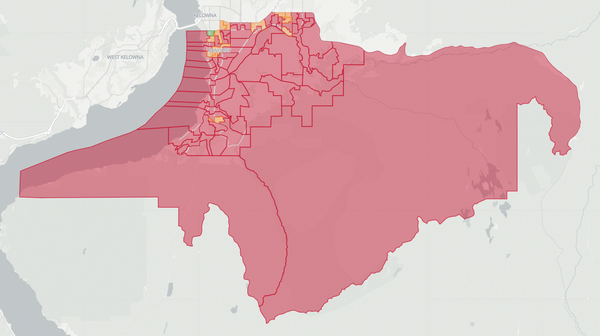
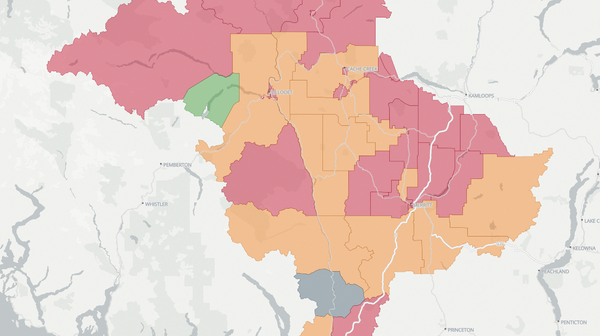
Kamloops-South Thompson — 2020 British Columbia Provincial Election Results Map
Kamloops-South Thompson — 2020 Election Results
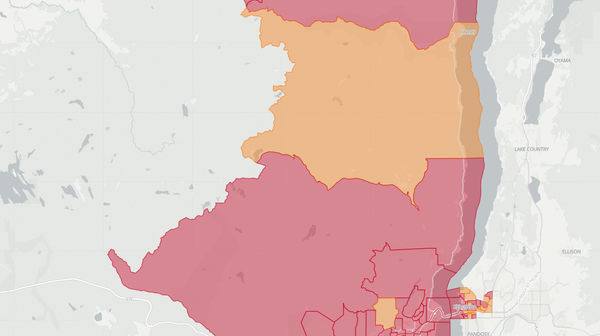
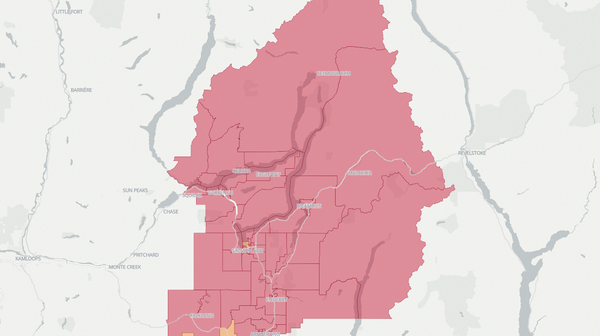
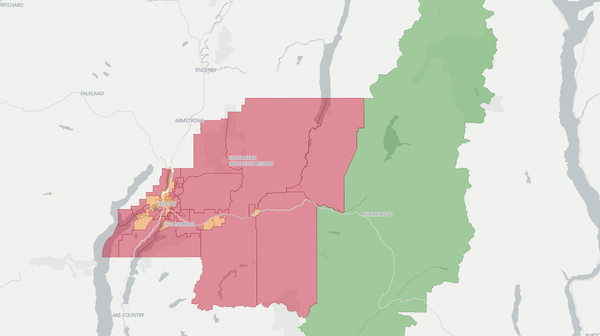
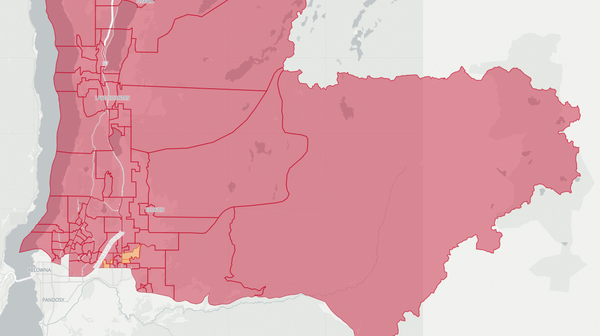
Poll-by-poll results for Kamloops-South Thompson in the 2020 British Columbia election. The BC Liberal Party candidate won this riding. Explore detailed voting data, candidate results, and turnout statistics at the poll level.
Riding information
Auto generated. Flag an issue.Kamloops—South Thompson
Kamloops—South Thompson covers the southern reaches of Kamloops and stretches east through the South Thompson River valley, taking in suburban neighbourhoods, ranchlands, and the semi-arid benchlands that define the BC Interior landscape. Kamloops, with roughly 100,000 residents, serves as the economic hub for a vast surrounding region, anchored by Thompson Rivers University, health care services, the transportation sector, and resource industries. The city sits at the confluence of the North and South Thompson rivers and has long been a crossroads for trade and travel in the province's interior.
The riding had been held by the BC Liberals since 2001, making it reliably centre-right territory heading into 2020. In the snap election called during the COVID-19 pandemic, Liberal incumbent Todd Stone sought a third term, while the NDP looked to make inroads in a seat that had not been seriously competitive in recent cycles.
Candidates
Todd Graham Stone (BC Liberal Party) — Stone was the incumbent MLA, first elected in 2013 and re-elected in 2017. Before entering politics, he founded and served as CEO of iCompass Technologies, a Kamloops-based software company that developed governance management solutions for local governments. He served as Minister of Transportation and Infrastructure from 2013 to 2017 and ran for the BC Liberal leadership in 2017–2018, finishing fourth. He had been involved with the BC Liberal Party since the 1990s.
Anna Thomas (BC NDP) — Thomas was the first Indigenous woman to run for MLA in the Kamloops—South Thompson riding. Of Nlaka'pamux and Cree heritage, she was originally from Lytton First Nation but grew up in Tk'emlups te Secwepemc territory. She served as president of the BC Native Women's Association, a position she was first elected to in 2018.
Dan Hines (BC Green Party) — Hines was an Anglican priest, international leadership consultant, and workshop facilitator who had spent two years consulting in Beijing before the campaign. A longtime Kamloops resident, he was a co-founder of the RareBirds Housing Co-operative, whose mandate is to develop community housing with a reduced environmental impact. He had previously run as the Green candidate in Kamloops—North Thompson in the 2017 election.
Local Issues
The opioid crisis had accelerated sharply since the 2017 election and was the most pressing concern heading into the 2020 campaign. Kamloops recorded twenty-five overdose deaths in 2019, and that toll was on pace to nearly double in 2020 as fentanyl contamination in the street drug supply intensified and the COVID-19 pandemic disrupted services. In February 2020, ASK Wellness launched a pilot program making prescription Dilaudid pills available to people with opioid dependency—a harm-reduction measure modelled on a Vancouver initiative—but residents remained divided over the balance between treatment, harm reduction, and enforcement. City council pressed BC Housing for a dedicated drug recovery facility, only to claim the provincial housing agency backed out of the commitment, leaving a gap in recovery infrastructure.
Thompson Rivers University anchored the riding's knowledge economy, and its expansion during the NDP's term reshaped the community's economic profile. The $30-million Industrial Training and Technology Centre opened in September 2018, positioning the School of Trades and Technology to meet Interior labour-market demand. The $37.2-million Chappell Family Building for Nursing and Population Health opened in 2020 with significant provincial funding. TRU's economic impact study estimated that one in ten jobs in the Thompson-Nicola-Cariboo region was supported by the university and its students, and the institution sat on the Mayor's Task Force on Economic Recovery as Kamloops navigated the pandemic downturn.
Wildfire preparedness took on new urgency after the catastrophic 2017 season and the severe 2018 season. In March 2019, the province announced its wildfire preparedness plan in Kamloops, and the City received $264,300 through the Community Resiliency Investment program for fuel and vegetation management around the urban-wildland interface. The City collaborated with Tk'emlups te Secwepemc and BC Wildfire Service on prescribed fire projects aimed at reducing hazardous fuel loads on the slopes surrounding residential neighbourhoods. Despite these investments, residents worried that the Interior's increasingly hot, dry summers—driven by climate change—were outpacing the pace of mitigation work.
The pandemic itself was a defining backdrop to the election. Kamloops businesses dependent on tourism and the service economy faced an uncertain future as public health restrictions limited capacity and travel. TRU's shift to remote instruction affected the local rental market and hospitality sector. Housing affordability remained a growing pressure, with the city's 2020 Housing Needs Assessment documenting rising demand for rental units and supportive housing. ICBC rate reform—the NDP government's move to a no-fault insurance model—generated debate among Interior drivers who relied heavily on their vehicles and wanted assurance that premiums would actually decline.