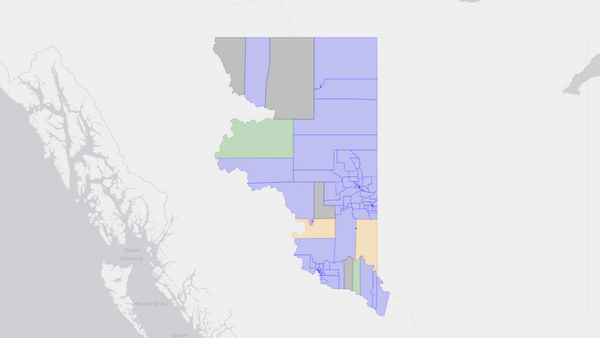
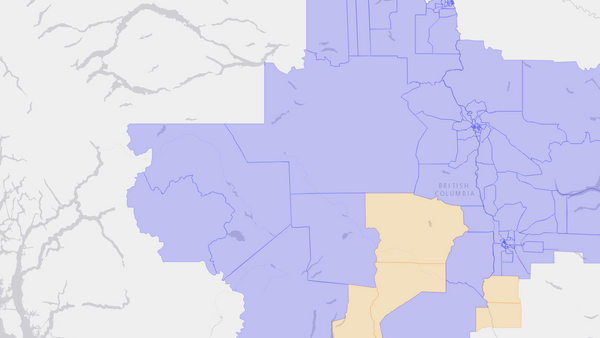
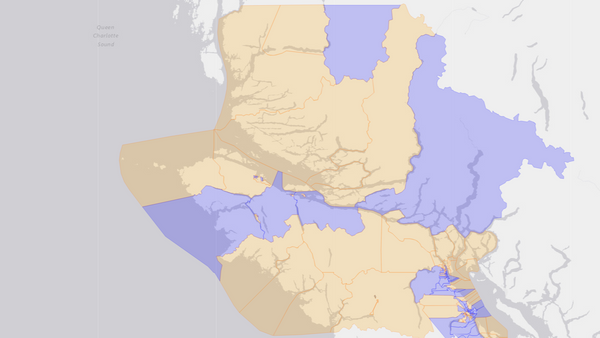
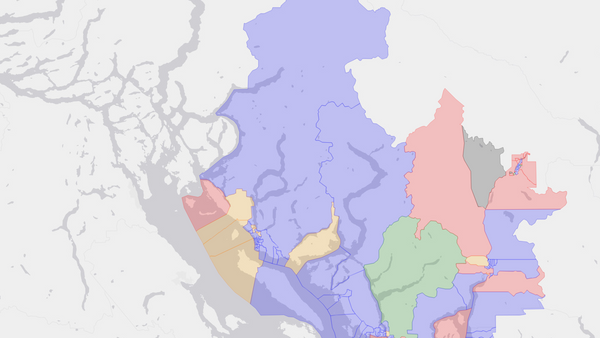
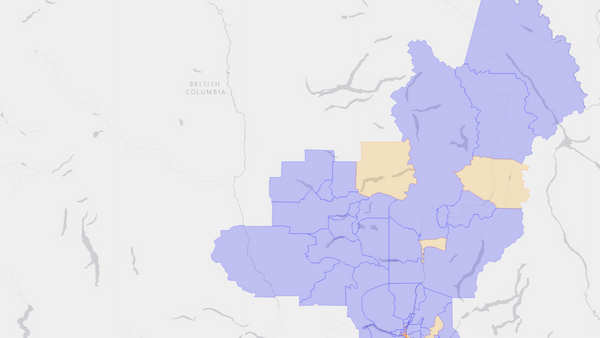
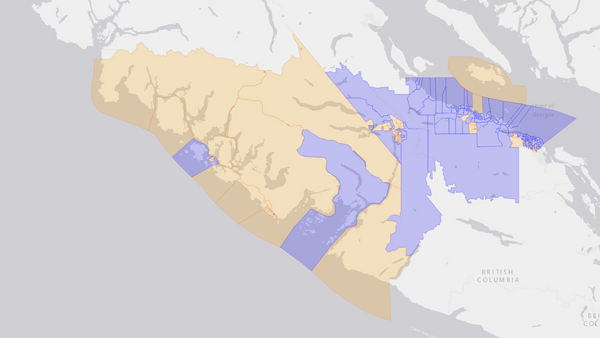
Skeena—Bulkley Valley, BC — 2008 Federal Election Results Map
Skeena—Bulkley Valley — 2008 Election Results
📌 The Canadian federal electoral district of Skeena—Bulkley Valley was contested in the 2008 election.
🏆 Nathan Cullen, the NDP-New Democratic Party candidate, won the riding with 17,219 votes (49.8% of the vote).
🥈 The runner-up was Sharon Smith (Conservative) with 12,561 votes (36.4%), defeated by a margin of 4,658 votes.
📊 Other notable candidates: Corinna Morhart (Liberal, 6%).
Riding information
Auto generated. Flag an issue.Skeena—Bulkley Valley
Roughly 324,000 square kilometres of northwestern British Columbia sat in this riding, running from the Queen Charlotte Islands and the outer coast inland along the Skeena and Bulkley rivers to the lakes country west of Prince George, and north through the Stikine to the Yukon boundary. Prince Rupert, Kitimat, Terrace, Smithers, Houston, Burns Lake and the Hazeltons were its main centres. Fewer than 92,000 people lived in it, a large share of them First Nations.
Candidates
Nathan Cullen (NDP) — Born in Toronto in 1972, Cullen graduated from Trent University in 1994 with an honours degree in international development and environmental studies. He spent several years in Central and South America doing community development work before settling in Smithers in 1998, where he ran a consulting practice in strategic planning and conflict resolution. He took the seat from the Conservative incumbent in 2004, served as his party's environment critic, sat on the committee that rewrote the government's Clean Air Act, and sponsored a bill to restrict phthalates in products made for infants.
Sharon Smith (Conservative) — Smith was mayor of Houston, a Bulkley Valley forestry town, and came to the contest from a community at the centre of the region's timber economy. In August 2007 the Conservative member for neighbouring Cariboo—Prince George, Dick Harris, designated her as a point of contact for Skeena—Bulkley Valley residents with federal business, an arrangement criticised across the northwest as a way around a seat the party did not hold.
Corinna Morhart (Liberal) — A social worker based in Prince Rupert.
Hondo Arendt (Green Party) — A college instructor in Prince Rupert, running on coastal protection and economic diversification.
Rod Taylor (Christian Heritage Party) — A quality control supervisor in the lumber industry near Smithers, Taylor had been his party's candidate here in 2004 and 2006.
Mary-Etta Goodacre, a retired teacher from Smithers, stood for the Canadian Action Party.
About the Riding
The northwest was in transition, and the direction was not settled. Prince Rupert had spent two decades absorbing the decline of the fishery and the loss of its pulp mill, but in 2007 the port opened the first phase of the Fairview container terminal — the first purpose-built ship-to-rail container facility in North America — using a deep natural harbour and Canadian National's line inland to offer shippers the shortest crossing between Asia and the continent. It gave the city its first growth story in a generation, and 2008 was its first full year of operation.
Kitimat's outlook was murkier. Built in the 1950s around Alcan's aluminium smelter, the town had lost its Methanex plant earlier in the decade and leaned on the smelter and the Eurocan paper mill. Rio Tinto had bought Alcan in 2007, and the decision on whether to rebuild the ageing smelter — the town's central economic question — was still outstanding. Terrace had meanwhile consolidated its role as the region's retail and services centre.
Inland the story was timber. Houston, Burns Lake and Smithers depended on sawmills working through beetle-killed pine, and the collapse of United States housing demand cut into shift schedules through 2008. The softwood lumber agreement signed two years earlier remained contentious among northern producers.
First Nations title and treaty questions ran through everything. Gitxsan, Wet'suwet'en, Tsimshian, Nisga'a and Haida territory all lay within the riding, and negotiations over land, fisheries and forestry conditioned development in ways with no parallel in southern seats. Cullen's opposition to expanded crude oil tanker traffic on the north coast, and his defence of the long-standing moratorium there, was a defining position in a riding whose communities lived on the water.