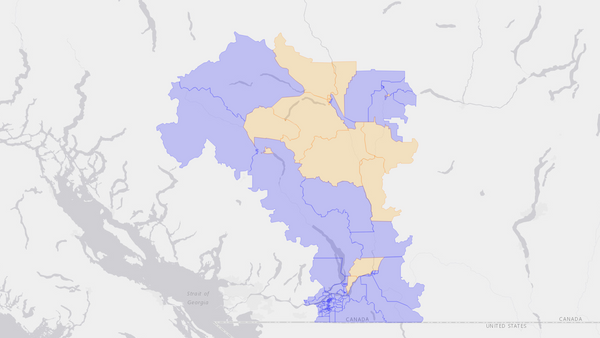
West Vancouver—Sunshine Coast—Sea to Sky Country, BC — 2008 Federal Election Results Map
West Vancouver—Sunshine Coast—Sea to Sky Country — 2008 Election Results
📌 The Canadian federal electoral district of West Vancouver—Sunshine Coast—Sea to Sky Country was contested in the 2008 election.
🏆 John Weston, the Conservative candidate, won the riding with 26,949 votes (44.6% of the vote).
🥈 The runner-up was Ian Sutherland (Liberal) with 16,069 votes (26.6%), defeated by a margin of 10,880 votes.
📊 Other notable candidates: Bill Forst (NDP-New Democratic Party, 14%) and Blair Wilson (Green Party, 14%).
Riding information
Auto generated. Flag an issue.West Vancouver—Sunshine Coast—Sea to Sky Country
Ferries and a single highway held this constituency together. From the Capilano River on the western edge of Metro Vancouver it took in West Vancouver, Lions Bay and Bowen Island, ran north up Howe Sound through Squamish to Whistler, then crossed to the Sunshine Coast and followed the shore through Gibsons, Sechelt and Pender Harbour to Powell River. Created in 1996 as West Vancouver—Sunshine Coast and renamed in the 2003 boundary order, its 13,259 square kilometres held 129,241 people at the 2006 census.
Candidates
John Weston (Conservative) — Weston had carried the Conservative banner here in 2006 and lost to Blair Wilson; this was his second attempt. A West Vancouver lawyer who had practised in Canada and in Taiwan, he worked in Mandarin and French as well as English and built an Asia-Pacific trade and investment practice through Pan Pacific Law Corporation. Educated at Harvard and Osgoode Hall Law School, he was among the founders of the Canadian Constitution Foundation, a litigation charity set up in 2002 around individual rights and limits on government power.
Ian Sutherland (Liberal) — Sutherland was the sitting mayor of Squamish, elected in 2002 at the head of the Squamish New Directions slate and returned in 2005. He had come west from New Brunswick and worked as a publishing executive before settling in the town. In June 2008 he announced he would not seek a third term; his years in the chair went to rebuilding a mill economy around tourism, recreation and waterfront redevelopment.
Bill Forst (NDP) — A retired teacher from Gibsons, Forst campaigned for the New Democrats on the coastal side of Howe Sound.
Blair Wilson (Green) — Wilson was the riding's sitting member. A chartered accountant born in North Vancouver with a political science degree from the University of Victoria, he took the seat for the Liberals in 2006, resigned from the caucus in October 2007 after a newspaper published allegations about his campaign spending and personal finances, and sat as an independent thereafter. Elections Canada finished its review on 21 July 2008 and cleared him of all but a few of the allegations. On 30 August he joined the Green Party, giving it a Commons seat for the first time; Parliament was dissolved eight days later, so he never sat under the new label. The move let Elizabeth May argue the Greens held a seat as she pressed for a place in the televised leaders' debates.
About the Riding
The seat's recent history ran through John Reynolds, who won West Vancouver—Sunshine Coast for Reform in 1997, held it through the Canadian Alliance and the Conservative merger, and retired in 2006. West Vancouver supplied most of the population and nearly all of the wealth: the British Properties, Ambleside and Dundarave, high home ownership, an older electorate, and long-established Chinese and Iranian communities.
Squamish was the industrial casualty. Western Forest Products shut the Woodfibre pulp mill across the sound in March 2006, ending 323 jobs and about a tenth of the district's tax base, and the town was staking its future on recreation and commuting. Whistler had become a construction site as the sliding centre, the Nordic venues in the Callaghan Valley and the athletes' village went up for the 2010 Games. Four-laning of the Sea to Sky Highway had moved north past the stretch where a 2006 blockade at Eagleridge Bluffs ended in arrests.
The Sunshine Coast lived on tourism, retirees, small-scale forestry and the BC Ferries timetable, and at its northern end the Catalyst Paper mill at Powell River was still the largest industrial employer as newsprint demand slid. Run-of-river power proposals on coastal creeks divided communities, and the autumn's financial turmoil sharpened argument over the Liberal carbon-pricing plan in a place where almost every trip meant a highway lane or a ferry deck.