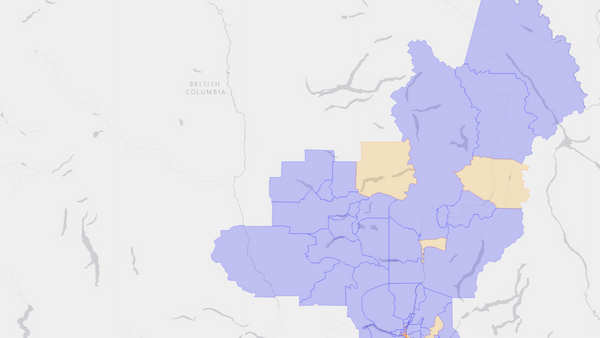
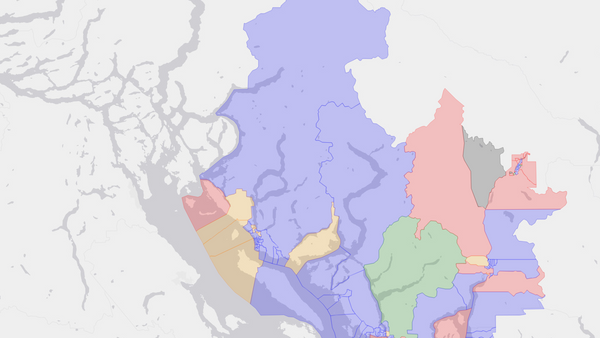
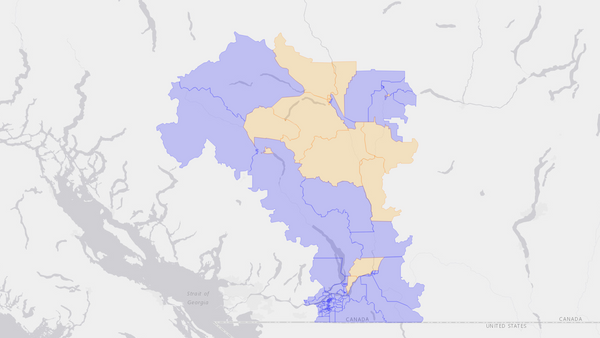
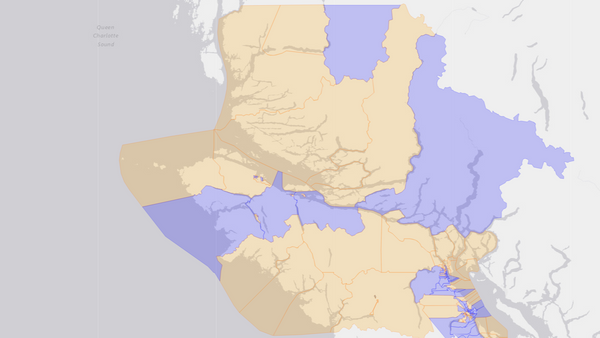
Cariboo—Prince George, BC — 2008 Federal Election Results Map
Cariboo—Prince George — 2008 Election Results
📌 The Canadian federal electoral district of Cariboo—Prince George was contested in the 2008 election.
🏆 Dick Harris, the Conservative candidate, won the riding with 22,637 votes (55.4% of the vote).
🥈 The runner-up was Bev Collins (NDP-New Democratic Party) with 10,581 votes (25.9%), defeated by a margin of 12,056 votes.
📊 Other notable candidates: Drew Adamick (Liberal, 11%) and Amber Van Drielen (Green Party, 6%).
Riding information
Auto generated. Flag an issue.Cariboo—Prince George
Highway 97 runs the length of this central British Columbia riding, but the district held only part of the city its name advertises. The boundary through Prince George followed the Nechako River, Highway 97 and the Fraser, so the southern and western neighbourhoods — College Heights, the university lands, the streets around Pine Centre — voted here, while downtown, the northern subdivisions, the pulp mills and the airport belonged to Prince George—Peace River. From that shared city the riding ran south past Quesnel, Wells and Barkerville to Williams Lake, west across the Chilcotin plateau to Chilko Lake, the Nemiah Valley and Anahim Lake, and northwest to Vanderhoof.
Candidates
Dick Harris (Conservative) — Born in Vancouver in 1944 and raised in Prince Rupert, Harris built and later sold a group of Prince George companies, the largest of them a tire sales and distribution business. He backed the Progressive Conservatives for two decades before joining Reform in 1989, chaired Reform Fund Canada, and unseated New Democrat MP Brian Gardiner in Prince George—Bulkley Valley in 1993. Stockwell Day made him chief opposition whip in 2001. When that riding disappeared in the 2003 redistribution he moved to this seat, and by 2008 he chaired both the party's British Columbia caucus and its national forestry caucus. He was seeking a sixth term.
Bev Collins (NDP) — An employment coach in Prince George, Collins had appeared on the ballot in this riding twice before, standing for the Canadian Action Party in 2004 and 2006.
Drew Adamick (Liberal) — A student living in Prince George, Adamick carried the Liberal nomination in a district that had not sent a Liberal to Ottawa since before the Reform breakthrough of 1993.
Amber Van Drielen (Green) — A Vancouver lawyer, Van Drielen was the Green Party's nominee.
Douglas Gook (Independent) — An organic farmer from the Quesnel area with a long involvement in ecological forestry and community organising, Gook had been the riding's Green candidate in 2004. With the Green nomination going to Van Drielen in 2008, he ran without a party label.
About the Riding
Wood paid most of the wages here, and wood was in trouble as the campaign opened. Mountain pine beetle had killed a large share of the mature lodgepole in the Prince George and Quesnel timber supply areas, and the rush to cut dead stands before it lost value had kept mills running hard for several years. That cushion was giving out: the American housing market collapsed through 2008, lumber demand went with it, and interior producers answered with curtailed shifts and closures. Ottawa's main response was the $1-billion Community Development Trust announced in January 2008 for communities dependent on a single industry — money the United States promptly complained about as a softwood subsidy.
Quesnel and Williams Lake sat closest to the resource, their payrolls tied to sawmills, plywood plants and the log haul. South and west of them the Cariboo opens into grassland where cattle ranching remains a working livelihood, and mineral exploration was busy as metal prices peaked over the summer. Taseko Mines had begun provincial and federal environmental assessment work on its proposed Prosperity gold and copper mine at Fish Lake, roughly 125 kilometres southwest of Williams Lake, setting mining employment against Tsilhqot'in objections to the site.
Land questions ran through the riding's politics more generally. In November 2007 the British Columbia Supreme Court released its ruling in the Tsilhqot'in title case, declining to declare Aboriginal title over the Chilcotin claim area but finding hunting, trapping and trading rights that provincial forest licensing had unjustifiably infringed. Nearer Prince George, the Lheidli T'enneh had negotiated a final agreement under the modern treaty process only to see band members reject it in a ratification vote in March 2007. Fuel prices, the provincial carbon tax that took effect on 1 July 2008 and the federal Liberal carbon-pricing plan all landed badly in a place where the nearest town can be an hour away.