Are Canadian political polls still useful?

I’ve long viewed polling as a useful but imperfect tool for gauging Canadian sentiment. It helps parties like the Conservatives under Pierre Poilievre create messaging that resonate with everyday Canadians frustrated by Liberal overreach on everything from taxes to immigration.

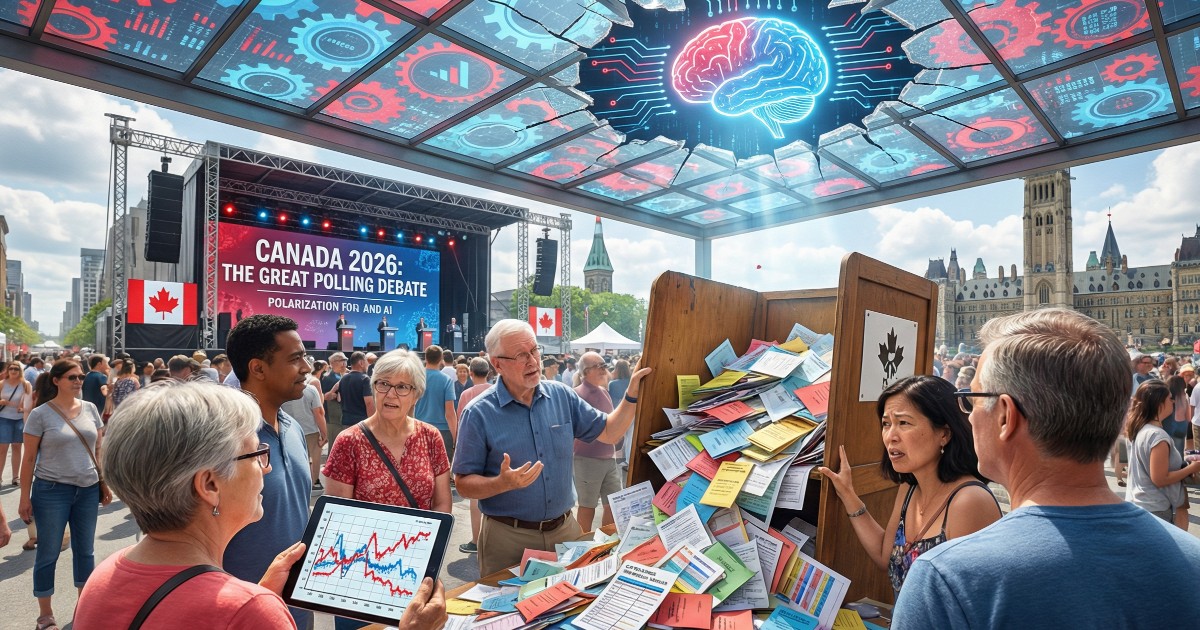
But lately, I’ve been wondering: has polling on key issues reached a ceiling in its usefulness? In an era of deepening divides and polarization, are these surveys truly illuminating public opinion, or are they just reinforcing the tribal lines we already know exist?

Like in many places, it’s no surprise that Canadian society has also become polarized, but I suspect the root cause isn’t purely ideological. It’s may just be our partisan nature.

Our evolutionary brains, wired for survival in tribes, prioritize loyalty to “our side” over nuanced contemplation of ideas. We gravitate toward who we like or oppose, rather than dissecting why we support or reject certain policies.

This tribalism explains why debates on climate change, immigration, and media trust often feel like proxy wars for team allegiance rather than genuine discourse. Conservatives rally around common-sense critiques of elite-driven narratives, while Liberals defend expansive government interventions. But in this setup, polling might be capturing signals of partisan identity more than authentic beliefs.

Inside the Abacus Data Poll – What It Attempts to Reveal About the Conservative Base

Take a recent poll by Abacus Data, conducted January 12-16, 2026, surveying 2,008 Canadian adults as part of a series with the Toronto Star ahead of the Conservative Party convention. It explores the Conservative base and how it stacks up against the rest of the country on hot-button issues. The findings highlight the limitations of traditional polling, in my opinion. Statistical tools are useful if they ask the right questions.

On climate change, for instance, only 34% of the Conservative base sees it as an urgent problem demanding immediate action, compared to 69% of everyone else and 58% overall. Instead, 73% of the base prioritizes affordability and energy security over accelerating green initiatives, versus 53% of non-base respondents. And 72% support approving more major energy projects like pipelines, against 56% of others.

From a conservative perspective, this makes sense: we’re pragmatic about balancing environmental concerns with economic realities, especially when “net-zero” mandates from Ottawa threaten jobs in Alberta’s oil patch or hike heating bills in Ontario.

But here’s the problem: these questions are heavily partisan-coded. Anyone with even a passing knowledge of Canadian politics knows climate alarmism is a left-wing staple, pushed by Liberals and NDP.

The Hidden Bias: How Partisan-Coded Questions Distort Real Opinions

Respondents might be answering not based on personal conviction, but to align with their team and perceived value. It’s reminiscent of those high school career surveys where you’d tick boxes you know were coded for “doctor” because that job is prestigious, not because you actually enjoyed biology. Whereas most of us would answer in the affirmative to “Do you like being outside?” if we were being honest, but didn’t because we didn’t want to dig ditches.

“Do you believe climate change is an existential threat?” Sure, if you’re signaling Liberal virtue. But are they your actual values, or the confort of your tribe?

Immigration and integration questions reveal similar coding. The poll shows 74% of the Conservative base favoring severe reductions in immigration levels, compared to 57% of others, with 63% of all Canadians agreeing on major cuts. Even starker, 78% of the base believes Canada has gone too far in accommodating different values and cultures, versus 49% of non-base Canadians.

Conservatives have been vocal about this. Poilievre’s push for controlled borders resonates because unchecked immigration strains housing, healthcare, and social cohesion. Yet these queries scream “right-coded.” They tap into known partisan divides: Liberals champion multiculturalism as an unqualified good, while conservatives worry about integration failures.

Poll respondents, sensing the “answer key,” might default to their tribe’s position rather than reflecting on personal experiences, like whether their community has benefited from or been burdened by rapid influxes.

Media trust is another flashpoint, and perhaps the most right-coded of all.

Only 23% of the Conservative base believes mainstream media reports facts fairly, compared to 62% of everyone else. Meanwhile, 69% of the base sees the system as rigged for elites, versus 48% of others, and just 26% trust institutions like courts or Elections Canada to function fairly, against 60% of non-base respondents.

As a conservative, this skepticism rings true. The CBC’s Liberal-friendly bias and Big Tech’s censorship of dissenting voices have eroded faith in legacy outlets. But again, these questions are loaded: media distrust is understood as right-wing populism, from Trump south of the border to Poilievre’s “gatekeepers” rhetoric. People know the script and recite it accordingly.

Rethinking the Questions – Probing Deeper Motivations

This partisan coding is a symptom of polling’s diminishing returns in an age of disruption – societal and technological. Old dividing lines such as left vs. right on climate or immigrationare being shaken by global events like supply chain crises, AI-driven job shifts, and cultural upheavals.

Traditional surveys feel dated, inefficient at probing deeper motivations without tipping off the “correct” answer. What if, instead of asking “Do you support carbon taxes?” (left-coded yes), we posed questions like “How do you weigh personal financial stability against long-term environmental goals?”

Or on immigration: “What community changes have you noticed in the last five years, and how do they affect your daily life?” These indirect probes could reveal fundamental drivers – fear of economic insecurity, desire for continuity – without cueing tribal responses.

We might discover that many Canadians, regardless of party, share conservative instincts on fiscal prudence or border security, but express them differently.

AI and Embeddings: The Future of Understanding Canadian Public Opinion?

This is where modern innovations like AI and large language models (LLMs) could outshine traditional pollsters.

AI offers tools to map concepts in ways that bypass human biases and scripted answers. At their core, LLMs use “embeddings” which are mathematical representations of words, phrases, or ideas as high-dimensional vectors. These vectors capture semantic relationships: “climate change” might cluster near “environmental policy” and “energy costs,” but AI can quantify similarities without assuming partisan priors.

For example, by analyzing open-ended responses or social media chatter through vector similarity searches, we could match concepts like “affordability” to “immigration pressures” or “media trust” to “elite capture,” revealing hidden connections that polls miss. Concept matching via cosine similarity (a measure of vector alignment) could uncover that a respondent’s skepticism of climate urgency stems not from denialism, but from vector proximity to “government overreach” or “economic hardship.”

We can supplement the experienced insight from pollsters, adding these semantic discoveries to understand motivations beyond tribal signals – and maybe even correct for them.

In the end, as Canada heads toward another election cycle, conservatives should push for smarter insights to cut through the noise. Current polling methods may have hit their useful ceiling. By embracing AI-assisted analysis and fewer coded questions, we might reconfigure a political environment that’s more contemplative and less combative, aligning with the common-sense approaches that puts Canadians first.

Rally for Canada budget consultation survey results

On Friday, I sent out an email to the tens of thousands on the Rally for Canada email list asking them to participate in a small survey concerning the upcoming federal budget.  I asked people four questions concerning the government spending and their public policy priorities.  Over three thousand people responded on Friday and over the weekend.  I will be passing on the results to the office of the Minister of Finance as promised.

Q: On the question of Canada’s upcoming federal budget to get us through the economic crisis, which balance within the following options do you think is best for the government to implement? (n=3003)

Q: Which issues are most important to you from a government policy point of view? (n=3051)

Here is the same graph sorted in descending order (n=3051):

Q: What should be done with the Senate? (n=3007)

Q: What should be done with funding for the CBC? (n=2998)

Some notes: “n” is the number of respondents to each question.  Data was gathered from 8am Friday through midnight Sunday night.  Sample data is gathered from a population set that registered on the anti-coalition website RallyforCanada.ca between December 4th 2008 and January 9th 2009.  Answers were not randomly cycled.

That said, this data gives us insight into the priorities of Canadians who are against the concept of a Bloc-supported NDP-Liberal coalition government.  The first question was a careful balance on both sides of the spending vs. taxes debate.  On one hand, the answer set does not include an option to decrease spending and on the other, four out of five answers prompt at least some tax relief.  Most analysts believe that the federal budget will include some tax relief and stimulus in the form of government spending.  The largest group believed a balance spending/tax relief approach would be best while the second largest group favours substantial tax relief and no new spending (given the options presented).

The second question had 24 options.  Each option was a yes/no checkbox to pick public policy priorities.  There was little surprise on the distribution of public policy interests as the generally right-of-centre respondents selected jobs, economy, crime, tax cuts, healthcare choice, and military spending as priorities while passing on foreign aid, culture and arts, and native affairs.  Wheat board reform is generally a conservative priority yet this question is likely too regional for a national survey.

On the specific questions, it is of particular interest that 90% of respondents believe that the Senate in it’s current form must change.  Only 10% of respondents thought that the Senate ought to be left as it is.  On the question of spending for a particular budget item, respondents indicated that funding for the CBC should be decreased (61%) while only 6% thought it should be increased.

The mask slips

The Conservatives have run advertising comparing Liberal leader Stephane Dion to an out-of-touch academic who doesn’t care about the priorities of average hard-working Canadians.

In this video that I captured from a press conference Dion gave in Richmond BC just minutes ago, Dion says “I like to have a lot of PhDs in Canada but we need also to have plumbers, and all the skilled workers that are needed must have the ability to come here in Canada. Not only PhDs”

While Stephane Dion would like to have Canada populated by like-minded academics like himself, he seems to begrudgingly concede that Canada also needs plumbers.

Imagine if you were somebody with skills that the Prime Minister of Canada only needed rather than liked.

I received an email from a reader which reads,