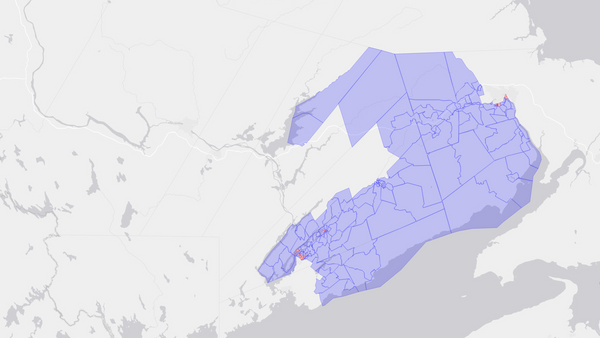
New Brunswick Southwest, NB — 2021 Federal Election Results Map
New Brunswick Southwest — 2021 Election Results
Poll-by-poll results for New Brunswick Southwest in the 2021 Canadian federal election. The Conservative candidate won this riding. Explore detailed voting data, candidate results, and turnout statistics at the poll level.
Riding information
Auto generated. Flag an issue.New Brunswick Southwest
New Brunswick Southwest covers the southwestern corner of the province, stretching from the Bay of Fundy coastline along the U.S. border with Maine inland through Charlotte County and into portions of York, Sunbury, Queens, Kings, and Saint John counties. The riding’s principal communities include St. Stephen, St. Andrews (known as St. Andrews by-the-Sea), St. George, Blacks Harbour, Grand Bay–Westfield, McAdam, Harvey Station, and Fredericton Junction. As the province’s most anglophone riding—over 90% of residents listed English as a first language—its population was approximately 65,000 in 2021, with many residents claiming English, Scottish, or Irish heritage.
The riding borders the state of Maine at St. Stephen, which sits directly across the St. Croix River from Calais, Maine. This cross-border geography has long shaped the district’s economy and daily life. The 2021 census showed a modest population decline of about 1.4% over the preceding intercensal period, consistent with broader rural depopulation trends in New Brunswick.
Candidates
John Williamson (Conservative) was seeking his third non-consecutive term as the riding’s MP. Born in 1970 into a Charlotte County family with deep roots in St. Andrews, he graduated from Fredericton High School and McGill University before earning a master’s degree in economic history at the London School of Economics. He was a founding member of the National Post’s editorial board (1998–2001), then served as federal director of the Canadian Taxpayers Federation (2002–2009). In 2009 he was appointed director of communications in the Prime Minister’s Office under Stephen Harper, stepping down in 2010 to launch his own political career. First elected in 2011, he lost his seat in 2015 before winning it back in 2019.
Jason Hickey (Liberal) grew up in St. John’s, Newfoundland, where he was introduced to politics at age nine while canvassing for his mother, Bonnie Hickey, who was the first female Member of Parliament for St. John’s East. A graduate of George Brown College in hospitality and tourism management, he worked across Canada in operations management for the tourism and hospitality industry before settling in southwestern New Brunswick with his partner.
Richard Trevor Warren (NDP) was born in Newfoundland and Labrador and moved to Regina in 2003 before returning to Atlantic Canada in 2013. He was an outspoken advocate for mental health awareness and brought that focus to his campaign.
About the Riding
Aquaculture is the economic backbone of Charlotte County, and salmon farming in the Bay of Fundy has transformed the region’s employment landscape. Cooke Aquaculture, headquartered in Blacks Harbour, grew from a small family operation with 5,000 fish in 1985 into one of the world’s largest fully integrated independent salmon farming companies. Its operations—including a $50-million expansion of its salmon processing plant in St. George and a new $21-million freshwater hatchery in Pennfield—provided over 1,000 jobs in the province. St. Stephen is also home to Ganong Bros., Canada’s oldest candy company, founded in 1873.
The riding’s tourism sector suffered acutely during the COVID-19 pandemic. The closure of the Canada–U.S. land border, which remained shut to non-essential travel through much of 2021, was described as devastating by local tourism operators, with many reporting 50% to 100% revenue declines and at least ten businesses closing permanently. St. Andrews by-the-Sea, a destination renowned for whale watching, golf, and the historic Algonquin Resort, was particularly hard hit. Paradoxically, some St. Stephen businesses fared better than expected during the closure, as local residents who would otherwise have crossed into Calais, Maine, redirected their spending to hometown shops.
Beyond tourism and aquaculture, the riding faced persistent challenges common to rural New Brunswick: an aging population, limited health care access in outlying communities, deteriorating municipal infrastructure, and recurring flood risks in low-lying areas near the Saint John River. The federal government’s carbon tax was a frequent topic of debate, particularly among residents in communities dependent on long driving distances and home heating fuel.