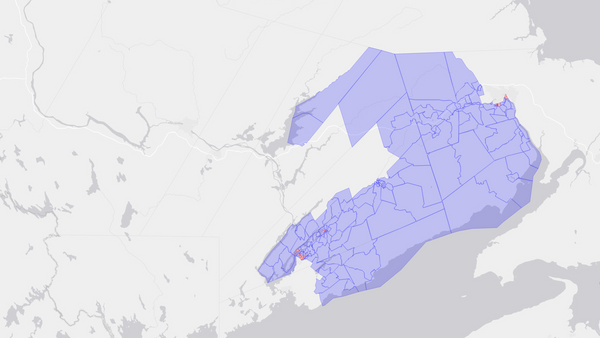
Moncton—Riverview—Dieppe, NB — 2021 Federal Election Results Map
Moncton—Riverview—Dieppe — 2021 Election Results
Poll-by-poll results for Moncton—Riverview—Dieppe in the 2021 Canadian federal election. The Liberal candidate won this riding. Explore detailed voting data, candidate results, and turnout statistics at the poll level.
Riding information
Auto generated. Flag an issue.Moncton—Riverview—Dieppe
Moncton—Riverview—Dieppe encompasses the urban heart of southeastern New Brunswick’s tri-community region: the city of Moncton, most of the town of Riverview, and the city of Dieppe. Situated at the geographic centre of the Maritime provinces along the Petitcodiac River, the area serves as a major transportation, retail, and services hub for the region. With a riding population of approximately 91,961 in the 2021 census, it is one of the most densely populated districts in Atlantic Canada. The broader Greater Moncton census metropolitan area, which includes surrounding communities, reached 157,717 residents in 2021.
The riding is distinctly bilingual. Dieppe is roughly 64% francophone, a product of decades of rural depopulation from northern and eastern Acadian New Brunswick. In Moncton, about 47% of residents are fluent in French, while Riverview is predominantly anglophone, with about 91% listing English as a first language. Nearly 52% of all francophone immigrants destined for New Brunswick settle in the Moncton metropolitan area. In 2021, there were over 18,000 immigrants and non-permanent residents living in the region, with newcomers arriving from the Philippines, India, Nigeria, Syria, France, China, and Morocco, among other countries.
Candidates
Ginette Petitpas Taylor (Liberal) was seeking a third consecutive term as the riding’s Member of Parliament. Born in Dieppe as the youngest of nine children, she graduated from the Université de Moncton with a bachelor’s degree in social work and spent 23 years working as a social worker and Victims Services Coordinator for the Codiac Regional RCMP, providing domestic violence intervention, crisis counselling, and violence risk assessment. She served as chairwoman of the New Brunswick Advisory Council on the Status of Women from 2004 to 2008 before being first elected in 2015. She subsequently served as federal Minister of Health.
Darlene Smith (Conservative) was originally from Nova Scotia’s Annapolis Valley and had lived in Moncton for 30 years by the time of the 2021 election. A graduate of Acadia University with a Bachelor of Business Administration, she had worked in retail management and operations before operating three special care homes in the Greater Moncton area, specializing in mental health services. She cited 20 years of behind-the-scenes involvement in politics as motivation for seeking the seat.
Serge Landry (NDP) was a regional representative for the Canadian Labour Congress in New Brunswick. His career in public service began in 1999 as a resident attendant at Villa du Repos, a long-term care centre in Moncton. He described running for office as the next step in his civic involvement after years of forwarding social justice causes in the region. His campaign priorities included affordable housing and a national pharmacare program.
About the Riding
The Greater Moncton area was one of Canada’s fastest-growing metropolitan regions entering the 2021 election. Between 2016 and 2021, the city of Moncton alone added 7,600 residents—a growth rate of 10.5%. Immigration was the primary driver, accounting for over 90% of population gains. This growth fuelled a building boom: in 2020, Moncton issued over $270 million in building permits, a record figure. The $108-million Avenir Centre, an 8,800-seat arena that opened in downtown Moncton in 2018, had already catalyzed over $68 million in new downtown assessment by 2021.
The economy was anchored by a diverse set of industries, including information technology, financial services, transportation logistics, and bilingual call centres—the area’s bilingualism being a key competitive advantage. Major employers included Assumption Life, Medavie Blue Cross, and various Irving and federal government operations. Dieppe’s industrial parks housed logistics and manufacturing firms, while Moncton’s service sector continued to expand.
However, rapid growth brought its own challenges. Housing affordability emerged as a dominant election issue, with rents rising sharply and low-income renters finding fewer options. A $3.4-million federal investment through the Rapid Housing Initiative was announced to support 62 new affordable units for individuals experiencing or at risk of homelessness. The city of Dieppe had allocated $13 million in 2021 for street reconstruction and transit improvements to keep pace with growth. Health care capacity, particularly emergency room wait times and physician shortages, was another persistent concern for voters.