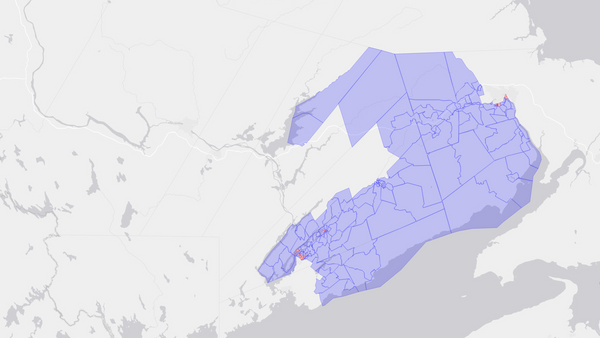
Miramichi—Grand Lake, NB — 2021 Federal Election Results Map
Miramichi—Grand Lake — 2021 Election Results
Poll-by-poll results for Miramichi—Grand Lake in the 2021 Canadian federal election. The Conservative candidate won this riding. Explore detailed voting data, candidate results, and turnout statistics at the poll level.
Riding information
Auto generated. Flag an issue.Miramichi—Grand Lake
Miramichi—Grand Lake is the largest federal electoral district in New Brunswick by land area, spanning approximately 18,900 square kilometres across the central and northeastern interior of the province. The riding stretches from the city of Miramichi on the Northumberland Strait inland through the Miramichi River valley to the Grand Lake region in the south. Major communities include Miramichi (population 17,692), Doaktown, Blackville, Chipman, and portions of the Grand Lake shoreline. Created through the 2012 redistribution, the riding drew 83% of its territory from the former Miramichi district, with smaller portions from the Fredericton, Beauséjour, and Tobique—Mactaquac ridings.
According to the 2021 census, the riding had a population of approximately 59,725. English is the dominant language, spoken as a first language by roughly 92% of residents, with French at about 7.6%. The median age in the Miramichi area skews older than the provincial average—the city of Miramichi recorded a median age of 50.0 years in 2021, compared to 45.8 provincially—reflecting decades of youth outmigration driven by limited economic opportunity in the region.
Candidates
Jake Stewart (Conservative) was a veteran of New Brunswick politics who had served 11 years as a Progressive Conservative MLA for Southwest Miramichi before resigning in August 2021 to seek the federal seat. A Blackville-area native born in 1978, Stewart had previously run for the provincial PC leadership in 2016 and served as Minister of Aboriginal Affairs in the Blaine Higgs government from 2018 to 2020. He also served as a Blackville municipal councillor earlier in his career.
Lisa Harris (Liberal) was a three-term Liberal MLA who represented Miramichi Bay-Neguac in the provincial legislature from 2014 to 2021. She served as provincial Minister of Seniors and Long-Term Care from 2016 to 2018 and also held the roles of deputy speaker and minister responsible for Celtic affairs. Before entering politics, Harris served on Miramichi city council. She defeated Miramichi Mayor Adam Lordon for the federal Liberal nomination in July 2021.
Bruce Potter (NDP) carried the NDP banner in the riding, continuing the party’s tradition of fielding candidates in the district despite historically modest vote shares in the region.
About the Riding
The Miramichi region’s economy was built on fishing, forestry, and mining, but by 2021 many of those traditional pillars had weakened considerably. Between 2004 and 2009, the area experienced a near-total collapse of its forestry base, with the shutdowns of pulp, paper, oriented strand board, and lumber facilities—including the UPM Kymmene mill—resulting in thousands of job losses. By 2021, the traditional resource sectors accounted for less than 10% of local employment, and the service sector had become the city’s largest employer.
The federal government’s Public Service Pay Centre, opened in Miramichi in 2012, brought approximately 550 new public service jobs to the area and became one of the region’s most significant employers. The centre processes payroll for roughly 300,000 federal public servants across 110 departments. Tourism, customer contact centres, light manufacturing, and small-scale entrepreneurship also contributed to partial economic diversification.
Despite these efforts, the riding continued to face challenges. Jobs in the broader Campbellton–Miramichi region dropped 5% between 2017 and 2021. Population stagnation and outmigration persisted, particularly among younger residents. The Miramichi River—one of the world’s premier Atlantic salmon rivers—remained central to the region’s identity and tourism economy, but declining fish stocks and environmental pressures on the watershed were ongoing concerns. Health care access in the rural interior, reliable broadband internet, and aging infrastructure were among the issues most frequently raised by constituents during the campaign.