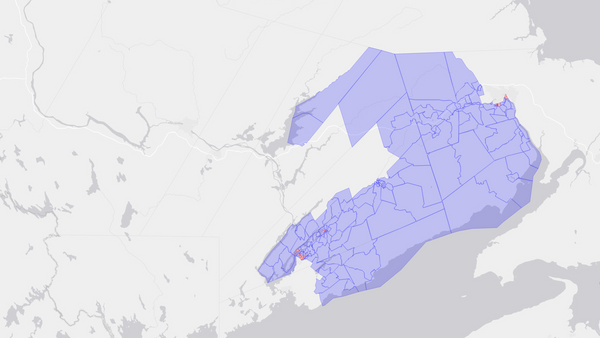
Tobique—Mactaquac, NB — 2021 Federal Election Results Map
Tobique—Mactaquac — 2021 Election Results
Poll-by-poll results for Tobique—Mactaquac in the 2021 Canadian federal election. The Conservative candidate won this riding. Explore detailed voting data, candidate results, and turnout statistics at the poll level.
Riding information
Auto generated. Flag an issue.Tobique—Mactaquac
Tobique—Mactaquac is a sprawling rural riding in western New Brunswick, covering more than 15,000 square kilometres along the Saint John River valley from Grand Falls in the north to the outskirts of Fredericton in the south, and westward to the U.S. border. The riding encompasses Carleton and Victoria counties and the eastern portion of York County (excluding the city of Fredericton). Key communities include Woodstock, Florenceville-Bristol, Hartland, Perth-Andover, Grand Falls, Nackawic, and Keswick Ridge. First Nations communities within the riding include Tobique First Nation, Kingsclear First Nation, and Woodstock First Nation.
According to the 2021 census, the riding had a population of approximately 69,344. The demographic profile is overwhelmingly anglophone (92.8% English, 4.8% French) and predominantly white (91.8%), with an Indigenous population of 5.8%. The religious landscape is diverse among Christian denominations, including Baptist, Catholic, United Church, Anglican, and Pentecostal communities, while 38% reported no religious affiliation. The median individual income in 2020 was $36,800, below the national average.
Candidates
Richard Bragdon (Conservative) was the incumbent MP who had flipped the riding from the Liberals in 2019. Born in Woodstock and raised in the Nackawic area, he resided in Keswick Ridge with his wife and three children. Before entering federal politics, Bragdon served as the elected Conservative Party of Canada National Council Member for New Brunswick. In the 43rd Parliament, his private member’s bill, the Act to Establish a Framework to Reduce Recidivism (Bill C-228), was adopted by the House of Commons.
Cully Robinson (Liberal) was an entrepreneur who had spent a decade building businesses and described himself as someone who thrived on the challenge of breaking into new markets. At the time of the campaign, he was also pursuing enrollment in the Canadian Armed Forces as a combat engineer.
Meriet Gray Miller (NDP) was a 20-year-old University of New Brunswick biology student from Upper Kent. Despite his youth, he was not new to electoral politics, having represented the Carleton-Victoria NDP in the 2020 New Brunswick provincial election before seeking the federal nomination.
About the Riding
Agriculture—above all, potato farming—is the heartbeat of the Tobique—Mactaquac economy. The Upper Saint John River Valley is one of Canada’s most productive potato-growing regions, and the riding is home to the global headquarters of McCain Foods in Florenceville-Bristol, self-proclaimed as the French Fry Capital of the World. McCain’s potato processing plant in Florenceville-Bristol employs over 1,000 people and underwent a $65-million production line expansion in 2017. The annual Potato Blossom Festival celebrates the crop that sustains much of the local economy. Hartland, located on the Saint John River, is famous for the Hartland Covered Bridge—at 390 metres, the longest covered bridge in the world—designated a National Historic Site in 1977.
The Mactaquac Dam, operated by NB Power, is one of the riding’s most prominent landmarks and a source of longstanding controversy. Built on the Saint John River in 1968 with a generating capacity of 670 megawatts—representing roughly 20% of New Brunswick’s electricity demand—the dam has been plagued by alkali-aggregate reaction in its concrete, causing the structure to expand and raising questions about its long-term future. The dam’s construction flooded communities and burial sites, and its impact on the Tobique First Nation has been a source of grievance for decades. A 2009 agreement between NB Power and the Tobique First Nation provided the community with five megawatts of electricity and a commitment to remediate a contaminated dump site near the dam, but broader concerns about fish passage, the decline of Atlantic salmon, and the dam’s environmental footprint persisted.
Forestry remains a secondary economic pillar. The town of Nackawic was originally planned around the St. Anne Nackawic pulp and paper mill, which was built to take advantage of the Mactaquac reservoir. Broadband connectivity, health care access in rural communities, and aging infrastructure were recurring concerns among voters. The federal carbon tax was a particularly prominent issue in a riding where long driving distances and cold winters make fuel costs a daily reality for most households.