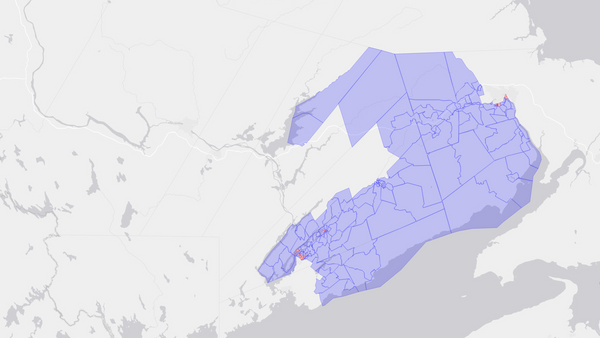
Saint John—Rothesay, NB — 2021 Federal Election Results Map
Saint John—Rothesay — 2021 Election Results
Poll-by-poll results for Saint John—Rothesay in the 2021 Canadian federal election. The Liberal candidate won this riding. Explore detailed voting data, candidate results, and turnout statistics at the poll level.
Riding information
Auto generated. Flag an issue.Saint John—Rothesay
Saint John—Rothesay sits on the southern coast of New Brunswick at the mouth of the Saint John River where it meets the Bay of Fundy. The riding encompasses the city of Saint John—one of Canada’s oldest incorporated cities, founded in 1785—along with the suburban towns of Rothesay and Quispamsis in the Kennebecasis Valley. According to the 2021 census, the riding had a population of approximately 82,000. Saint John itself had 69,895 residents, while Quispamsis grew to 18,768 and Rothesay reached 11,977. The broader Saint John census metropolitan area, which includes additional surrounding communities, recorded a population of 130,613, reflecting 3.5% growth since 2016.
The riding contains sharp socioeconomic contrasts. The suburban Kennebecasis Valley communities of Rothesay and Quispamsis are among the most affluent in the province, while parts of Saint John’s urban core experience some of the deepest poverty in Atlantic Canada—nearly one in three children in the city lived below the poverty line. The district has a diverse population that includes French-speaking, Indigenous, and immigrant communities, with newcomers arriving from China, India, and the Philippines, among other countries.
Candidates
Wayne Long (Liberal) was a two-term incumbent seeking re-election for a third time. Born in 1963 in Saint John, he built a career in the seafood industry, serving as a product manager for Stolt Sea Farm Inc. before becoming president of Scotiaview Seafood Inc. He became best known locally as president of the Saint John Sea Dogs hockey club, guiding the Quebec Major Junior Hockey League franchise to the Memorial Cup championship in 2011. Long was an outspoken supporter of the Energy East pipeline project and drew national attention in 2017 for publicly opposing his own party’s proposed tax changes for private corporations.
Mel Norton (Conservative) was a lifelong Saint John resident who earned his bachelor of arts in political science from the University of New Brunswick in Saint John and a law degree from UNB Fredericton, graduating in 1999. Admitted to the New Brunswick Bar in 2000, he practiced labour, employment, and construction litigation law with the firm Lawson Creamer. Norton served as mayor of Saint John from 2012 to 2016 and later sought the provincial Progressive Conservative leadership. He identified biomedical research and expansion of the port of Saint John as key opportunities for the riding.
Don Paulin (NDP) was a 30-year-old healthcare worker and CUPE member running in his first political campaign. He began his career in finance and accounting before shifting to healthcare. He drew on his experience growing up in poverty as a motivation for running, saying he had never heard politicians advocate for people like him.
About the Riding
Saint John’s economy has long been defined by the Irving family of companies, whose operations dominate the city’s industrial landscape. The Irving Oil refinery—the largest in Canada, with a capacity of 320,000 barrels per day—accounts for approximately half the dollar value of New Brunswick’s exports and supports roughly 2,440 jobs through its supply chain. The refinery is supplied by supertankers docking at the Canaport deep-water terminal, commissioned in 1970, which also hosts a liquefied natural gas import terminal opened in 2009. Irving also operates a pulp mill, a newsprint mill, and a tissue paper plant in the area.
The cancellation of the Energy East pipeline in 2017 remained a sore point for many residents who had viewed the project as a major economic catalyst for the port city. The port of Saint John, one of the few ice-free deep-water ports on the Atlantic coast, continued to seek new shipping and logistics opportunities. The city also has a long shipbuilding heritage, though large-scale shipbuilding at its dry dock—one of the largest in the world—had largely ceased since 2003.
Housing affordability and visible homelessness were among the most pressing issues facing the riding in 2021. Between 2021 and 2023, the number of individuals experiencing homelessness in New Brunswick’s three largest cities more than doubled. In Saint John, emergency shelter use was increasing sharply, and encampments were becoming more visible. The city’s deep economic divide—home to both one of Canada’s wealthiest corporate empires and some of Atlantic Canada’s highest child poverty rates—made income inequality and affordable housing central concerns of the campaign.