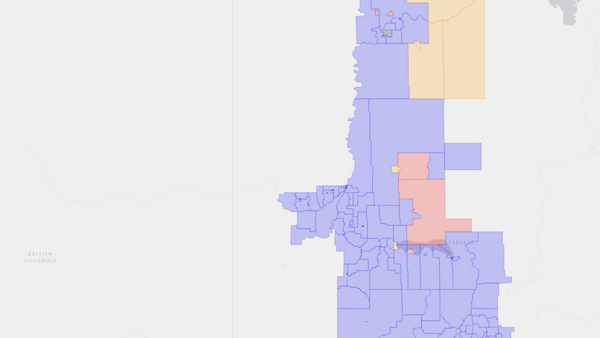
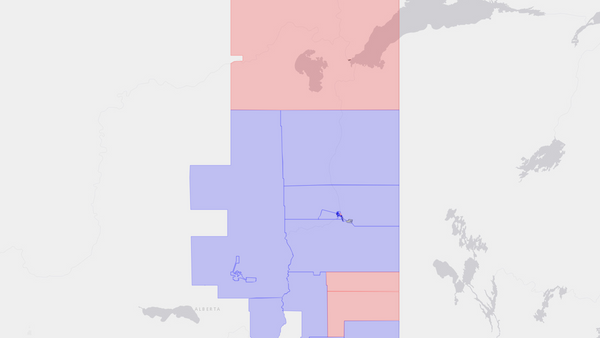
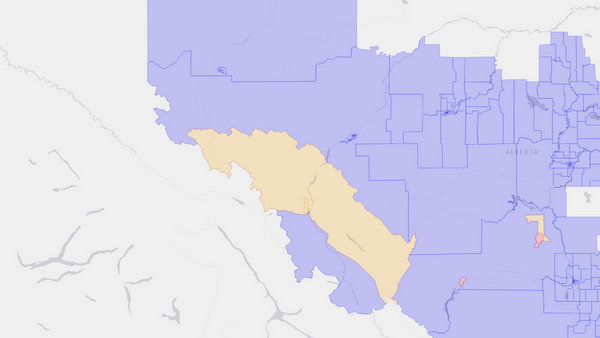
Grande Prairie—Mackenzie, AB — 2019 Federal Election Results Map
Grande Prairie—Mackenzie — 2019 Election Results
📌 The Canadian federal electoral district of Grande Prairie—Mackenzie was contested in the 2019 election.
🏆 Chris Warkentin, the Conservative candidate, won the riding with 51,198 votes (84.0% of the vote).
🥈 The runner-up was Erin Alyward (NDP-New Democratic Party) with 4,245 votes (7.0%), defeated by a margin of 46,953 votes.
Riding information
Auto generated. Flag an issue.Grande Prairie--Mackenzie
Grande Prairie--Mackenzie occupies Alberta's northwestern corner, reaching from the city of Grande Prairie north to the border with the Northwest Territories and west to British Columbia. More than half the riding's population is concentrated in Grande Prairie, Alberta's seventh-largest city, while the remainder is dispersed across boreal forest, farmland, and remote hamlets spanning an enormous geographic area.
Candidates
Chris Warkentin (Conservative) -- Born in Grande Prairie and raised on the family farm near the hamlet of DeBolt, Warkentin studied at Peace River Bible Institute and later took business and marketing courses at Grande Prairie Regional College before operating a custom home building company. First elected in 2006 for the former Peace River riding, he had been re-elected in every subsequent general election. During the previous Parliament he served as chair of the Aboriginal Affairs and Northern Development Committee and was later appointed deputy House leader for the Official Opposition.
Erin Alyward (NDP) -- A first-time political candidate, Alyward entered the race motivated by a desire to create positive change. She prioritized childcare, domestic violence prevention, and human rights issues.
Kenneth Munro (Liberal) -- A professor emeritus of history at the University of Alberta, Munro was a longtime Liberal organizer who had previously served as president of the party's Alberta wing.
Douglas Gordon Burchill (People's Party) and Shelley Termuende (Green Party) also sought election.
About the Riding
Grande Prairie sits at the hub of the Montney Formation, one of North America's most prolific natural gas plays, and the broader Peace Country region hosts extensive conventional oil, natural gas, and natural gas liquids production. The energy sector's cyclical fortunes ripple through every corner of the local economy, from housing costs to municipal infrastructure. By 2019, pipeline capacity constraints and volatile commodity prices continued to weigh on the region's drilling activity.
Agriculture and forestry form the riding's second economic pillar. The Peace Country's long summer daylight hours and fertile soils support productive canola, wheat, and barley cultivation despite the northern latitude. The northwest also produces a significant share of the province's pulp, oriented strand board, and dimensional lumber, with forestry operations sustaining employment in communities like High Level, Manning, and Fairview.
The riding's immense geographic scale presents persistent infrastructure challenges. Communities in the far north have limited access to health care, education, and government services. In May 2019, a threatening wildfire forced the evacuation of High Level and surrounding communities, displacing roughly 5,000 people and underscoring the vulnerability of remote northern communities to natural disasters. Broadband connectivity remained uneven across the rural and remote portions of the constituency. Grande Prairie itself experienced rapid population growth in the preceding decade, straining municipal infrastructure and creating demand for expanded housing, transportation, and social services. Federal issues during the campaign centred on energy market access, pipeline approvals, agricultural trade, wildfire preparedness, and investment in highways and broadband for remote communities.