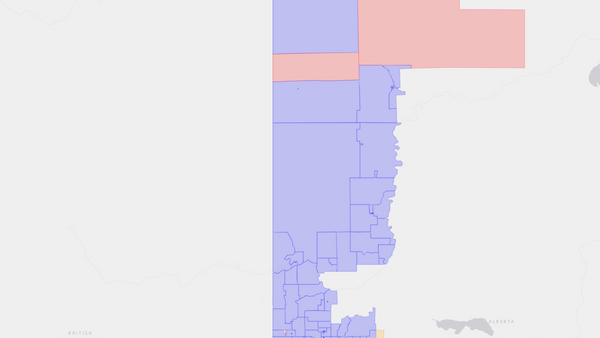
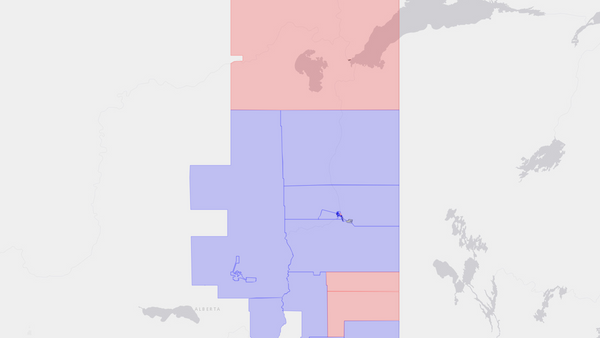
Peace River—Westlock, AB — 2019 Federal Election Results Map
Peace River—Westlock — 2019 Election Results
📌 The Canadian federal electoral district of Peace River—Westlock was contested in the 2019 election.
🏆 Arnold Viersen, the Conservative candidate, won the riding with 41,659 votes (80.7% of the vote).
🥈 The runner-up was Jennifer Villebrun (NDP-New Democratic Party) with 3,886 votes (7.5%), defeated by a margin of 37,773 votes.
📊 Other notable candidates: Leslie Penny (Liberal, 6%).
Riding information
Auto generated. Flag an issue.Peace River--Westlock
Peace River--Westlock covers over 105,000 square kilometres of north-central Alberta -- an area larger than Iceland -- stretching from the town of Westlock, just north of Edmonton, through dense boreal forest and muskeg to communities near the 60th parallel. The riding includes the towns of Peace River, Slave Lake, High Prairie, Athabasca, Barrhead, and Westlock, along with Fort Vermilion and numerous First Nation and Metis communities.
Candidates
Arnold Viersen (Conservative) -- Raised in the Dutch-Canadian farming community of Neerlandia, northwest of Athabasca, Viersen attended Covenant Canadian Reformed School from Grade 1 through Grade 12, then apprenticed as an auto service technician at NAIT and earned his journeyman ticket. He later obtained a business degree from the University of the Fraser Valley. First elected in 2015, Viersen served on the Indigenous and Northern Affairs Committee during the previous Parliament.
Jennifer Villebrun (NDP) -- A former lawyer from the Peace Region who lived in Sunset House, between High Prairie and Valleyview, Villebrun was a veteran NDP candidate who had previously run for the Green Party in the 2008 federal election and the NDP in 2011. A proud Metis community leader, she advocated for greater federal investment in infrastructure and services for remote communities.
Leslie Penny (Liberal) -- A registered nurse who first came to Barrhead in 1972 to work at the local hospital, Penny served as a councillor for the Town of Barrhead beginning in 2013. She had previously run as a provincial Liberal candidate in Barrhead-Morinville-Westlock in 2008 and 2012.
John Schrader (People's Party) -- A Westlock County cattle rancher, Schrader campaigned on smaller government and lower taxes. He identified investor confidence, the health of the oil and gas industry, and agriculture as the most pressing issues for the constituency.
Peter Nygaard (Green Party) also sought election.
About the Riding
Peace River--Westlock's economy is built on oil and gas extraction, agriculture, and forestry. Conventional oil and natural gas production provides employment across the riding's western and northern reaches. The agricultural sector is diverse, with grain farming, cattle ranching, and mixed operations spread across the riding's southern half. The Peace River district's extended summer daylight hours and fertile grey luvisol soils support productive canola and grain crops at latitudes where farming might otherwise seem improbable.
Forestry operations, including pulp mills and lumber facilities, employ workers in communities such as Slave Lake, High Prairie, and along the highway corridors north of Athabasca. Slave Lake was devastated by wildfire in May 2011, when the town lost approximately 374 properties and other structures -- roughly one-third of its residential properties -- in what was then the second-costliest insured disaster in Canadian history. By 2019, the community had largely rebuilt, but the experience left lasting awareness of wildfire risk across the boreal region.
The riding is home to a significant Indigenous population, including multiple First Nations and Metis settlements. Communities such as Wabasca-Desmarais, Peerless Trout First Nation, and Bigstone Cree Nation face acute challenges around housing, clean water, healthcare access, and educational attainment. The riding's cultural mosaic also includes French-Canadian farming communities, Dutch Reformed settlements like Neerlandia, and Mennonite and Hutterite German-Canadian communities. Fort Vermilion, near the riding's northern boundary, is one of the oldest European settlements in Alberta, dating to 1788. Federal issues during the 2019 campaign included pipeline approvals, agricultural trade, Indigenous services, rural healthcare access, broadband connectivity, and wildfire preparedness for remote northern communities.