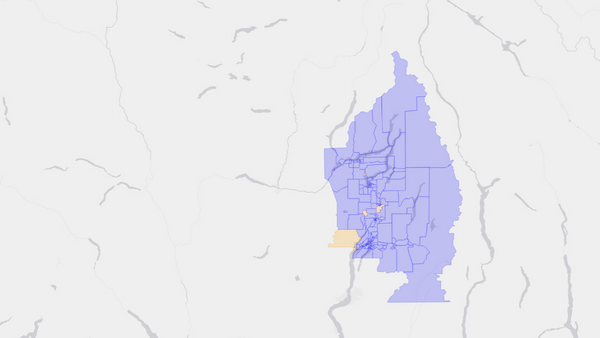
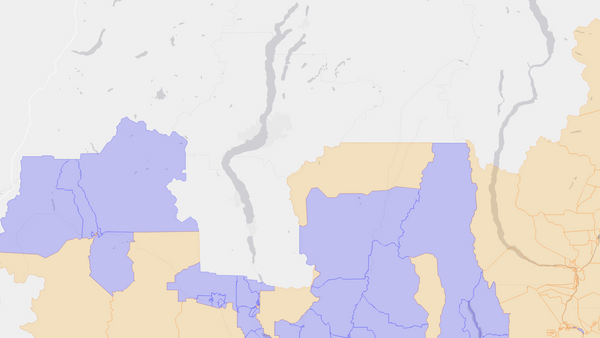
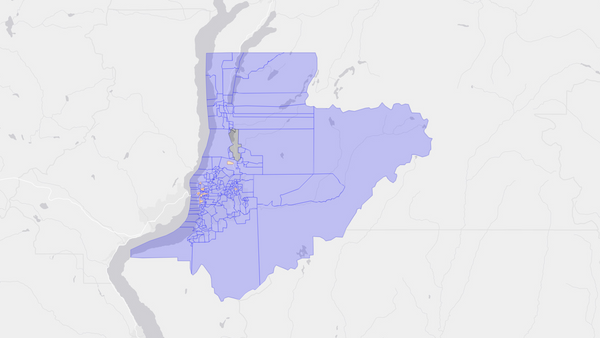
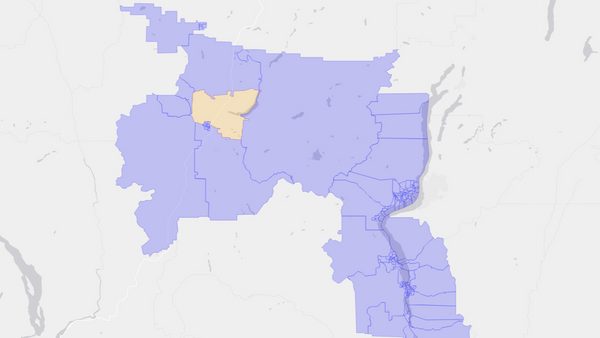
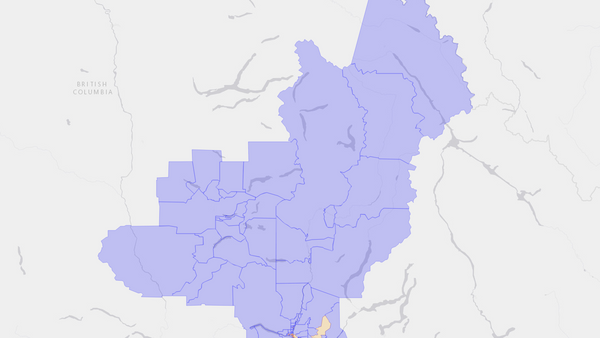
Kootenay—Columbia, BC — 2011 Federal Election Results Map
Kootenay—Columbia — 2011 Election Results
📌 The Canadian federal electoral district of Kootenay—Columbia was contested in the 2011 election.
🏆 David Wilks, the Conservative candidate, won the riding with 23,541 votes (55.5% of the vote).
🥈 The runner-up was Mark Shmigelsky (NDP-New Democratic Party) with 14,199 votes (33.5%), defeated by a margin of 9,342 votes.
📊 Other notable candidates: Bill Green (Green Party, 6%).
Riding information
Auto generated. Flag an issue.Kootenay—Columbia
Kootenay—Columbia sprawled across the southeastern corner of British Columbia, encompassing some 85,000 square kilometres of mountainous terrain between the Rocky Mountains and the Selkirk and Purcell ranges. The riding stretched from Radium Hot Springs in the north to the United States border in the south, taking in communities such as Cranbrook, Kimberley, Fernie, Invermere, Golden, and Creston. Its dramatic landscape of river valleys, ski resorts, and national parks made it one of the most geographically stunning constituencies in Canada.
Candidates
David Wilks (Conservative) — Wilks was born in Lethbridge and served as an RCMP officer for twenty years beginning in 1980, with postings to Terrace, New Aiyansh, Golden, Penticton, and Sparwood before retiring in 2000. After leaving the force he purchased a family entertainment business in Sparwood and entered local politics, winning a council seat in 2002 and then serving as mayor of Sparwood from 2005. As mayor he chaired the Regional District of East Kootenay board. He won the Conservative nomination after longtime MP Jim Abbott announced his retirement, and captured the riding with approximately 56 percent of the vote.
Mark Shmigelsky (NDP) — Shmigelsky carried the NDP banner in Kootenay—Columbia, finishing second. He performed well in the western communities of the riding where NDP support was traditionally stronger, but was unable to overcome the Conservative margin in the larger population centres of Cranbrook and the Elk Valley.
Bill Green (Green Party) — Green was a local environmentalist who ran for the Green Party in Kootenay—Columbia and later served as co-chair of the riding’s Green Party Electoral District Association. He also ran again as the Green candidate in the 2015 federal election.
Betty Aitchison (Liberal) — Aitchison ran as the Liberal candidate in Kootenay—Columbia, a riding where Liberal support had been declining for several election cycles.
Brent Bush (Independent) — Bush had previously run as the NDP candidate in Kootenay—Columbia in the 2004 and 2006 federal elections, losing to Jim Abbott by wide margins each time. In 2011 he ran as an Independent.
About the Riding
Kootenay—Columbia was a vast rural riding whose economy depended heavily on natural resources and tourism. The mining sector was a dominant employer, particularly the coal operations around Sparwood and Elkford in the Elk Valley, where Teck Resources operated some of the largest metallurgical coal mines in the world. Forestry had historically been another pillar of the local economy, though mill closures and reduced timber harvesting in the 2000s had hit many smaller communities hard. Tourism was the third major economic driver, with ski resorts at Fernie, Panorama, and Kicking Horse attracting visitors year-round, along with the hot springs at Radium and Fairmont.
The riding’s population was older than the provincial average, with a significant retiree community drawn by the region’s natural beauty and relatively affordable housing compared to the Lower Mainland. Cranbrook, the largest city with approximately 19,000 residents, served as the commercial and service hub for the East Kootenay. Kimberley had reinvented itself as a resort town after the Sullivan Mine closed in 2001. First Nations communities, including the Ktunaxa Nation, had a presence across the region.
Politically, the riding had been a Conservative stronghold for decades. Jim Abbott held the seat from 1993 through 2008, winning five consecutive elections by comfortable margins. His retirement opened the door for David Wilks, but the riding’s conservative leanings were never seriously in doubt. NDP support was concentrated in the western portions of the riding and in some union-connected mining communities, while the Liberals had steadily lost ground since the early 2000s.
The 2011 campaign in Kootenay—Columbia focused on resource development, pipeline proposals, environmental protection of the region’s watersheds, and infrastructure spending for rural communities. Wilks’s background as a former RCMP officer and small-town mayor resonated with voters in a riding that valued law enforcement and local governance experience. His decisive victory continued the Conservative dominance that had defined the riding for nearly two decades.