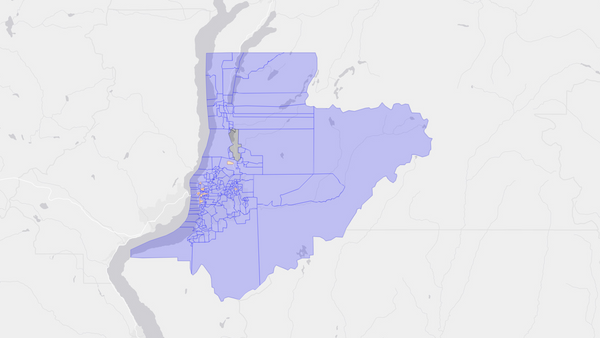
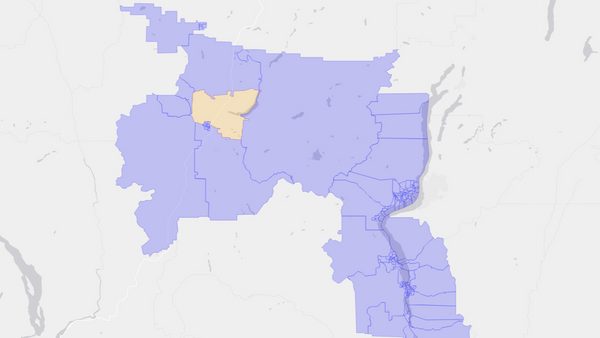
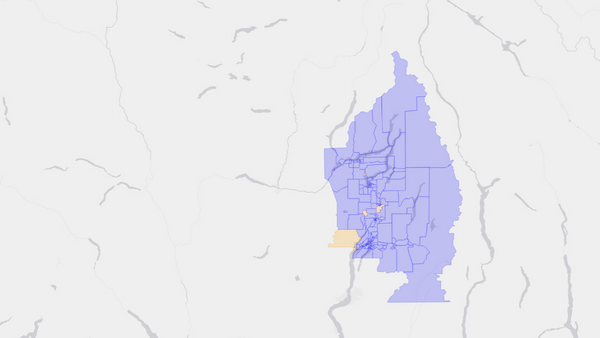
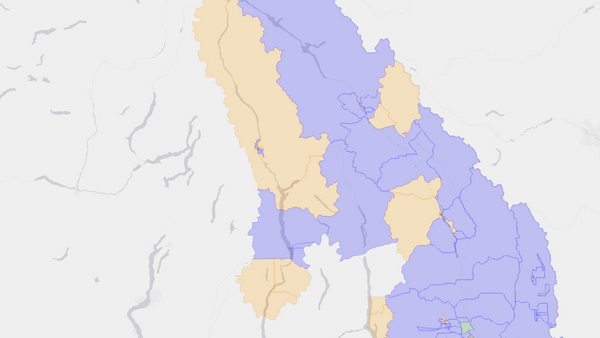
British Columbia Southern Interior, BC — 2011 Federal Election Results Map
British Columbia Southern Interior — 2011 Election Results
📌 The Canadian federal electoral district of British Columbia Southern Interior was contested in the 2011 election.
🏆 Alex Atamanenko, the NDP-New Democratic Party candidate, won the riding with 25,206 votes (51.0% of the vote).
🥈 The runner-up was Stephen Hill (Conservative) with 19,273 votes (39.0%), defeated by a margin of 5,933 votes.
📊 Other notable candidates: Bryan Hunt (Green Party, 6%).
Riding information
Auto generated. Flag an issue.British Columbia Southern Interior
British Columbia Southern Interior was a federal electoral district in the mountainous southeastern corner of the province, encompassing the West Kootenay region and portions of the southern Okanagan and Boundary Country. The riding stretched from the Similkameen Valley communities of Princeton and Keremeos through the fruit-growing towns of Oliver and Osoyoos, eastward through Grand Forks and the historic mining centres of Rossland, Trail, and Nelson, and northward along the Arrow Lakes to include Castlegar, Kaslo, New Denver, and Slocan. The landscape was defined by deep river valleys, mountain ranges, and a chain of lakes carved by glaciers.
Candidates
Alex Atamanenko (NDP)* — Born on January 24, 1945, in New Westminster, Atamanenko was educated at the University of British Columbia and the University of Toronto, earning a Bachelor of Physical Education, a teaching diploma, and a Master of Arts in Russian. Of Ukrainian-Russian heritage, he taught Russian, French, and English at schools across Canada and the United States before settling in the BC interior. He first ran in the riding in 2004, losing narrowly to incumbent Conservative Jim Gouk, then won decisively in 2006 after the Conservative replacement candidate, Derek Zeisman, was disowned by the party over smuggling charges and finished third. Atamanenko was re-elected in 2008 and won his third consecutive victory in 2011 with approximately 52 percent of the vote.
Stephen Hill (Conservative) — Hill was the Conservative candidate from the Rossland area. He campaigned on the Conservative government's economic record and resource development but drew controversy during the campaign for remarks made at a trade forum in Nelson that included dismissive comments about some attendees, for which he later apologized. Hill finished second with approximately 38 percent of the vote.
Bryan Hunt (Green Party) — Hunt was the Green Party candidate in the riding, finishing with about 6.4 percent of the vote in a region with strong environmental awareness.
Shan Lavell (Liberal) — Lavell carried the Liberal banner in the riding but finished a distant fourth with approximately 3.8 percent of the vote, reflecting the party's near-total collapse in interior BC.
About the Riding
British Columbia Southern Interior was a region of striking geographic and cultural contrasts. The western portion of the riding, in the Similkameen and South Okanagan, shared the fruit-growing and wine-producing character of the broader Okanagan region, with orchards, vineyards, and tourism supporting the communities of Oliver and Osoyoos. To the east, the West Kootenay region had a markedly different identity, shaped by a century of mining and smelting history and by the cultural legacy of communities including Doukhobor settlers who had established themselves around Castlegar and the surrounding area in the early twentieth century.
Trail was home to the Teck Cominco lead-zinc smelter, one of the largest industrial operations in the interior and a major employer for the surrounding communities of Rossland, Warfield, Montrose, and Fruitvale. Nelson, the largest community in the West Kootenay, had reinvented itself as a cultural and artistic hub, attracting counterculture residents, outdoor recreation enthusiasts, and small business entrepreneurs. The city's progressive political culture and heritage architecture made it a distinctive community within the riding. Castlegar, at the confluence of the Kootenay and Columbia Rivers, served as a transportation hub and was home to Selkirk College.
The riding's political leanings reflected its working-class roots and progressive values. The West Kootenay in particular had a long tradition of labour activism and support for the NDP, rooted in the mining and smelting industries. Alex Atamanenko had built a loyal following through his focus on local issues including organic agriculture policy, opposition to genetically modified organisms, environmental protection of the Columbia River watershed, and support for small-scale farming. His personal style — approachable and grounded in community — resonated with the riding's independent-minded electorate.
The 2011 election reinforced the NDP's hold on the riding, with Atamanenko benefiting from both his personal incumbency and the national Orange Wave. The Conservative challenge under Stephen Hill was weakened by his campaign trail missteps, while the Liberals were reduced to near irrelevance in the riding. Atamanenko retired before the 2015 election, closing a chapter of NDP representation in a riding that was subsequently redistricted into Kootenay—Columbia and South Okanagan—West Kootenay.