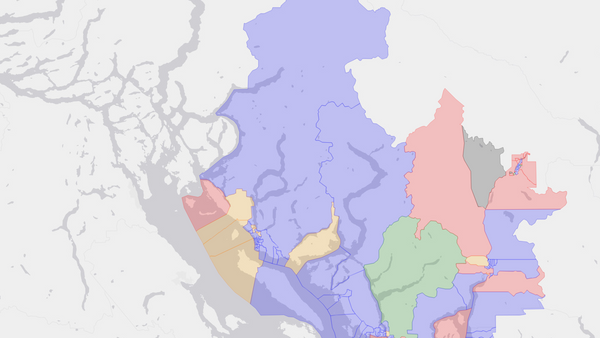
Chilliwack—Fraser Canyon, BC — 2008 Federal Election Results Map
Chilliwack—Fraser Canyon — 2008 Election Results
📌 The Canadian federal electoral district of Chilliwack—Fraser Canyon was contested in the 2008 election.
🏆 Chuck Strahl, the Conservative candidate, won the riding with 29,198 votes (62.3% of the vote).
🥈 The runner-up was Helen Kormendy (NDP-New Democratic Party) with 8,791 votes (18.8%), defeated by a margin of 20,407 votes.
📊 Other notable candidates: Barbara Lebeau (Green Party, 9%) and Myra Sweeney (Liberal, 9%).
Riding information
Auto generated. Flag an issue.Chilliwack—Fraser Canyon
Few British Columbia ridings covered so much ground for so few voters. Almost the whole electorate lived at the southern end, in the city of Chilliwack and the farmland of the eastern Fraser Valley. From there the boundaries climbed north through Hope and the walls of the Fraser Canyon past Boston Bar and Lytton, followed the Thompson to Spences Bridge, Ashcroft and Cache Creek, and reached west to Lillooet and the Bridge River country. Agassiz and the District of Kent occupied the middle ground below Mount Cheam.
Candidates
Chuck Strahl (Conservative) — Strahl worked in his family's Chilliwack-area logging and road-building firm before winning Fraser Valley East for Reform in 1993, and had represented the area continuously since, the district taking its current name and shape in 2004. He served as deputy speaker from 2004 to 2006, entered Stephen Harper's first cabinet as minister of agriculture and agri-food in February 2006, and moved to Indian affairs and northern development in August 2007. In June 2008 he steered the Tsawwassen First Nation treaty legislation and the bill establishing a specific claims tribunal through Parliament, in the month the residential schools apology was delivered in the Commons.
Helen Kormendy (NDP) — A councillor in the Village of Ashcroft, Kormendy had worked as a social worker in child protection and family support and as a mediator for divorcing couples. A lifelong New Democrat, she campaigned on the argument that federal decision-making had tilted too far toward corporate interests.
Barbara Lebeau (Green) — A court transcriptionist from Hope, Lebeau carried the Green nomination in a riding whose canyon communities lived on forestry and highway traffic.
Myra Sweeney (Liberal) — An institutional parole officer with roughly seven years in corrections, living in Abbotsford, Sweeney had run here for the Liberals in 2006 and finished third. She used her working experience to argue that the Conservative approach to crime ignored the mental illness and addiction behind much of it.
Harold J. Ludwig (Christian Heritage Party) — A retired businessman from Abbotsford, Ludwig stood for the Christian Heritage Party, which had contested the seat at each of the previous general elections.
Dorothy-Jean O'Donnell, a lawyer from Hope, appeared on the ballot for the Marxist-Leninist Party for the third consecutive election.
About the Riding
Chilliwack sits on the alluvial soil of the Fraser floodplain, and the valley floor around it carries one of the densest concentrations of dairy barns, poultry sheds, corn silage and berry fields in Canada. Growers spent the summer of 2008 absorbing sharply higher feed and fertilizer bills, which gave the argument over carbon pricing an edge here that it lacked in the cities — the provincial carbon tax had taken effect on 1 July, and the federal Liberals were proposing one of their own.
The city was also changing shape. Buyers priced out of Metro Vancouver were pushing subdivisions toward the mountain benches, and the former Canadian Forces Base Chilliwack, wound up in 1997, had been rebuilt as Canada Education Park, shared by the RCMP's Pacific Region Training Centre, the Justice Institute of British Columbia and a campus that became part of the University of the Fraser Valley when the province granted the institution full university status in the spring of 2008. Flood works stayed near the top of the municipal agenda after the province funded urgent dike raising ahead of the anxious 2007 freshet.
North of Hope the riding becomes another country. The canyon corridor squeezes the Trans-Canada Highway and both transcontinental railways through terrain with almost no flat ground, and its settlements live on logging, ranching, road maintenance and passing traffic. The Fraser food fishery matters intensely there, and the treaty and claims files that occupied the riding's own member in cabinet were live local business rather than abstractions — Sto:lo communities on the valley floor and the canyon nations upriver had long-standing interests in both. The southern end of the riding had meanwhile become one of the more culturally mixed parts of the Fraser Valley.