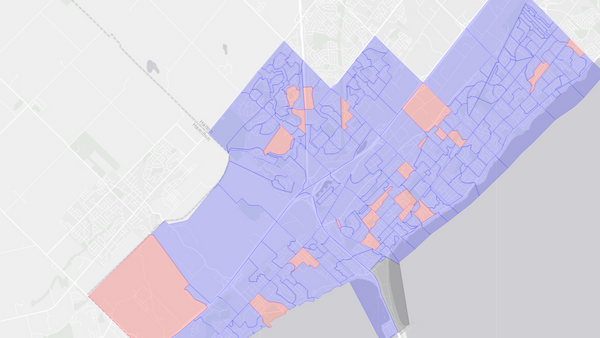
Hamilton East—Stoney Creek, ON — 2008 Federal Election Results Map
Hamilton East—Stoney Creek — 2008 Election Results
📌 The Canadian federal electoral district of Hamilton East—Stoney Creek was contested in the 2008 election.
🏆 Wayne Marston, the NDP-New Democratic Party candidate, won the riding with 19,919 votes (41.3% of the vote).
🥈 The runner-up was Larry Di Ianni (Liberal) with 13,455 votes (27.9%), defeated by a margin of 6,464 votes.
📊 Other notable candidates: Frank Rukavina (Conservative, 24%).
Riding information
Auto generated. Flag an issue.Hamilton East—Stoney Creek
Created for the 2004 election out of the old Hamilton East and Stoney Creek seats, this riding covered the part of Hamilton lying north of the Niagara Escarpment and east of Ottawa Street, then continued along the Lake Ontario shore through the former City of Stoney Creek as far as Winona. Dense pre-war streets in the west gave way to the harbour-side industrial lands, then to postwar and newer subdivisions spreading east.
Candidates
Wayne Marston (NDP) — Marston was born in Sisson Ridge, New Brunswick, in 1947 and had lived in Hamilton for some four decades. He retired from Bell Canada in 1995, led the Hamilton and District Labour Council as president for eleven years, and sat as a Hamilton-Wentworth District School Board trustee from 2000 until his election to Parliament. He contested the former Hamilton East riding three times against Liberal cabinet minister Sheila Copps — in 1993, at a by-election in 1996 and in 1997 — before taking the new seat in 2006 from Liberal incumbent Tony Valeri. In the 39th Parliament he served as the New Democrats' human rights critic and worked on legislation to protect the pensions of workers whose employers became insolvent.
Larry Di Ianni (Liberal) — Di Ianni taught high school for the Hamilton-Wentworth Catholic board and retired as a secondary school principal, holding a master's degree in education. He was first elected to Stoney Creek council in 1982 and served six terms there, won a Hamilton council seat in 2000 after amalgamation, and served as mayor from 2003 until his defeat by Fred Eisenberger in the 2006 municipal election. He was working as a consultant when he took the Liberal nomination, and his name was the best known on the ballot.
Frank Rukavina (Conservative) — Rukavina, a project coordinator from Hamilton, had also been the Conservative candidate here at the previous general election.
David William Hart Dyke (Green Party) — Hart Dyke was an editor living in Stoney Creek.
Gord Hill, a printer, ran for the Progressive Canadian Party, and Sam Cino, a construction worker from Stoney Creek, ran as an Independent.
About the Riding
The western end of the riding was Hamilton's industrial waterfront. ArcelorMittal Dofasco, Hamilton's largest private-sector employer with a workforce of roughly 5,000, had its works here, and the former Stelco plant — under United States Steel ownership since the end of October 2007 — stood just across the riding boundary to the west. Both fed an economy that had been shedding manufacturing jobs for years and faced a weaker order book as the autumn's financial crisis spread. Port facilities on Hamilton Harbour connected the mills to Great Lakes and St. Lawrence Seaway shipping.
The largest physical change in the area was less than a year old. The Red Hill Valley Parkway opened to traffic on 17 November 2007 at a cost of roughly $245 million, ending a fight over the valley that had run for decades. It linked the Lincoln M. Alexander Parkway on the mountain to the Queen Elizabeth Way near the harbour, and its supporters in the east end had argued throughout that it would open industrial and commercial land.
Stoney Creek had a different character again: commercial strips and big-box development along the QEW, lakeshore residential growth, and a fruit-growing fringe around Fruitland and Winona steadily giving way to housing. Battlefield House and the monument commemorating the engagement of June 1813 stood at the community's centre, and a large Italian-Canadian population shaped much of its small business and community life.
Federally, the weight fell on the security of industrial pensions and severance in insolvency, employment insurance eligibility for workers facing layoff, the conditions imposed on foreign purchasers of Canadian steel assets, and infrastructure money for a municipality that had just absorbed the cost of a major expressway.