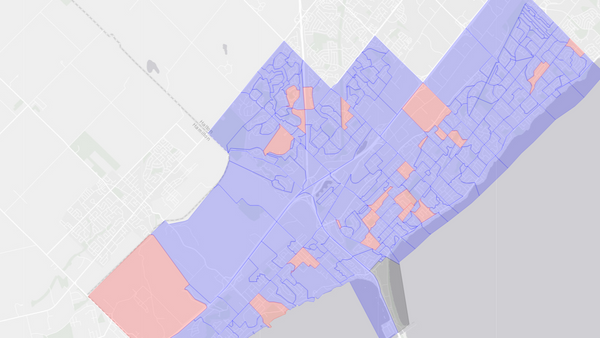
Hamilton Centre, ON — 2008 Federal Election Results Map
Hamilton Centre — 2008 Election Results
📌 The Canadian federal electoral district of Hamilton Centre was contested in the 2008 election.
🏆 David Christopherson, the NDP-New Democratic Party candidate, won the riding with 20,010 votes (49.3% of the vote).
🥈 The runner-up was Leon O'Connor (Conservative) with 9,051 votes (22.3%), defeated by a margin of 10,959 votes.
📊 Other notable candidates: Helen M. Wilson (Liberal, 18%) and John Livingstone (Green Party, 9%).
Riding information
Auto generated. Flag an issue.Hamilton Centre
Hamilton Centre was assembled in 2003 out of pieces of Hamilton East, Hamilton West and Ancaster—Dundas—Flamborough—Aldershot. It took in the lower city between Hamilton Harbour and the Niagara Escarpment, running from Ottawa Street in the east across the downtown to Strathcona and Kirkendall in the west, and it climbed the escarpment face to include a wedge of the west mountain above the brow. The North End, Keith, Gibson, Durand and the central business district all sat inside it.
Candidates
David Christopherson (NDP) — Christopherson had held elected office in Hamilton almost continuously since 1985, when he won a seat on city and regional council. In 1990 he unseated the Liberal member for Hamilton Centre at Queen's Park, Lily Oddie Munro, who had served in David Peterson's cabinet, and he went on to serve in Bob Rae's government as Solicitor General and as Minister of Correctional Services. After running for mayor of Hamilton in 2003 he took the new federal seat in 2004 against Stan Keyes, the sitting Liberal member for the abolished Hamilton West riding and then Minister of National Revenue, and he held it in 2006. Through the 39th Parliament he carried the New Democrat files on cities and community infrastructure, on labour and on steel, and sat as deputy chair of the parliamentary steel caucus.
Leon O'Connor (Conservative) — O'Connor, a Hamilton teacher, was not new to local ballots. He had contested Hamilton West for the Canadian Alliance in 2000 and Hamilton Centre for the Conservatives in 2004.
Helen M. Wilson (Liberal) — Wilson, a retired resident of Dundas, ran for the Liberals in a seat the party had not won since its creation.
John Livingstone (Green Party) — Livingstone, a director of operations, had also carried the Green banner in the riding at the previous general election.
Anthony Giles filed for the Libertarians, Lisa Nussey for the Marxist-Leninist Party and Ryan Sparrow for the Communist Party.
About the Riding
Steel set the terms of local argument. The former Stelco works on the bayfront, inside the riding, had passed to United States Steel at the end of October 2007, a purchase cleared under the Investment Canada Act on the strength of undertakings about production and employment. Whether those undertakings would hold as orders softened through 2008 was asked openly at the plant gates. Immediately east of the riding boundary stood ArcelorMittal Dofasco, with roughly 5,000 employees the largest private-sector employer in the city, and between the two integrated producers and their supply chains a substantial share of working Hamilton drew its living from the industry.
The Port of Hamilton, the busiest Canadian port on the Great Lakes, moved iron ore, coal, salt and grain across piers within and next to the riding. Away from the water the employment base was health care, education, social services, municipal and provincial administration, and retail.
Downtown Hamilton in 2008 held visible contrasts. City Hall, the Farmers' Market, the central library and the Hamilton GO Centre all sat inside the riding, and James Street North had begun to draw galleries, studios and small restaurants into storefronts that had stood empty for years. The same riding contained the lower-city neighbourhoods with the city's heaviest concentrations of poverty, rooming-house stock and food-bank use.
Those two realities shaped what mattered federally: access to employment insurance for laid-off industrial workers, the security of company pensions when an employer became insolvent, money for affordable housing, and the conditions attached to foreign takeovers of Canadian steel producers.