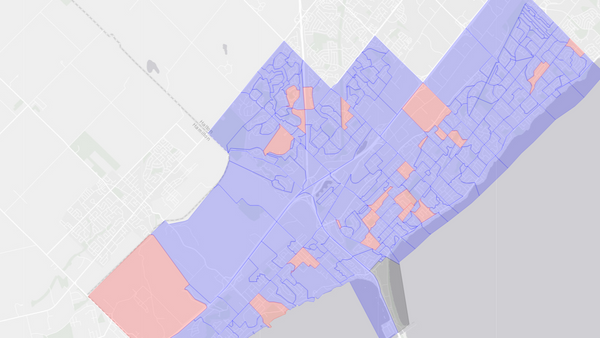
Ancaster—Dundas—Flamborough—Westdale, ON — 2008 Federal Election Results Map
Ancaster—Dundas—Flamborough—Westdale — 2008 Election Results
📌 The Canadian federal electoral district of Ancaster—Dundas—Flamborough—Westdale was contested in the 2008 election.
🏆 David Sweet, the Conservative candidate, won the riding with 26,297 votes (46.5% of the vote).
🥈 The runner-up was Arlene MacFarlane-VanderBeek (Liberal) with 15,322 votes (27.1%), defeated by a margin of 10,975 votes.
📊 Other notable candidates: Gordon Guyatt (NDP-New Democratic Party, 17%) and Peter Ormond (Green Party, 9%).
Riding information
Auto generated. Flag an issue.Ancaster—Dundas—Flamborough—Westdale
McMaster University sits near the middle of this riding, and much of its character radiates outward from there. The seat covers the former municipalities of Ancaster, Dundas and Flamborough, folded into Hamilton in the 2001 amalgamation that combined six municipalities into a city of roughly 490,000, together with the Westdale and Ainslie Wood neighbourhoods beside the campus. Hamilton's industrial lower city and harbour lie outside its boundaries.
Candidates
David Sweet (Conservative) — Born in Kingston on 24 June 1957, Sweet built a career in business before politics, running a management consulting and corporate training practice for seventeen years and serving as founding president of the Canadian Association of Professional Speakers in 1996. He won the Conservative nomination here in 2004 against John Bryden, the sitting member who had crossed from the Liberals, then lost the general election to Liberal Russ Powers; he came back to beat Powers on 23 January 2006. In his first term he was vice-chair of the public accounts committee and sat on the veterans affairs committee and the subcommittee on international human rights. On 22 June 2006 he obtained the unanimous consent of the Commons for a motion granting the Dalai Lama honorary Canadian citizenship.
Arlene MacFarlane-VanderBeek (Liberal) — MacFarlane-VanderBeek sat on the council of the Town of Dundas in the years before amalgamation ended the town's independent government, and worked in communications and public affairs. Her campaign leaned on that municipal record and on the Liberal vote that had elected Powers four years earlier.
Gordon Guyatt (NDP) — A physician and professor at McMaster, Guyatt was among the most heavily cited medical researchers in the country; the term evidence-based medicine first appeared in a 1991 editorial he wrote for ACP Journal Club. This was his fourth campaign for the New Democrats in this part of Hamilton, after 2000 in the predecessor riding and 2004 and 2006 here.
Peter Ormond (Green Party) — An environmental consultant, Ormond ran for the Greens, who had been gaining ground in the riding's suburban and rural polls.
Jamilé Ghaddar, a settlement worker, stood for the Marxist-Leninist Party for the second time in the riding.
About the Riding
The territory divides into four distinct pieces. Westdale and Ainslie Wood are dense, walkable and full of students and university staff. Dundas sits in a valley below the Niagara Escarpment with a preserved main street and a strong local identity that survived amalgamation intact. Ancaster spread rapidly through the 1990s and 2000s as new subdivisions filled land above the escarpment, drawing higher-income households. Flamborough is largely rural — Waterdown at the junction of Highways 5 and 6 is its principal centre, with Carlisle, Freelton, Rockton and Copetown scattered across farmland and gravel country to the west.
McMaster is by far the largest single employer, and its medical school, teaching hospitals and research institutes give the local economy a base that Hamilton's manufacturing sector does not. Redeemer University College, on the Ancaster side, is the riding's other post-secondary institution. Conservation land is unusually plentiful for a riding inside a large city: the Dundas Valley, Cootes Paradise and the escarpment waterfalls above Dundas draw visitors from across the region.
The 2008 economy still reached in from outside. United States Steel had bought Stelco in late 2007, and the future of Hamilton steelmaking — jobs, pensions and the commitments attached to a foreign takeover — worried households throughout the western suburbs even though the plants themselves stand in other ridings. Urban boundary expansion onto Flamborough and Ancaster farmland was a live municipal fight with federal echoes in environmental policy, and the carbon tax argument landed differently in commuter subdivisions than it did on campus.