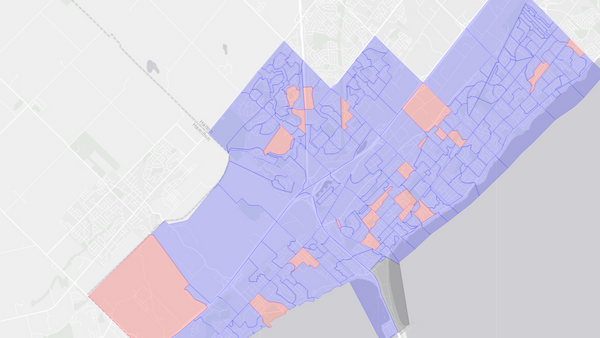
Niagara West—Glanbrook, ON — 2008 Federal Election Results Map
Niagara West—Glanbrook — 2008 Election Results
📌 The Canadian federal electoral district of Niagara West—Glanbrook was contested in the 2008 election.
🏆 Dean Allison, the Conservative candidate, won the riding with 28,089 votes (52.0% of the vote).
🥈 The runner-up was Heather Carter (Liberal) with 12,955 votes (24.0%), defeated by a margin of 15,134 votes.
📊 Other notable candidates: Dave Heatley (NDP-New Democratic Party, 15%) and Sid Frere (Green Party, 7%).
Riding information
Auto generated. Flag an issue.Niagara West—Glanbrook
This riding straddles a boundary most of its residents cross without thinking about it: the line between Niagara Region and the City of Hamilton. On the Niagara side sit Grimsby, the town of Lincoln, West Lincoln township and the town of Pelham; on the Hamilton side lies Glanbrook, the rural southeast corner of the amalgamated city. The Niagara Escarpment cuts across the middle, separating the narrow fruit-growing bench along Lake Ontario from the flatter farmland above it.
Candidates
Dean Allison (Conservative) — Allison was the only person to have held the seat, winning it when it was created in 2004 and again in 2006. He had first run federally in 2000, as the Canadian Alliance candidate in the old riding of Erie—Lincoln. A Beamsville resident with an economics degree from Wilfrid Laurier University, he built up businesses in the Niagara area, worked for a large franchise organisation, and ran a private equity firm backing small companies and start-ups. Outside business he was a founding member of the Canadian arm of the Dave Thomas Foundation for Adoption and of a program that brings children affected by the Chernobyl disaster from Belarus to Canada, chaired the fundraising foundation for West Lincoln Memorial Hospital, led the chamber of commerce in Lincoln, and sat on the boards of the Ontario Trillium Foundation and Junior Achievement Niagara. In the Parliament that ended in September 2008 he served on the public accounts and international trade committees and as vice-chair of the Ontario Conservative caucus.
Heather Carter (Liberal) — Carter was a business manager from Fonthill, in the town of Pelham.
Dave Heatley (NDP) — Heatley was a retired Hamilton resident who ran for the New Democrats.
Sid Frere (Green Party) — A retired school principal living in St. Anns, Frere stood for the Greens.
Dave Bylsma (Christian Heritage Party) — Bylsma was a cabinet maker, also from St. Anns.
About the Riding
Farming here is unusually specialised. The escarpment bench around Beamsville, Vineland and Jordan is Ontario's tender fruit country, producing peaches, pears, cherries and grapes, and it holds one of the densest concentrations of wineries in Canada along the Niagara Wine Route. Commercial greenhouses cluster thickly through the same stretch. Above the escarpment, West Lincoln and the Glanbrook countryside run to cash crops, dairy and poultry, which put supply management and farm income programs on the federal agenda in a way they are not in most southern Ontario ridings. The closure of the CanGro cannery at St. Davids in June 2008, in the neighbouring Niagara Falls riding, hit growers on this side of the boundary hard, since it had been the last processor buying their canning fruit.
Growth pressures pull in the other direction. Grimsby, wedged between the escarpment and the lake on the Queen Elizabeth Way, functions increasingly as a commuter town for Hamilton and the western Greater Toronto Area, and Binbrook in Glanbrook had been absorbing subdivisions since Hamilton's amalgamation. The John C. Munro Hamilton International Airport at Mount Hope sits inside the riding and had built a business as an overnight air cargo hub, which makes airport operations and federal transport regulation a local matter rather than an abstract one.
The Bruce Trail follows the escarpment across the riding, and conservation areas such as Ball's Falls near Jordan support a modest tourism trade. Smithville, Fonthill and Fenwick supply the small-town commercial base for the rural townships.
Manufacturing job losses across the Hamilton area formed the economic backdrop to the campaign, alongside the Liberal proposal to shift taxation toward carbon, which drew particular attention from farmers facing fuel and fertiliser costs.