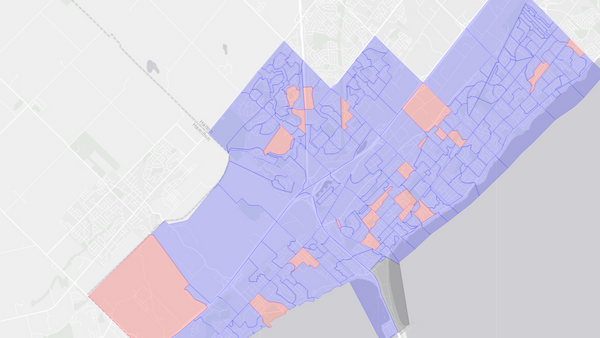
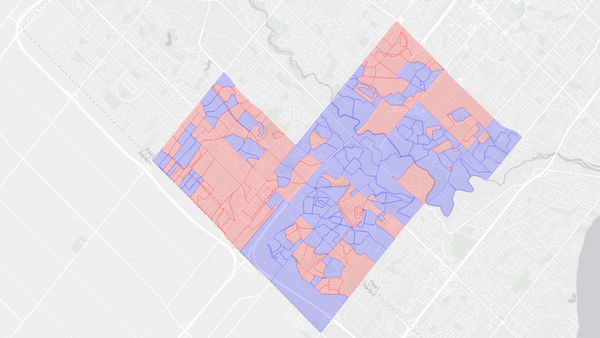
Halton, ON — 2008 Federal Election Results Map
Halton — 2008 Election Results
📌 The Canadian federal electoral district of Halton was contested in the 2008 election.
🏆 Lisa Raitt, the Conservative candidate, won the riding with 32,986 votes (47.5% of the vote).
🥈 The runner-up was Garth Turner (Liberal) with 25,136 votes (36.2%), defeated by a margin of 7,850 votes.
📊 Other notable candidates: Rob Wagner (NDP-New Democratic Party, 9%) and Amy Collard (Green Party, 7%).
Riding information
Auto generated. Flag an issue.Halton
The Halton riding used at the 2004, 2006 and 2008 elections took in only part of the regional municipality whose name it carried. It covered the whole Town of Milton, the part of Oakville lying northwest of Dundas Street, Eighth Line and Upper Middle Road, and the part of Burlington northwest of the Queen Elizabeth Way, Walkers Line, Upper Middle Road, Guelph Line and Dundas Street. Halton Hills, in spite of the name, belonged to Wellington—Halton Hills; the built-up lakeshore of Oakville and Burlington belonged to ridings of their own. What remained was a wedge running from the upper edge of two commuter towns through Milton and out over the Niagara Escarpment to Kilbride and Mount Nemo.
Candidates
Lisa Raitt (Conservative) — Raitt was raised in Sydney, Nova Scotia, took a science degree at St. Francis Xavier University and a master's in chemistry at the University of Guelph, then read law at Osgoode Hall and was called to the Ontario bar in 1998. She trained afterwards with barristers at the Middle Temple in London, working on international trade and transportation. In 1999 she joined the newly created Toronto Port Authority as corporate secretary and general counsel, was named harbourmaster in April 2001, and became president and chief executive officer in 2002, giving up the harbourmaster's duties in 2004. The party appointed her its Halton candidate in September 2008, days after the writs were issued. She had not held elected office.
Garth Turner (Liberal) — Turner went into the campaign as the sitting member, but not for the party that had elected him. He spent about a decade as business editor of the Toronto Sun, also wrote for The Globe and Mail and Maclean's, and published widely read books on real estate and personal finance. He first entered the Commons as the Progressive Conservative member for Halton—Peel in 1988, chaired the Commons committee on consumer and corporate affairs, finished fourth on the opening ballot of the 1993 Progressive Conservative leadership race, and served as Kim Campbell's Minister of National Revenue before losing his seat that autumn. He returned in 2006 as a Conservative, beating Liberal Gary Carr. The Ontario Conservative caucus voted to suspend him on 18 October 2006 over material he had published on his weblog and he was subsequently out of the party altogether, sitting as an independent until he joined the Liberal caucus on 6 February 2007.
Rob Wagner (NDP) — Wagner was a municipal administrator and carried the New Democratic nomination.
Amy Collard (Green Party) — Collard, of Burlington, gave her occupation as full-time volunteer.
Tony Rodrigues, a Milton bus driver, stood for the Christian Heritage Party.
About the Riding
Growth organised everything else. Milton counted 53,939 residents at the 2006 census, up 71.4% in five years and the fastest rate of any municipality in Canada, and the subdivisions kept pushing north and east of the old town core. Schools, water and wastewater capacity, arterial roads and hospital services all trailed the population curve, which made federal infrastructure transfers and the municipal share of the gas tax concrete local questions.
The riding's working geography was the commute. Highways 401 and 407 crossed it, and GO's Milton service ran over freight-owned track that carried only weekday peak-period trains into Toronto. The draft regional transportation plan Metrolinx released in September 2008 proposed two-way all-day rail service to Milton within fifteen years.
North and west of the built-up area the land climbs into escarpment country — conservation land, aggregate operations and rural concession roads through north Burlington and north Milton — which set hard limits on where development could go. Households skewed young, heavily mortgaged and dependent on the drive to work in Mississauga, Toronto and Hamilton, so the credit crisis unfolding through September and October and the argument over the Liberal carbon-tax proposal both had an obvious local edge.