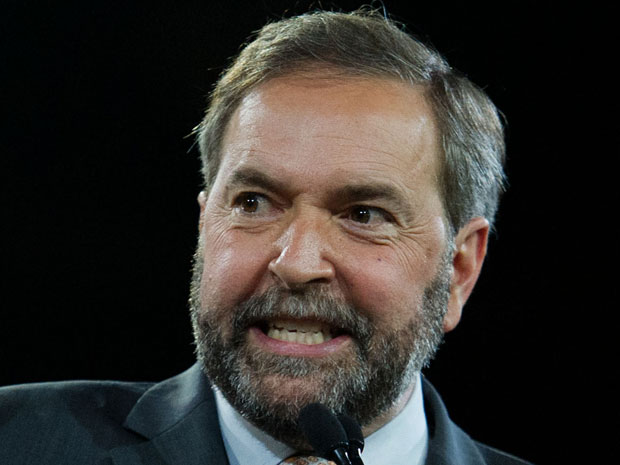
Seven Months, 131,000 members, 69,000 votes, 4 ballots, Thomas Mulcair: 57%. This past weekend in Toronto, the federal New Democrats elected the next leader of their party and Her Majesty’s Leader of the Loyal Opposition. Riding the so-called Orange Wave to an unprecedented 103 seats in the 41st General Election, NDP spirits were buoyed at convention despite the purpose of their task, to replace the much-beloved Jack Layton, who passed away last year.
For all of the hype and hope, the convention was marred by low voter turnout. Out of 131,000+ members, only 69,000 of them voted and many of those votes were aggravated over the course of the day of voting as voting systems jammed. For comparison’s sake, in 2004, 67,000 votes were cast for Stephen Harper’s leadership among Conservatives on the first ballot. As press gallery reporters look to flat-tires on campaign buses as metaphors for electoral viability, the voting issues did not help Canadians see confidence in the NDP.
In the end, NDP members chose Thomas Mulcair, however, today the party is divided. Mulcair’s chief rival, Brian Topp, was the pick of many Layton loyalists, organized labour and the old-guard of the party. Indeed, Ed Broadbent’s characterization of Mulcair during the leadership race has caused division among the ranks.
Thomas Mulcair was seen as a darkhorse candidate from Quebec. His bio describes him as a former provincial Liberal cabinet minister, and reports have linked his interests to Conservative Party candidacy, Mulcair can be described as a political chameleon. Many will doubt his sincerity as a leader of social democrats. Maclean’s magazine recently opined that he is more accurately described as a Liberal that would rather defend the status quo than agitate for social change. His supporters weren’t the dyed-in-the-wool NDP partisans, but more so they were those attracted to the spectacle of politics.
Will Thomas Mulcair lead the NDP to greater electoral fortunes? In 2003, the conservative family was split between two major parties: the Progressive Conservatives under Peter MacKay and the Canadian Alliance under Stephen Harper. Mulcair may see a path to victory by building a formal coalition of sorts between the Liberal Party and the NDP. With mergers and cooperation, Stephen Harper was the ideologue, while the PC party the centrists. If polarization of the electorate is to serve the NDP, the formula may not be correct as Mulcair is leading as a non-ideological centrist perhaps looking to broker an arrangement with a weaker centrist party.
Politically who benefits and loses from a Mulcair victory?
Mulcair’s appeal to a certain part of the NDP’s traditional base may be shaky. Mulcair is seen more of a patrician than a man-of-the-people. Critics have called him cold and arrogant. To connect with blue-collar (Joe and Jane Lunch-bucket) types, the French-cuff-shirted image Mulcair carries may benefit the Conservatives. Mulcair risks losing touch with the type of middle-class clock-punching Sun-reading populists.
Geographically, the Mulcair NDP will be very competitive in Quebec further retrenching the traditional positions of the Liberal Party and the Bloc. The last bastions of strong Liberal support are Montreal and Toronto. Mulcair’s riding is in downtown Montreal. Westerners will perceive an urban elitist Quebecker lecturing their region on energy policy and the oilsands. Mulcair was a former resource minister in Charest’s cabinet who allegedly resigned on environmental principles. Pipeline politics is not only a major factor in the American Presidential election cycle, but here too in Canada. The Northern Gateway pipeline is a major sticking point in BC and Alberta. Mulcair’s leadership will fix the geographic and issue focal point too far East and too far disconnected for Western sentiment. Where the NDP is competitive therefore, is not where the Conservatives are competitive. Under Mulcair’s leadership, the NDP is competitive where they find the Liberals as their chief rival.
The NDP and the Conservatives see common goal in the elimination of the Liberal Party. Mulcair can help achieve this by showing impressive opposition to Stephen Harper’s government in a majority leaving the over-covered Liberal Party with less airtime. He can also start appealing to common left-leaning principles to make them the brand of the NDP. Viable electability for the NDP will not just come through recasting the Conservative scandal-of-the-week to the Ottawa press (a strategy that failed Ignatieff) but voters will be attracted to specific hallmark policies that the NDP now must craft for more than 25% of the electorate (and haphazard Quebec voters). Mulcair must avoid the elitist label and speak on pocketbook issues in order to protect NDP gains.
Winning with only 57% of the vote on the final ballot and with a bellicose Topp holding on to the bitter end just to oppose a Mulcair leadership, the victor has fences to mend in his party. Though a new party leader has the prerogative of filling his office with his own loyalists, he’ll have to handle the inevitable departure of senior figures with as much grace as possible. Mulcair also faces the possibility of losing the labour segment of the NDP base. Though CUPE eventually endorsed the new NDP leader, most of the other unions supported Topp (some were for Nash then Topp). The Liberal strategy moving forward should be to capture disgruntled union stakeholders and bring them into Liberal decision making processes. The CAW famously left Layton for Martin during the 2004 election and a former socialist premier of Ontario might be the one to bring them back into the smaller red tent.
The Conservative strategy on Mulcair will be to encourage those that dislike Harper to fall into Mulcair’s camp at the expense of the Liberals because the Harper Tories still see the Liberals as their chief rivals. As for the votes the Conservatives can get, their main message will be jobs and the economy and tht theirs is the only party that is focusing on the same while the other parties focus on special interests and themselves.