Could the last supporter of small government turn off the lights when they leave?

So, Canada’s New Nanny™ banned light bulbs today. Today, Natural Resources Minister Gary Lunn announced that the government would force retailers to phase out incandescent light bulbs by 2012.

This kind of action is actually counter productive to our progress and to the development of even greener technologies. By tying the invisible hand of the market, the Canadian government has in effect created an artificially high demand in fluorescent lights instead of letting Edison-style incandescents compete with the swirly fluorescents in the marketplace. The inefficient bulbs banned today cost seven times less than the fluorescent variety. Indeed, cost itself poses the problem. By removing incandescent bulbs from the marketplace, the government is removing competition. Now, manufacturers of fluorescent bulbs do not face competing pressure from the incandescent demand. Thus, there is less incentive to make a cheaper and even more efficient fluorescent bulb now that the government has removed its competition from the shelves. Over the long term, we may have in fact stunted the development of cheaper and more efficient means of illumination.

Some may argue that over time, due to energy savings, fluorescent bulbs have better value than incandescents. If this is the case, there is already incentive to switch over. I would rather the government give 100% tax credits on fluorescent light bulb purchases than have it ban me from making my own consumer choices.

Today, I am a little disappointed in my Conservative Party. This is also the same party that two short years ago argued that banning trans-fats was counter to the principles of consumer choice. By one extension, this light bulb decision is even counter to the government’s position on the long gun registry. In 2012, bureaucrats won’t have light bulbs to register. No, by 2012, the government will have thankfully banned harmful incandescent bulbs and the only ones that you’ll be able to find will be on the black market. This isn’t the party that favours government regulations, bans, and registrars is it?

Further, what secondary effects can are we not considering? Studies have shown that children exposed to fluorescent light were statistically more likely to develop hyperopia (far-sightedness). Children under the age of two whose rooms were lit with fluorescent lighting are more likely to develop astigmatism. Fluorescent lighting has also been shown to heighten the symptoms of agoraphobia.

So, the government has decided to ban light bulbs to appease the growing hysteria that, some might say, stems from the left-wing need for global social and economic reconfiguration. Granted, the ban will have a measured benefit in the short term. But, for reasons I’ve outlined above, it is best for the consumer to make such a decision because the market has shown a great talent for addressing consumer needs, whatever they may be.

If a lightbulb is turned on in Timmins, will a tidal wave hit Japan?
Who will sing a folk song for the women of Afghanistan?

There are times when I cannot understand the logical path that the left takes in order to come to some of their conclusions.

For example, the other day, Stephane Dion floated a trial balloon on his idea that perhaps instead of handing Taliban detainees over to the Afghan people, we should import them and detain them here in Canada!

Nevermind that Dion and Jack Layton’s activist base have been advocating for the release of men linked to al Qeada in Canada and held on security certificates. They advocate that if we can’t deport them back to the backward countries that may torture them, we shouldn’t detain them here but rather release them into the public. Now, consider Dion’s plan: import Taliban fighters for detaining, and failing the stomach to detain them — the logical progression and historical record goes — release them into the general Canadian public when leftwing activists condemn the Canadian government for holding combatants without charge.

Most times, while logic is lacking, left-wing positions can often be explained by a sense of self-loathing as these revolutionaries are dyspeptic of their presence in our modern Western civilization.

Let’s look deeper into the intellectual pretzel of Dion and Layton’s crowd.

In a March 2007 article in the Globe and Mail, Amir Attaran wrote:

Transport our detainees from Afghanistan to prisoner-of-war camps in Canada. This sounds awful, but that is a shrill and unhistorical analysis. Starting in June of 1940, Canada transported about 40,000 German and Italian enemy combatants to this country and held them in camps in Alberta, Ontario and Quebec. Those enemies were treated humanely. They were fed even as Canadians suffered under food rationing. They were given democracy classes, so they could spread those ideas in their fascist homelands. When the war ended, they went home; some returned as immigrants.

All of this was expensive, but Mackenzie King decided Canada should uphold the Geneva Conventions — and we did.

Not only would this option show Canada at our humanitarian best, but it poses vital questions. If Mackenzie King could imprison 40,000 European enemies without devastating Canada’s war effort, then how can it be seriously contended that Stephen Harper cannot now imprison roughly 40 Afghan enemies (the number detained by the Canadian Forces from 2002 through mid-2006)? Mr. O’Connor says the Canadian Forces will always follow the Geneva Conventions. If that’s so, why does the military fail to provide Geneva protections to 0.1 per cent of detainees, compared to the Second World War historical norm?

The heart-rending answer to these questions appears to be race. Canada’s inability to treat European and Afghan enemies on equal terms indicates that our military and foreign-policy establishment may still be dominated by a Eurocentric ethos. The current detainee policy suggests a subterranean racism that lags decades behind Canada’s contemporary reality as a multicultural state.

A primary concern for the Allies and Canadian forces during the Second World War was that Germans and Italians would escape or be liberated by their comrades and rejoin the fight. The removal of 40,000 prisoners from the European theater made sense strategically. If Canadians have captured 40 Taliban fighters, this number is certainly more manageable (and less significant of a strategic concern) when it comes to detainment.

Layton and Dion and their supporters on the left are inconsistent when it comes to their claimed ideology of rights and their policy position that we ought to pull out of Afghanistan. Why do these leaders want to abandon the Afghan mission when the alternative is unthinkable from a human rights perspective? To the Liberals, was the Charter a practical document for Canadian rights or does it represent a global ideal? Women in parliament? Girls in schools? The crackdown by the Taliban would be horrendous if Canada left. In fact, why was World War II worth the fight and why would Layton and Dion suggest that we shirk our responsibility to stop fascism in Afghanistan? Is it the Eurocentric ethos of the NDP and Liberal Party? Or is it more consistent with the trend of reductio ad americanum practiced by the left?

Who is Amir Attaran? Unfortunately, he’s close to the only seemingly sane faction of the Liberal Party. The Globe and Mail provides some information:

Amir Attaran, now Canada research chair in law, population health, and global development policy at the University of Ottawa, was a research fellow at the Kennedy School during Mr. Ignatieff’s time at the Carr.

He ran afoul of an influential faculty member and the school’s administration over a line of academic inquiry he insisted on pursuing, and found himself about to be booted out.

He brought his troubles to Mr. Ignatieff, who gave him office space and mentoring support until he could find another academic home. “Michael stuck up for me against some extremely nasty attacks,” Prof. Attaran says.

Tous ensemble in a twisted stew of self-loathing. It is illogical to suggest that we must transport Taliban fighters to protect them from torture while advocating that we withdraw from Afghanistan leaving women and vulnerable minorities to certain dehumanization.

Canada is in Afghanistan to enable the vulnerable to stand up, but we must also work to protect the human rights of all Afghanis. While war never happens as planned and calls for constant refinements to operations on the ground, we must always work towards maintaining our fundamental principles of freedom, democracy and the rule of law so that others may enjoy them too.

CBC Fauxtography

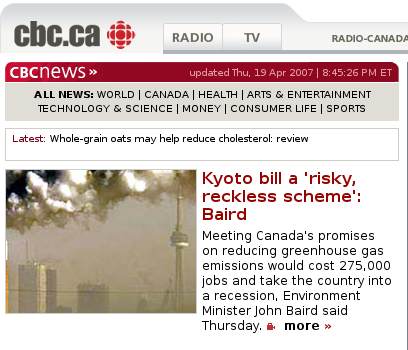
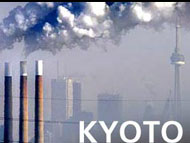
Kate McMillan did some fantastic work yesterday uncovering image manipulation by the Canadian Broadcasting Corporation on an April 19th story about the government’s sobering Kyoto costing. McMillan discovered that the CBC had cropped and applied a photoshop “dirty” filter to an image of smokestacks in Toronto to accentuate environmental damage. Not only was the juxtaposition of pollution and a story on Kyoto costing inappropriate (a less but still inappropriate image would have been a photoshopped stack of papers stamped “Kyoto” crushing the piggy bank of a Canadian family) but to manipulate an image to reflect a editorial point of view is downright unethical. The image was also used in a news story back on February 14th.

top-kyoto.jpg
Pre-photoshop image

cbckyoto.jpg
Screen-capture of April 19th story

Not only is the photoshopping unethical, it violates CBC’s own Journalistic Standards and Practices:

From section III, subsection 2:

Accuracy

The information conforms with reality and is not in any way misleading or false. This demands not only careful and thorough research but a disciplined use of language and production techniques, including visuals.

Integrity
The information is truthful, not distorted to justify a conclusion. Broadcasters do not take advantage of their power to present a personal bias.

Of course, this isn’t the first time that agents of news organizations have manipulated images dishonestly to exaggerate the news in order to convince others of their worldview. News organizations ought to be dispassionate observers and reporters of events and never should have an agenda of convincing the audience of the merits of any particular agenda.