Skeena—Bulkley Valley, BC — 2025 Federal Election Results Map
Skeena—Bulkley Valley — 2025 Election Results
📌 The Canadian federal electoral district of Skeena—Bulkley Valley was contested in the 2025 election.
🏆 Ellis Ross, the Conservative candidate, won the riding with 21,202 votes (47.2% of the vote).
🥈 The runner-up was Taylor Bachrach (NDP-New Democratic Party) with 17,677 votes (39.3%), defeated by a margin of 3,525 votes.
📊 Other notable candidates: Inderpal Dhillon (Liberal, 11%).
Riding information
Auto generated. Flag an issue.Skeena—Bulkley Valley
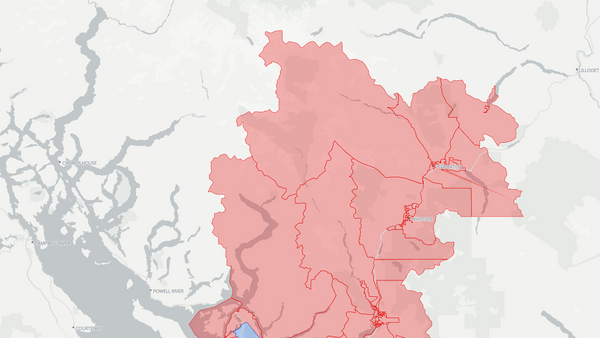
Skeena—Bulkley Valley is British Columbia's largest federal riding, occupying the northwest quarter of the province. The riding stretches from the archipelago of Haida Gwaii in the Pacific to the lakes and forests of the Bulkley-Nechako region inland, and from the Alaska Panhandle border in the north to the northern reaches of the Central Coast. Major communities include the port city of Prince Rupert, the regional service centre of Terrace, the aluminum smelter town of Kitimat, and the Bulkley Valley towns of Smithers, Houston, and Burns Lake. The riding has the highest proportion of Indigenous residents of any federal constituency in British Columbia.
Candidates
Ellis Ross (Conservative) is Haisla and grew up on the Haisla Nation reserve in Kitamaat Village near Kitimat. He became the Haisla Nation Council's first full-time councillor in 2003 and was elected Chief Councillor in 2011, during which time he negotiated resource development agreements including a major LNG deal. Inducted into the Order of British Columbia in 2014, Ross entered provincial politics in 2017, winning the Skeena riding as a BC Liberal MLA. He was re-elected in 2020 and ran for the BC Liberal leadership in 2021, finishing second. He resigned his provincial seat to run federally.
Taylor Bachrach (NDP) served as the Member of Parliament for Skeena—Bulkley Valley from 2019 to 2025. A Smithers resident, Bachrach began his political career on Telkwa's municipal council in 2008 before serving as mayor of Smithers from 2011 to 2019, winning re-election twice. He holds a background in communications and ran a communications business. In Parliament, he served as the NDP critic for Transport and deputy critic for Infrastructure and Communities.
Inderpal Dhillon (Liberal) is a Terrace city councillor elected in 2022 and an entrepreneur who has founded, acquired, and operated over a dozen businesses in the Terrace region, including convenience stores, restaurants, and a construction company. He moved to Terrace from Surrey in 2010.
Adeana Young (Green Party) ran as the Green Party candidate, and Rod Taylor (Christian Heritage Party) represented the Christian Heritage Party.
About the Riding
Skeena—Bulkley Valley is a resource-dependent riding shaped by its geography and Indigenous heritage. Prince Rupert, at the riding's western edge, is one of North America's closest deep-water ports to Asia, and its container terminal, grain elevator, and coal terminal make it a critical node in Canada's Pacific trade infrastructure. Terrace, the riding's largest community, functions as a regional service and transportation hub, positioned at the junction of Highway 16 and Highway 37.
Kitimat, at the head of the Douglas Channel, is home to Rio Tinto's aluminum smelter and has been at the centre of British Columbia's liquefied natural gas ambitions, with the LNG Canada export facility—the largest private-sector infrastructure investment in Canadian history—under construction nearby. The Bulkley Valley towns of Smithers, Telkwa, Houston, and Burns Lake depend on forestry, ranching, and small-scale agriculture, though mill closures in recent years have eroded the region's traditional economic base.
Haida Gwaii, accessible only by air or a lengthy ferry crossing from Prince Rupert, is home to the Haida Nation and has a distinct cultural and economic identity built around fishing, forestry, tourism, and Indigenous governance.
In 2025, the riding's political conversation was dominated by the tension between resource development and environmental stewardship. The LNG Canada project brought construction jobs and economic optimism to Kitimat and Terrace, while concerns about pipeline safety, marine shipping risks, and cumulative environmental impacts persisted. The forestry crisis—driven by pine beetle devastation, mill closures, and shifting global markets—left communities like Houston and Burns Lake struggling with unemployment. The Missing and Murdered Indigenous Women and Girls crisis remained a painful issue along the Highway 16 corridor, known as the Highway of Tears. Healthcare delivery across the riding's vast distances, including physician shortages and limited hospital services in smaller communities, was a persistent challenge.