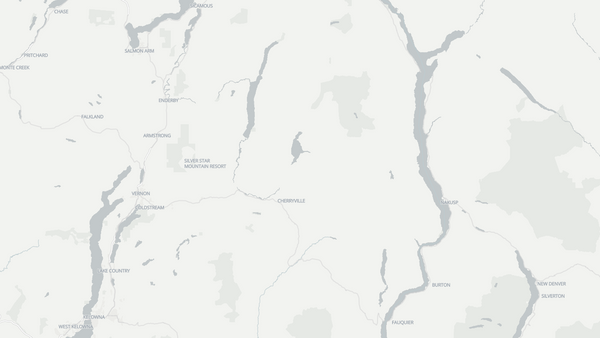
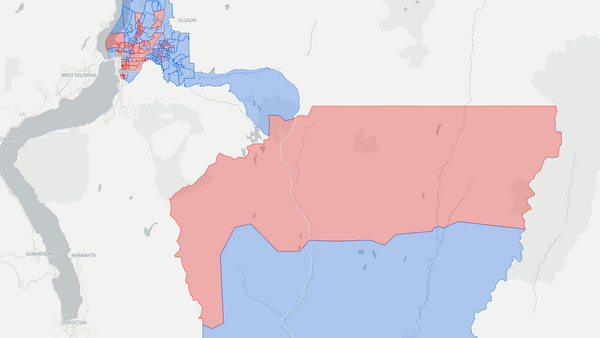
Kamloops—Thompson—Nicola, BC — 2025 Federal Election Results Map
Kamloops—Thompson—Nicola — 2025 Election Results
📌 The Canadian federal electoral district of Kamloops—Thompson—Nicola was contested in the 2025 election.
🏆 Frank Caputo, the Conservative candidate, won the riding with 32,008 votes (51.5% of the vote).
🥈 The runner-up was Iain Currie (Liberal) with 24,961 votes (40.2%), defeated by a margin of 7,047 votes.
📊 Other notable candidates: Miguel Godau (NDP-New Democratic Party, 6%).
Riding information
Auto generated. Flag an issue.Kamloops—Thompson—Nicola
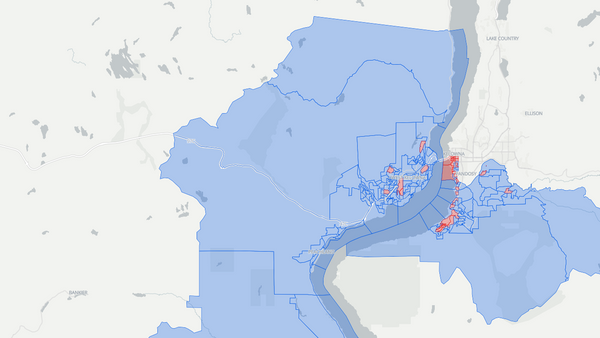
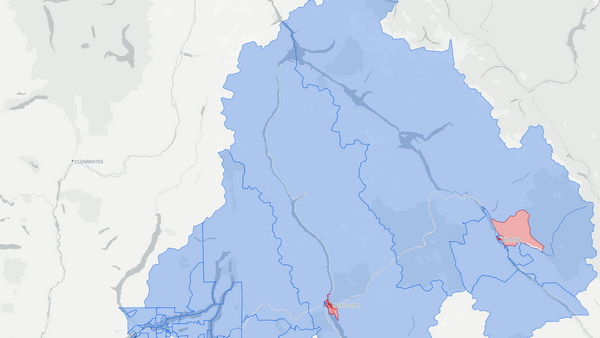
Kamloops—Thompson—Nicola is a newly configured riding for the 2025 election, encompassing the western half of the city of Kamloops and a vast rural territory stretching from the North Thompson Valley down through the Nicola Valley. The riding takes in the communities of Barriere, Clearwater, Lillooet, Lytton, Ashcroft, Cache Creek, Clinton, Logan Lake, and Merritt, as well as the Tk’emlúps te Secwépemc reserve and North Kamloops. These communities, formerly spread across three separate federal ridings, were brought together under the 2022 redistribution. The riding’s geography spans from the dry canyon lands of the Fraser and Thompson rivers to the forested North Thompson Valley approaching the Cariboo region.
Candidates
Frank Caputo (Conservative) is the incumbent, first elected in 2021 in the former riding of Kamloops—Thompson—Cariboo. Born and raised in Kamloops by parents who immigrated from southern Italy, Caputo holds a Bachelor of Arts from Simon Fraser University, a Bachelor of Laws with distinction from the University of Saskatchewan, and a Master of Laws from the University of Alberta. He worked in corrections and as a Crown prosecutor in Kamloops before also teaching law and sociology at Thompson Rivers University.
Iain Currie (Liberal) is a Kamloops-born lawyer, small business owner, and university instructor. After law school, he returned to Kamloops and spent nearly two decades as a Crown prosecutor before moving to private practice in 2017. Currie previously ran for the Green Party in the 2019 and 2021 federal elections before joining the Liberals in 2025.
Miguel Godau (NDP) was born and raised in Ashcroft and currently works for the Department of Child and Youth Mental Health. Trained as a counsellor and psychotherapist, he began his career in outreach with the Elizabeth Fry Society and has extensive experience in union activism with the BC General Employees’ Union.
Jenna Lindley (Green Party) ran as the Green Party candidate in the riding, focusing on environmental sustainability and community well-being.
Chris Enns (People’s Party) stood as the PPC candidate.
About the Riding
Kamloops is the largest city in the riding and serves as the commercial, health-care, and educational hub of the southern interior. Thompson Rivers University anchors the city’s post-secondary sector, and the Royal Inland Hospital is the regional trauma centre. The city’s economy is diversified across mining, forestry, ranching, transportation, and tourism, with Kamloops’ position at the junction of the Trans-Canada and Yellowhead highways making it a critical logistics corridor.
The riding’s rural communities have faced profound challenges in recent years. Lytton was largely destroyed by wildfire in June 2021, and rebuilding has been slow and contentious. Merritt was severely damaged by flooding in November 2021 when the Coldwater River inundated much of the town. These back-to-back disasters brought climate adaptation and disaster preparedness to the forefront of local politics.
In 2025, affordability was the most commonly cited concern across the riding. Kamloops’ housing market, once considered affordable by BC standards, saw prices rise sharply over the preceding five years. In smaller communities like Merritt and Clearwater, the cost of groceries, fuel, and heating weighed heavily on households with incomes below the provincial median. Ranching and forestry, the traditional economic foundations of the rural interior, faced ongoing uncertainty from wildfire risk, water scarcity, and trade policy. Health-care staffing shortages—particularly in emergency departments and rural clinics—were a persistent and deeply felt concern across the riding.