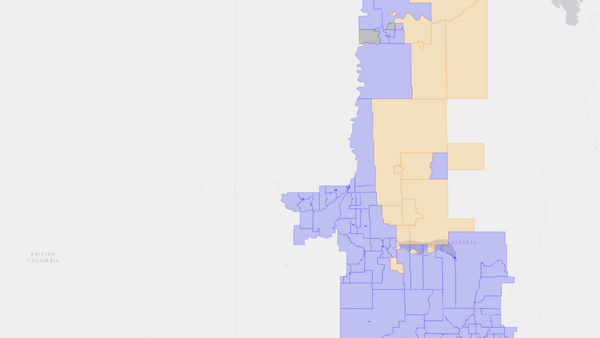
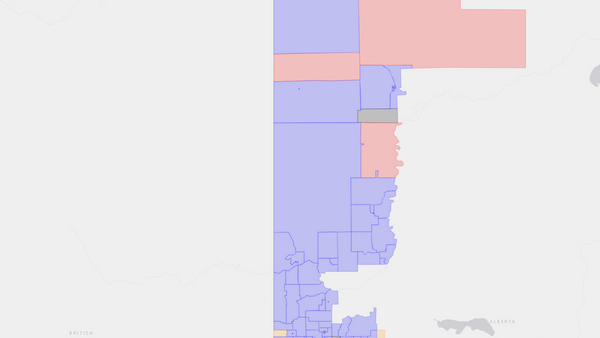
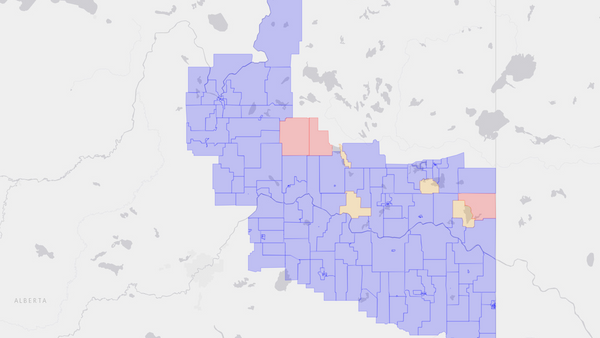
Fort McMurray—Cold Lake, AB — 2015 Federal Election Results Map
Fort McMurray—Cold Lake — 2015 Election Results
📌 The Canadian federal electoral district of Fort McMurray—Cold Lake was contested in the 2015 election.
🏆 David Yurdiga, the Conservative candidate, won the riding with 28,625 votes (60.6% of the vote).
🥈 The runner-up was Kyle Harrietha (Liberal) with 13,403 votes (28.4%), defeated by a margin of 15,222 votes.
📊 Other notable candidates: Melody Lepine (NDP-New Democratic Party, 8%).
Riding information
Auto generated. Flag an issue.Fort McMurray—Cold Lake
Formed during the 2012 redistribution from the former Fort McMurray—Athabasca riding, Fort McMurray—Cold Lake spans northeastern Alberta, taking in the Regional Municipality of Wood Buffalo, the city of Cold Lake, and Lac La Biche County. The riding contains the heart of the Athabasca oil sands — the largest bitumen deposit in the world — and Canadian Forces Base Cold Lake, one of Canada's busiest military airfields.
Candidates
David Yurdiga (Conservative) — Yurdiga studied power engineering and built a career that included work at the Eco-Bay Mine in Nunavut, selling industrial chemicals and safety equipment from Fort McMurray, and starting a consulting and property management business in Lac La Biche. He took over his family farm near Grassland in 2005 and raised organic beef cattle. Elected to Athabasca County council in 2007, he served as deputy reeve and then reeve from 2009 to 2013 before winning the June 2014 by-election in Fort McMurray—Athabasca.
Kyle Harrietha (Liberal) — Harrietha had run as the Liberal candidate in the 2014 Fort McMurray—Athabasca by-election, placing a strong second with about 35 percent of the vote, the strongest Liberal result the riding had seen in years. He sought to build on that performance in the newly redrawn constituency.
Melody Lepine (NDP) — A member of the Mikisew Cree First Nation from Fort Chipewyan, Lepine served as Director of Government and Industry Relations for the Mikisew Cree, overseeing consultation on resource development across Treaty 8 territory. She held a background in environmental conservation sciences from the University of Alberta and had pursued advanced studies in environmental management at Royal Roads University.
Brian Deheer (Green Party), Scott Berry (Libertarian), and Roelof Janssen (Christian Heritage Party) also stood for election.
About the Riding
The riding's economy revolves around the oil sands and the military. Fort McMurray, the urban service area within the Regional Municipality of Wood Buffalo, grew from roughly 10,000 people in the early 1980s to an estimated 80,000 permanent residents by 2015, with a large shadow population of fly-in, fly-out workers swelling the number further. The city of Cold Lake, formed in 1996 from the merger of three communities, had a population of about 15,000 and depended heavily on military spending at CFB Cold Lake and in-situ oil sands extraction in the Cold Lake deposit. By 2015, collapsing global oil prices had put severe pressure on the regional economy, with layoffs, project deferrals, and declining municipal revenues raising concerns about the boom-and-bust cycle. In July 2015, a Nexen Energy pipeline spilled roughly 5,000 cubic metres of bitumen emulsion southeast of Fort McMurray, one of the largest such spills in Alberta history, fuelling debate over pipeline safety and environmental oversight. Federal issues during the campaign included energy infrastructure approvals, environmental regulation, support for military families at CFB Cold Lake, and services for Indigenous communities including the Mikisew Cree and Athabasca Chipewyan First Nations in the Fort Chipewyan area.