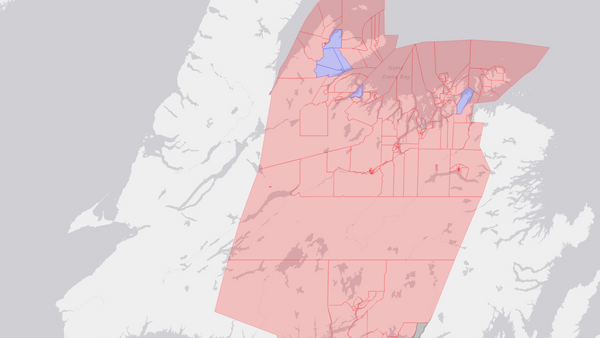
Labrador, NL — 2015 Federal Election Results Map
Labrador — 2015 Election Results
📌 The Canadian federal electoral district of Labrador was contested in the 2015 election.
🏆 Yvonne Jones, the Liberal candidate, won the riding with 8,878 votes (71.8% of the vote).
🥈 The runner-up was Edward Rudkowski (NDP-New Democratic Party) with 1,779 votes (14.4%), defeated by a margin of 7,099 votes.
📊 Other notable candidates: Peter Penashue (Conservative, 14%).
Riding information
Auto generated. Flag an issue.Labrador
Labrador is the largest federal riding in Atlantic Canada by area, covering the entire mainland portion of Newfoundland and Labrador—a vast territory of boreal forest, tundra, and subarctic coastline stretching from the Strait of Belle Isle to the northern tip of the Labrador Peninsula. Happy Valley-Goose Bay, situated on the shores of Lake Melville, is the region's largest town and administrative centre. The riding also takes in the mining hub of Labrador City—Wabush, the Innu communities of Sheshatshiu and Natuashish, the Inuit self-governing region of Nunatsiavut along the north coast, and the hydroelectric town of Churchill Falls.
Candidates
Yvonne Jones (Liberal) — Jones came to the 2015 contest as the incumbent, having won the seat in a May 2013 by-election. Before entering federal politics, she had spent seventeen years in the Newfoundland and Labrador House of Assembly representing Cartwright—L'Anse au Clair, served as provincial Liberal leader, and held the Fisheries and Aquaculture portfolio in Premier Roger Grimes's cabinet. Earlier in her career she was the mayor of Mary's Harbour and a journalist working across the province.
Edward Rudkowski (NDP) — Rudkowski carried the NDP banner in Labrador, focusing on issues facing northern and remote communities.
Peter Penashue (Conservative) — Penashue grew up in the Innu community of Sheshatshiu and served as president of the Innu Nation for twelve years across two terms. He won the riding for the Conservatives in 2011 and was appointed to cabinet as Minister of Intergovernmental Affairs. He resigned his seat in March 2013 after his campaign was found to have accepted ineligible contributions totalling tens of thousands of dollars, then lost the ensuing by-election to Jones. He sought a political comeback in 2015.
About the Riding
Labrador's economy revolves around natural resources on a massive scale. The iron-ore mines at Labrador City and Wabush feed global steel production and employ thousands of workers. The Churchill Falls generating station, one of the largest underground hydroelectric facilities in the world, has operated since 1971 under a long-term power contract with Hydro-Québec that remains a source of political frustration in the province. By 2015, the Muskrat Falls hydroelectric project on the lower Churchill River—roughly 25 kilometres west of Happy Valley-Goose Bay—was under construction, already facing cost overruns and schedule delays that would become a dominant provincial issue. The Voisey's Bay nickel mine near Nain continued to be a major employer. Across northern Labrador, six Inuit communities accessible only by air or sea face persistent challenges with housing, health care, and transportation infrastructure. Federal engagement on Indigenous services, resource development, and northern connectivity figured prominently in the riding's political conversation.