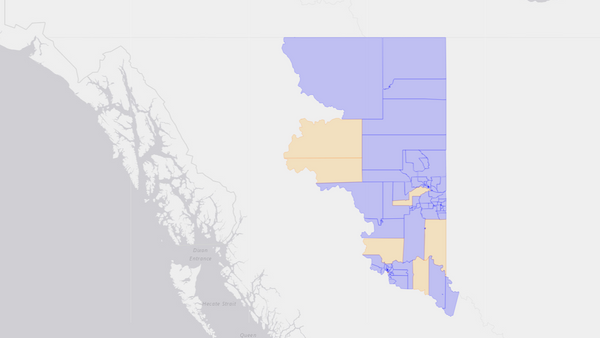
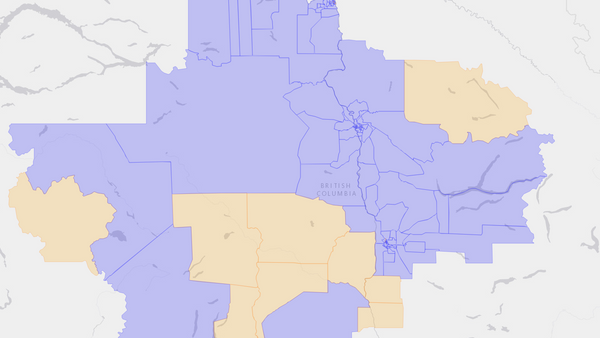
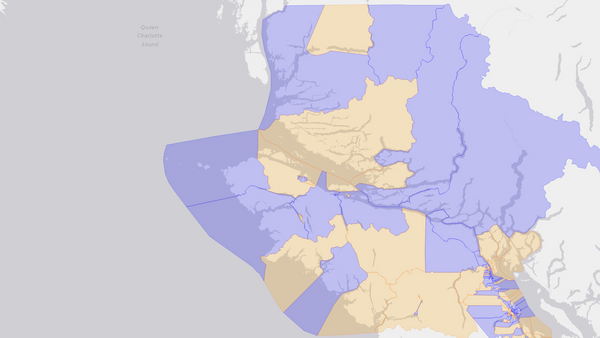
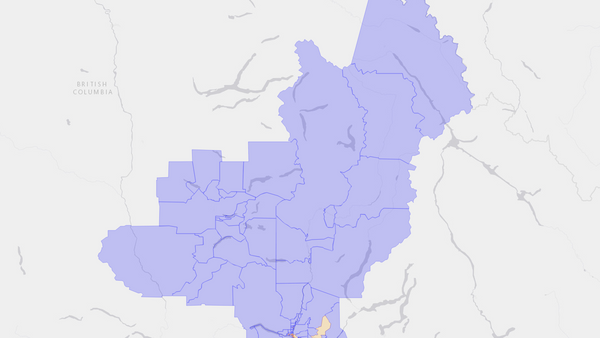
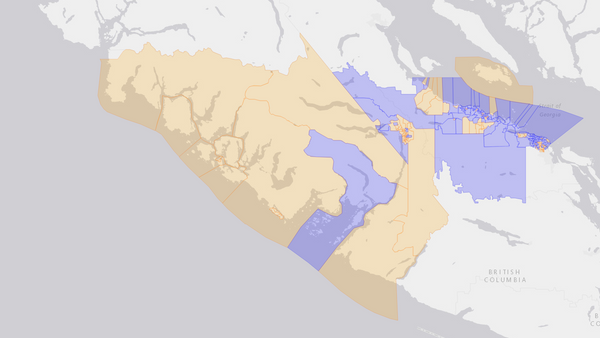
Skeena—Bulkley Valley, BC — 2011 Federal Election Results Map
Skeena—Bulkley Valley — 2011 Election Results
📌 The Canadian federal electoral district of Skeena—Bulkley Valley was contested in the 2011 election.
🏆 Nathan Paul Cullen, the NDP-New Democratic Party candidate, won the riding with 19,431 votes (55.4% of the vote).
🥈 The runner-up was Clay Harmon (Conservative) with 12,117 votes (34.5%), defeated by a margin of 7,314 votes.
Riding information
Auto generated. Flag an issue.Skeena—Bulkley Valley
Skeena—Bulkley Valley was a vast federal electoral district encompassing nearly the entire northwestern quarter of British Columbia, one of the largest ridings in the country by area. The district stretched from the archipelago of Haida Gwaii in the Pacific Ocean eastward through the Coast Mountains, along the Skeena and Bulkley river valleys, and into the lakes district of the central interior. Major communities included the port city of Prince Rupert, the industrial town of Kitimat, the regional centre of Terrace, the Bulkley Valley town of Smithers, and smaller centres such as Burns Lake, Houston, and the Hazeltons.
Candidates
Nathan Cullen (NDP)* — Born on July 13, 1972, in Toronto, Cullen moved to British Columbia after spending several years working on community economic development projects in Central and South America, where he learned Spanish. He settled in Smithers in 1998 and started a consulting firm focused on strategic planning and conflict resolution. First elected to Parliament in 2004, Cullen quickly became one of the NDP's most prominent and popular MPs, known for his advocacy on environmental issues, opposition to the Enbridge Northern Gateway pipeline, and his engaging communication style. He won re-election in 2011 with approximately 55 percent of the vote, the highest plurality in the riding since 1962.
Clay Harmon (Conservative) — Harmon was a Terrace businessman who ran as the Conservative candidate, campaigning on job creation, corporate tax cuts, and tougher criminal sentencing. He criticized Cullen as a barrier to economic development in the region, characterizing the NDP incumbent's opposition to resource projects as costing the northwest jobs and investment. Harmon finished second with roughly 34.5 percent of the vote.
Kyle Warwick (Liberal) — Warwick carried the Liberal banner in the riding but struggled for visibility in what was essentially a two-way race between the NDP and Conservatives. He finished with approximately 3.6 percent of the vote.
Roger Benham (Green Party) — Benham was the Green Party candidate, finishing with about 3.1 percent of the vote in a riding where environmental issues were central but the Green Party had limited organizational presence.
Rod Taylor (CHP) — Taylor was a lumber industry worker based in the northwest who had run for the Christian Heritage Party in the riding in every election since 2004. He later became national leader of the CHP in 2014. Taylor received approximately 3 percent of the vote.
Maggie Braun (CAP) — Braun represented the Canadian Action Party, a minor party focused on monetary reform and Canadian sovereignty.
About the Riding
Skeena—Bulkley Valley's identity was shaped by resource extraction and Indigenous culture. The riding's economy had long depended on forestry, fishing, and mining, with the Rio Tinto aluminum smelter in Kitimat operating since the 1950s as one of the region's largest private employers. Prince Rupert, at the mouth of the Skeena River, served as a deep-water port and commercial fishing centre, while communities along the Bulkley Valley relied on sawmills, ranching, and small-scale agriculture. The riding had significant Indigenous populations, including the territories of the Gitxsan, Wet'suwet'en, Tsimshian, and Haida Nations.
The dominant political issue in the riding by 2011 was the proposed Enbridge Northern Gateway pipeline, which would have carried Alberta oil sands bitumen across the northern interior to a marine terminal in Kitimat for export to Asian markets. The project divided the community sharply: some saw it as a transformative economic opportunity that would bring jobs and investment to a region that had suffered from mill closures and fishing industry decline, while others — including many First Nations, environmentalists, and commercial fishers — feared the risk of oil spills in the sensitive coastal and river ecosystems. Nathan Cullen positioned himself as one of the most vocal opponents of the pipeline, a stance that resonated strongly with a broad coalition of his constituents.
Cullen's personal popularity transcended typical partisan lines in the riding. His accessibility, frequent community presence, and willingness to engage with all sides of issues earned him support even among voters who might otherwise lean Conservative. The 2011 result — 55 percent of the vote in a riding with a competitive Conservative challenger — demonstrated the strength of his personal brand. Cullen went on to run for the NDP leadership in 2012, finishing third but gaining national attention for his proposal to hold joint nomination meetings with other progressive parties.
The NDP's national Orange Wave amplified Cullen's already strong local position, but his dominance in Skeena—Bulkley Valley was built primarily on years of constituency work and his identification with the region's concerns about resource development, environmental protection, and the economic future of remote northern communities.