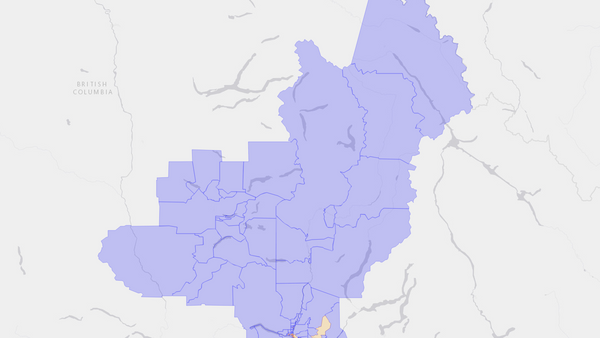
Cariboo—Prince George, BC — 2011 Federal Election Results Map
Cariboo—Prince George — 2011 Election Results
📌 The Canadian federal electoral district of Cariboo—Prince George was contested in the 2011 election.
🏆 Dick Harris, the Conservative candidate, won the riding with 24,443 votes (56.2% of the vote).
🥈 The runner-up was Jon Van Barneveld (NDP-New Democratic Party) with 13,135 votes (30.2%), defeated by a margin of 11,308 votes.
📊 Other notable candidates: Heidi Redl (Green Party, 6%) and Sangeeta Lalli (Liberal, 5%).
Riding information
Auto generated. Flag an issue.Cariboo—Prince George
Cariboo—Prince George is a vast riding stretching across the central interior of British Columbia, from the ranching and logging communities near Williams Lake in the south through Quesnel and northward to the regional hub of Prince George. The riding also extends west to include Vanderhoof and surrounding rural areas. With a population of approximately 117,000, the district encompasses a mix of small resource-dependent towns, First Nations communities on the traditional territories of the Secwepemc, Tsilhqot’in, and Dakelh peoples, and the service-oriented economy of Prince George.
Candidates
-
Dick Harris (Conservative) — Born in 1944, Harris was a longtime Prince George businessman who owned and operated several companies in the region, most notably a tire distribution business, before entering politics. He was first elected to Parliament in the 1993 federal election as a Reform Party candidate in Prince George—Bulkley Valley, having previously supported the Progressive Conservatives for two decades before joining the Reform movement in 1989. He was re-elected continuously through 1997, 2000, 2004, 2006, and 2008, serving under the Reform, Canadian Alliance, and ultimately Conservative Party banners. Harris served as Chief Opposition Whip from 2001 to 2002 and was later appointed chair of the British Columbia Conservative Caucus and the party’s national forestry caucus by Prime Minister Harper. In 2011, he won his seventh consecutive general election with approximately 56% of the vote.
-
Jon Van Barneveld (NDP) — Van Barneveld was a 22-year-old undergraduate student at the University of Northern British Columbia at the time of the 2011 election. He ran as the NDP candidate in Cariboo—Prince George, finishing as Harris’s closest challenger but trailing by over 11,000 votes. His campaign benefited from the national NDP surge under Jack Layton but could not overcome the riding’s strong Conservative leanings.
-
Heidi Redl (Green Party) — Redl was a cattle rancher from the Cariboo region who emphasized practical environmentalism over ideology. She decided to seek the Green Party nomination partly to ensure the riding had a local candidate and partly out of concern over the proposed Taseko Prosperity gold and copper mine. Redl, who lived with multiple sclerosis and had travelled overseas for experimental vascular surgery, brought a down-to-earth perspective shaped by decades of rural life and resource-sector experience.
-
Sangeeta Lalli (Liberal) — Lalli was a fourth-year political science student at the University of British Columbia who had been active in student politics. She was considered a parachute candidate, as she was completing her semester at UBC when the election was called, though she had family roots in the Cariboo region and had spent time in the area since childhood. She finished fourth with approximately 2,200 votes.
-
Henry Thiessen (CHP) — A retired helicopter pilot from Vanderhoof with 34 years of aviation experience, Thiessen ran for the Christian Heritage Party and would go on to run again for the CHP in subsequent elections.
-
Jon Ronan (Independent) — Ronan ran as an independent candidate in the riding, receiving a small share of the vote.
-
Jordan Turner (Rhinoceros) — Turner ran as the Rhinoceros Party’s satirical candidate in the riding and participated in all-candidates forums alongside the other nominees.
About the Riding
Cariboo—Prince George has long been defined by its dependence on natural resources, particularly forestry and mining. Prince George, which the riding shares with Prince George—Peace River, serves as the economic and service hub for the entire central interior of British Columbia, with healthcare, retail, manufacturing, construction, and education forming its five largest employment sectors. The surrounding communities of Quesnel, Williams Lake, and Vanderhoof are more directly tied to the forest industry, with sawmills, pulp mills, and related operations providing the economic backbone for many families.
By 2011, the riding was grappling with the devastating aftermath of the mountain pine beetle epidemic, which had been ravaging British Columbia’s lodgepole pine forests since the late 1990s. The outbreak destroyed over half of the province’s commercial pine timber and hit the Prince George timber supply area particularly hard, threatening communities where up to half the local income base derived from forestry. The federal and provincial governments had responded with the Mountain Pine Beetle Action Plan from 2006 to 2011, coordinating efforts among governments, industry, First Nations, and communities to manage the ecological and economic fallout.
Politically, the riding had been a Conservative stronghold since Dick Harris first won the seat in 1993 under the Reform Party banner. The region’s resource-sector workforce, rural character, and socially conservative values aligned naturally with the Conservative platform. In 2011, even as the NDP experienced a historic national surge under Jack Layton’s leadership—the so-called Orange Wave that reshaped Canadian politics—the effect in Cariboo—Prince George was modest. Harris comfortably won re-election with a strong majority, reflecting the deeply entrenched Conservative support in British Columbia’s interior.
The 2011 campaign in the riding touched on familiar themes: forestry policy, the pine beetle recovery, resource development, and the proposed Prosperity Mine near Fish Lake, which the federal government had rejected on environmental grounds in 2010. The riding’s First Nations communities, including the Tsilhqot’in, Secwepemc, and Dakelh nations, had significant stakes in land-use and resource decisions. With seven candidates on the ballot, including a Rhinoceros Party entrant, the race nonetheless remained a foregone conclusion, with Harris cruising to victory in what would be his final election before retiring from politics ahead of the 2015 campaign.