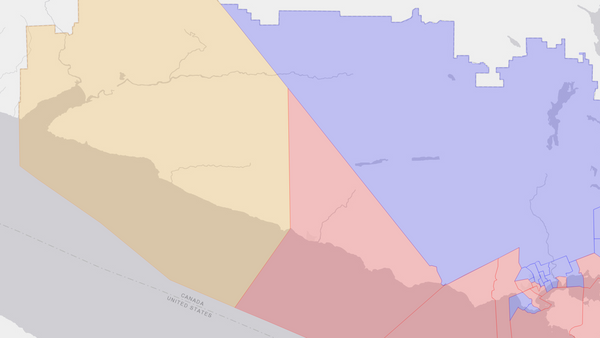
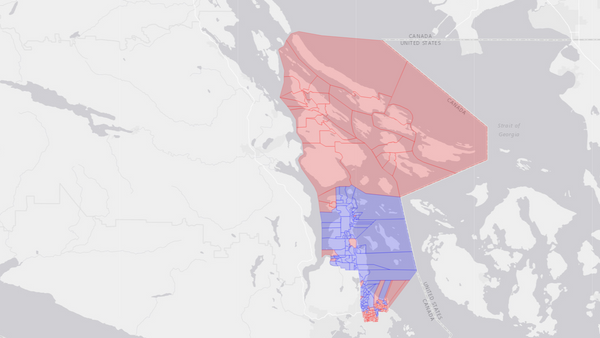
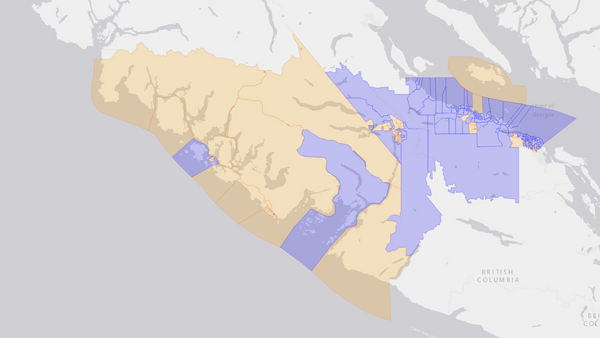
Nanaimo—Cowichan, BC — 2008 Federal Election Results Map
Nanaimo—Cowichan — 2008 Election Results
📌 The Canadian federal electoral district of Nanaimo—Cowichan was contested in the 2008 election.
🏆 Jean Crowder, the NDP-New Democratic Party candidate, won the riding with 27,454 votes (45.2% of the vote).
🥈 The runner-up was Reed Elley (Conservative) with 22,844 votes (37.6%), defeated by a margin of 4,610 votes.
📊 Other notable candidates: Christina Knighton (Green Party, 10%) and Brian Scott (Liberal, 7%).
Riding information
Auto generated. Flag an issue.Nanaimo—Cowichan
Running about sixty kilometres down the east side of Vancouver Island, this riding starts in south Nanaimo, passes through Cassidy, Ladysmith and Chemainus, opens into the Cowichan Valley around Duncan and North Cowichan, and ends at Mill Bay and Shawnigan Lake below the Malahat. Duncan, the valley's commercial centre, is the smallest incorporated city in Canada by area and sits surrounded by the District of North Cowichan and by the reserve lands of Cowichan Tribes, the largest single First Nation band in British Columbia.
Candidates
Jean Crowder (NDP) — Born in Montreal on 7 July 1952, Crowder studied psychology at Wilfrid Laurier University and spent her career in human resources, holding posts at Malaspina University-College, at Human Resources Development Canada, and at the provincial ministry responsible for skills training and labour. She served a year on North Cowichan council from 2003 before winning the seat for the New Democrats in 2004 and holding it in 2006. As her party's Aboriginal affairs critic she carried Motion 296 on Jordan's Principle, which the Commons adopted unanimously on 12 December 2007 which held that the government first approached should pay for a First Nations child's care and argue jurisdiction afterwards.
Reed Elley (Conservative) — Elley held this seat from 1997 to 2004, elected first for Reform and then for the Canadian Alliance and sitting as a Conservative after the 2003 merger, and he was attempting to win it back. A retired Baptist minister with a history degree and a divinity degree from McMaster University, he had pastored churches in Ontario, Alberta and British Columbia. In Parliament he served as deputy health critic and vice-chair of the health committee, and later as senior critic for Indian Affairs and then for labour. He and his wife Louise raised their family at Chemainus and fostered a great many other children over the years.
Christina Knighton (Green) — Knighton worked as a consultant in Nanaimo.
Brian Scott (Liberal) — Scott, a businessman from Cowichan Bay, was the Liberal candidate.
Jack East, a retired railway worker from Campbell River, stood for the Marxist-Leninist Party.
About the Riding
The pulp mill at Harmac, on the water south of Nanaimo, gave the campaign its local drama. Its owner, Pope & Talbot, went into bankruptcy after the United States housing market turned, and the mill shut in May 2008, putting more than 500 people out of work. Several hundred of the employees each put up $25,000 and joined three British Columbia investors to buy the plant for $13.2 million in August. One production line fired up again on 3 October, eleven days before the vote, under the name Nanaimo Forest Products.
Forestry underwrote much of the rest of the riding. Catalyst Paper's Crofton mill on the North Cowichan shoreline was the valley's largest industrial employer and taxpayer, and sawmilling supported Ladysmith, Chemainus and Lake Cowichan — all of it exposed to the same collapse in lumber and paper demand.
Wineries, cideries and small farms had multiplied in the valley's long warm summers, and Chemainus and Ladysmith had built a visitor trade on heritage buildings, murals and the arts. Health care and education were the largest steady employers: the Cowichan District Hospital in Duncan, and Malaspina University-College, which became Vancouver Island University on 1 September 2008, with its main campus in south Nanaimo and a second in Duncan.
The riding had one of the highest proportions of Indigenous residents in the province, and treaty negotiations, fisheries access, housing on reserve and child welfare funding were sustained local issues rather than occasional ones. Crowder had won the seat in 2004, when Elley stepped down, and consolidated it two years later.