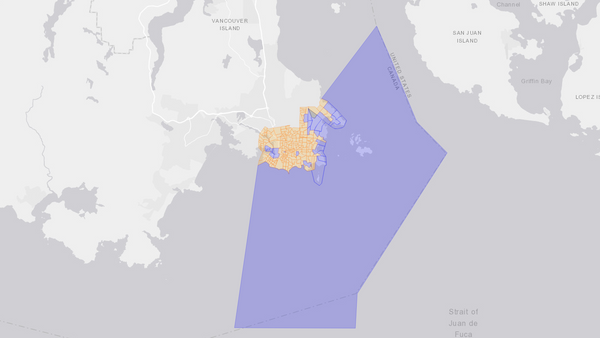
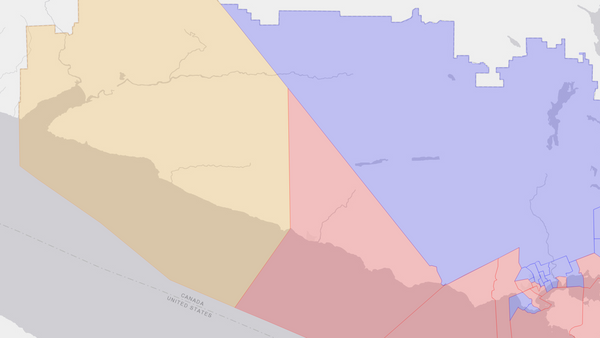
Saanich—Gulf Islands, BC — 2008 Federal Election Results Map
Saanich—Gulf Islands — 2008 Election Results
📌 The Canadian federal electoral district of Saanich—Gulf Islands was contested in the 2008 election.
🏆 Gary Lunn, the Conservative candidate, won the riding with 27,991 votes (43.4% of the vote).
🥈 The runner-up was Briony Penn (Liberal) with 25,366 votes (39.4%), defeated by a margin of 2,625 votes.
📊 Other notable candidates: Andrew Lewis (Green Party, 10%) and Julian West (NDP-New Democratic Party, 6%).
Riding information
Auto generated. Flag an issue.Saanich—Gulf Islands
The riding joined the Saanich Peninsula north of Victoria to the archipelago across the Strait of Georgia — Salt Spring, the Penders, Galiano, Mayne and Saturna. Sidney, North Saanich, Central Saanich and the northern reaches of the District of Saanich made up the mainland share, the boundary cutting across Saanich along Arbutus and Finnerty roads, McKenzie Avenue and Blanshard Street. Around 115,700 people lived in 504 square kilometres, and registered electors made up an exceptionally high share of that number — the signature of one of the oldest electorates in the country.
Candidates
Gary Lunn (Conservative) — Born in Trail in 1957, Lunn took his law degree at the University of Victoria and practised there before entering federal politics. He won the seat for Reform in 1997 and held it through the Canadian Alliance and Conservative years. Minister of Natural Resources since February 2006, he went into the election still answering for Chalk River: Parliament legislated the restart of the isotope reactor in December 2007 over the objections of the nuclear regulator, and the following month the government removed the president of the Canadian Nuclear Safety Commission on his recommendation.
Briony Penn (Liberal) — Born in Saanich in 1960 into a family five generations on the coast, Penn studied geography and anthropology at the University of British Columbia and completed a doctorate in geography at Edinburgh in 1988. She had taught environmental studies at the University of Victoria as an adjunct professor since 1991, co-founded The Land Conservancy of British Columbia in 1997, and was widely known for her natural history writing and broadcasting. She lived on Salt Spring Island and had declared her candidacy in March 2007.
Andrew Lewis (Green Party) — A landscape contractor who came from Britain to Vancouver Island in the early 1990s and settled on Salt Spring, Lewis was deputy leader of the Green Party of Canada from 2004 to 2006 and had carried the riding for the party in 2006. He attacked the natural resources minister's record on tankers, asbestos and nuclear power.
Julian West (NDP) — A college instructor from Saanich who had earlier been active in the British Columbia Green Party, West withdrew on 23 September. The deadline for replacing a nominated candidate had passed, so his name stayed on the ballot and the New Democrats ran no campaign for the final three weeks.
Dale P. Leier ran for the Libertarian Party, Patricia O'Brien for the Work Less Party, Jeremy Arney for the Canadian Action Party and Dan Moreau for the Christian Heritage Party.
About the Riding
The peninsula was farmland, small towns and federal installations: some of the province's most productive Agricultural Land Reserve acreage in Central Saanich, the commercial centre and island gateway at Sidney, and in North Saanich, Victoria International Airport, the BC Ferries terminal at Swartz Bay and the Institute of Ocean Sciences at Patricia Bay.
Across the water the islands ran on a smaller scale: farm gates and studios on Salt Spring, seasonal populations on Galiano, Mayne, Saturna and the Penders, ferry timetables that governed the day, and a long tradition of land trusts and conservation covenants under the extra land-use layer of the Islands Trust.
The campaign drew national attention. With three challengers competing for much the same environmental vote, strategic voting became an open subject of argument, and the Dogwood Initiative rallied outside Lunn's office on 20 September over crude oil tanker traffic. On the eve of the vote, automated telephone calls placed from outside Canada reached households in the riding urging support for the withdrawn New Democrat. Beneath the tactical noise sat farmland and shoreline protection, ferry fares, and health care for a very old population.