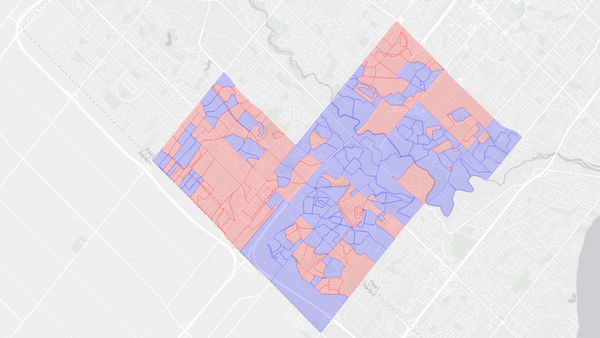
Brampton West, ON — 2008 Federal Election Results Map
Brampton West — 2008 Election Results
📌 The Canadian federal electoral district of Brampton West was contested in the 2008 election.
🏆 Andrew Kania, the Liberal candidate, won the riding with 21,746 votes (40.3% of the vote).
🥈 The runner-up was Kyle Seeback (Conservative) with 21,515 votes (39.9%), defeated by a margin of 231 votes.
📊 Other notable candidates: Jagtar Shergill (NDP-New Democratic Party, 14%) and Patti Chmelyk (Green Party, 6%).
Riding information
Auto generated. Flag an issue.Brampton West
No federal riding in Canada held more people than Brampton West when the 2006 census was taken: 170,422, in a seat drawn only three years earlier and covering under 58 square kilometres. Its territory was the south-western quarter of the city — the historic downtown at the Four Corners, Peel Village, Credit Valley, Bram West and Springbrook — everything west and south of the Madoc neighbourhood, which sat in the seat next door.
The riding was open. Colleen Beaumier, who had represented Brampton-area constituencies for the Liberals since 1993, first as MP for Brampton, then for Brampton West—Mississauga and finally for Brampton West, announced on 5 September 2008 that she would not run again. Parliament was dissolved two days later.
Candidates
Andrew Kania (Liberal) — Born in 1967, Kania studied law at Toronto and took a master's degree in law at Leicester, in England. He joined the Ontario bar in 1991 and practised in Brampton as senior counsel with the firm bearing his own name, won election as secretary of a provincial bar association representing more than 17,000 lawyers, and taught family law and civil litigation on the Law Society of Upper Canada's bar admission course. In his party he had been outreach director and Ontario co-chair of Stéphane Dion's 2006 leadership campaign.
Kyle Seeback (Conservative) — A civil litigator who took his bachelor of laws at the University of Western Ontario, Seeback practised in Brampton with the firm Simmons, DaSilva & Sinton. The 2008 campaign was his first run for the House of Commons.
Jagtar Shergill (NDP) — An insurance and financial adviser in Brampton, Shergill had been the New Democratic candidate in the same riding in 2006.
Patti Chmelyk (Green Party) — Chmelyk worked as an administrator and lived in Brampton.
About the Riding
Everything here was shaped by the speed of construction. Brampton added more than 100,000 residents between the 2001 and 2006 censuses, and concession roads on the west side turned into subdivisions faster than boundary commissions could redraw seats around them — which is how one riding came to hold more people than Prince Edward Island. Households were large, the population was young, and a substantial share of residents had immigrated within the previous two decades, most visibly from Punjab and the Caribbean.
For most residents, work meant a commute. Highway 410 and the Brampton GO line funnelled traffic into Mississauga, Vaughan and Toronto each morning, and the congestion that resulted made highway and transit funding a recurring local demand. Brampton's larger employers — vehicle assembly on Williams Parkway, Loblaw's distribution and office operations, Rogers facilities and the logistics sector along the 410 — sat mostly on the east side of the city but drew workers from this one. That left Brampton West exposed to the autumn of 2008, with the automotive industry in crisis and southern Ontario manufacturing already cutting shifts.
Two other pressures shaped the local conversation. Hospital capacity was the first: Brampton Civic had opened in 2007 to replace Peel Memorial and was built for a catchment of roughly half a million people, and whether one hospital could serve the city was argued about continuously through 2008. Settlement services were the second — language training, credential recognition, family reunification processing — with local agencies contending their funding had been set for a much smaller Brampton. Both fed the same federal question about whether Ottawa's transfers and immigration programs had kept up with the outer edge of the Greater Toronto Area.
Physically the riding is straightforward: arterial grids, big-box retail at the interchanges, schools ringed by portables, and the Credit River and Fletcher's Creek valleys supplying most of the open space. Downtown Brampton, at the Four Corners where Queen Street crosses Main, gave the seat its one stretch of nineteenth-century streetscape.