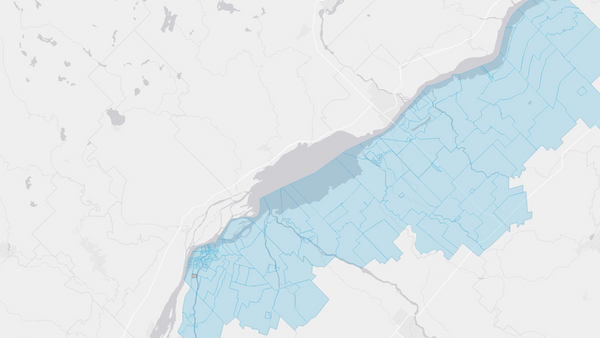
Trois-Rivières, QC — 2008 Federal Election Results Map
Trois-Rivières — 2008 Election Results
📌 The Canadian federal electoral district of Trois-Rivières was contested in the 2008 election.
🏆 Paule Brunelle, the Bloc Québécois candidate, won the riding with 22,405 votes (45.3% of the vote).
🥈 The runner-up was Claude Durand (Conservative) with 11,998 votes (24.2%), defeated by a margin of 10,407 votes.
📊 Other notable candidates: Marcos G. Simard (Liberal, 18%) and Geneviève Boivin (NDP-New Democratic Party, 9%).
Riding information
Auto generated. Flag an issue.Trois-Rivières
Set where the Saint-Maurice empties into the St. Lawrence, at the midpoint of the run from Montreal to Quebec City, Trois-Rivières was one of the oldest continuously settled places in Canada and the commercial capital of the Mauricie. The riding covered most of the amalgamated city, but Pointe-du-Lac and Trois-Rivières-Ouest — municipalities in their own right until 2002 — had been drawn into Berthier—Maskinongé instead. Within its boundaries were the historic town centre, the Cap-de-la-Madeleine sector, the port and the industrial flats along the river.
Candidates
Paule Brunelle (Bloc Québécois) — Born in Trois-Rivières in August 1953 and living across the river at Champlain, Brunelle came to politics from business, having run companies and served as an executive director. She won the riding for the Bloc Québécois in 2004, succeeding Yves Rocheleau, and was returned in 2006. She served as the Bloc's critic for intergovernmental affairs and for industry, portfolios that put her in the middle of the manufacturing and forestry files affecting her own region.
Claude Durand (Conservative) — Durand, of Trois-Rivières, ran as the Conservative candidate.
Marcos G. Simard (Liberal) — Simard, also a Trois-Rivières resident, carried the Liberal banner.
Geneviève Boivin (NDP) — A coordinator living in Bécancour, across the river, Boivin stood for the New Democrats.
Ariane Blais (Green Party) — Blais, of Trois-Rivières, ran for the Green Party.
About the Riding
Sieur de Laviolette planted the settlement in July 1634, twenty-six years after Quebec City and ahead of anywhere else in New France. From the late 1920s to the early 1960s the town called itself the paper capital of the world. The claim had substance. The Canadian International Paper works, built in 1919 at the mouth of the Saint-Maurice and expanded to eight machines in 1925, was for a time the largest paper mill anywhere. That era ended in stages: the CIP site was designated a national historic site in 1991, the buildings came down in 2001, and the surviving water filtration plant was recognised as a heritage site by the city in 2007. Kruger's Wayagamack mill in the delta was still running, but mill after mill in the surrounding region had cut shifts or closed through the decade.
The Université du Québec à Trois-Rivières, opened in 1969, was the single largest institutional change in the city's modern history. Its work in paper science, hydrogen energy and biomaterials pointed toward a technical economy built on the remains of the old one, and along with the regional hospital it made public-sector professional employment the counterweight to industrial decline. The port stayed busy year-round, ice-free and connected to the national highway network, handling roughly three hundred ships a year in bulk and general cargo.
The amalgamations of 2002 brought the city's population to 126,323 at the 2006 census. That population skewed older than the Quebec average, a consequence of young people leaving for Montreal and Quebec City that had been visible in the census for two decades, and French was the mother tongue of nearly 94 percent of residents. Summer festivals, chief among them the FestiVoix, and the restored old town carried a tourist season that partly offset the industrial losses.
Going into October 2008 the local federal agenda was dominated by what was happening to pulp and paper. The high dollar, collapsing American newsprint demand and the credit squeeze of that autumn threatened operations throughout the Mauricie, and questions about loan guarantees for forestry firms, employment insurance for displaced mill workers and research funding for the university's materials programmes all ran through the same problem.