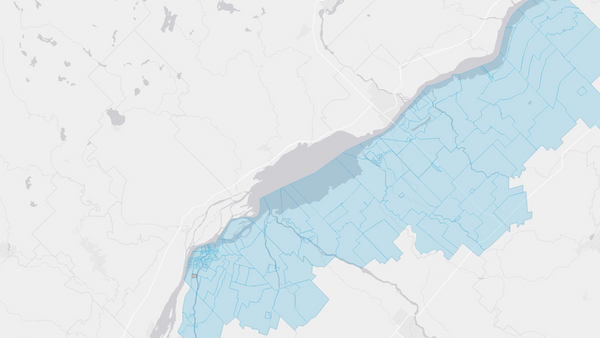
Drummond, QC — 2008 Federal Election Results Map
Drummond — 2008 Election Results
📌 The Canadian federal electoral district of Drummond was contested in the 2008 election.
🏆 Roger Pomerleau, the Bloc Québécois candidate, won the riding with 17,613 votes (38.8% of the vote).
🥈 The runner-up was André Komlosy (Conservative) with 11,490 votes (25.3%), defeated by a margin of 6,123 votes.
📊 Other notable candidates: Jean Courchesne (Liberal, 17%) and Annick Corriveau (NDP-New Democratic Party, 16%).
Riding information
Auto generated. Flag an issue.Drummond
Drummond consists of the regional county municipality of the same name, a block of farm townships wrapped around the manufacturing city of Drummondville on the Saint-François River in the Centre-du-Québec. The riding sits at the junction of Autoroutes 20 and 55, roughly midway between Montreal and Quebec City, and includes Saint-Germain-de-Grantham, Saint-Cyrille-de-Wendover, Wickham, Notre-Dame-du-Bon-Conseil, Saint-Guillaume, Saint-Félix-de-Kingsey, Saint-Lucien and L'Avenir. Pauline Picard, the Bloc Québécois member since 1993, did not seek re-election, which left the seat open.
Candidates
Roger Pomerleau (Bloc Québécois) — Born in Montreal in 1947, Pomerleau worked as a carpenter before entering federal politics. He was elected for the Bloc in Anjou—Rivière-des-Prairies in 1993, sat through the 35th Parliament, and lost the seat to Liberal Yvon Charbonneau in 1997. He was recruited to run in Drummond, where he lived at Lefebvre, after Picard announced her departure.
André Komlosy (Conservative) — A Drummondville lawyer in his early forties, Komlosy launched his Conservative campaign in the riding in September 2008.
Jean Courchesne (Liberal) — Courchesne, of Drummondville, stood for the Liberals.
Annick Corriveau (NDP) — Corriveau was the New Democratic candidate.
Réginald Gagnon (Green Party) — Gagnon carried the Green Party banner.
About the Riding
Drummondville was founded in 1815 by Lieutenant-Colonel Frederick George Heriot as a settlement for soldiers discharged after the War of 1812, and the river that gave the town its site later gave it its industry. Hosiery and textile plants arrived from 1919 — Butterfly Hosiery, Gossard, Jenckes — and hydroelectric development on the Saint-François through the 1920s supplied the cheap power that brought Canadian Celanese, for decades the town's largest employer. For most of the twentieth century Drummondville was a mill town, and the city of 67,392 residents counted in the 2006 census still described itself as one of the province's manufacturing capitals.
By 2008 the textile trade that built the city had been shrinking for years, squeezed by import competition and by a Canadian dollar that had climbed to parity with the American dollar in the autumn of 2007. What remained was a broader industrial base: plastics, metal fabrication, food processing and transport equipment. Girardin, which began in 1935 as a used-car dealership and repair shop at Saint-Félix-de-Kingsey, had grown into a Drummondville minibus manufacturer and school-bus distributor. A cluster of trucking firms ranks among the larger regional employers, a reflection of the city's position on the Autoroute 20 corridor. The seizing-up of credit markets in the weeks before the vote gave the health of that base an immediacy it might not otherwise have had.
Outside the city the riding is farm country — dairy herds, grain and sugar bushes across the Grantham and Wendover townships — and supply management, farm input costs and rural road maintenance carry weight in the villages. The population is overwhelmingly French-speaking, and Drummondville serves as the administrative and commercial hub of the Centre-du-Québec, with a CEGEP, the Hôpital Sainte-Croix and the Promenades Drummondville shopping centre drawing traffic from across the MRC.
The city has a long cultural profile as well. The folklore festival now known as the Mondial des Cultures was launched in 1982, after members of the Mackinaw dance ensemble came home from a similar event at Dijon, and it grew into one of the larger summer draws in the region. Federal reductions to arts and culture programs announced that summer became a recurring campaign issue across Quebec through September.
Politically, Drummond had returned Bloc Québécois members without interruption since 1993, and Picard's retirement made it the first genuinely open contest here in fifteen years.