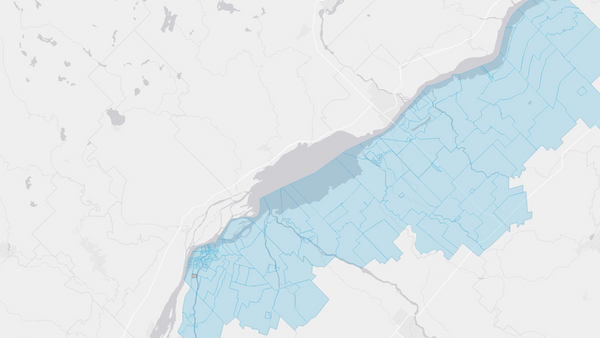
Richmond—Arthabaska, QC — 2008 Federal Election Results Map
Richmond—Arthabaska — 2008 Election Results
📌 The Canadian federal electoral district of Richmond—Arthabaska was contested in the 2008 election.
🏆 André Bellavance, the Bloc Québécois candidate, won the riding with 23,913 votes (46.0% of the vote).
🥈 The runner-up was Éric Lefebvre (Conservative) with 15,080 votes (29.0%), defeated by a margin of 8,833 votes.
📊 Other notable candidates: Gwyneth Helen Grant (Liberal, 13%) and Stéphane Ricard (NDP-New Democratic Party, 9%).
Riding information
Auto generated. Flag an issue.Richmond—Arthabaska
This riding stretches across two administrative regions, from the furniture plants of Victoriaville in the Centre-du-Québec southwest through the Appalachian foothills to the Saint-François valley towns of Windsor and Richmond in the Estrie. It covers roughly 3,570 square kilometres, comprising the regional county municipalities of Arthabaska and Les Sources together with the central part of Le Val-Saint-François, and includes Warwick, Kingsey Falls, Danville and the town of Asbestos.
Candidates
André Bellavance (Bloc Québécois) — Born in Victoriaville on 3 June 1964, Bellavance studied at Université Laval and the Université de Montréal and worked as a journalist and radio announcer before becoming a political assistant on Parliament Hill. He won the seat in June 2004 and held it in 2006. He sat on the Commons agriculture and agri-food committee and spoke for the Bloc on farm questions, above all the defence of supply management. Weeks into his first term he declined a request from a Royal Canadian Legion branch in Richmond for Canadian flags from his office, saying that as a sovereigntist he was not comfortable promoting Canada through it; the refusal drew national attention, and Prime Minister Paul Martin and Opposition Leader Stephen Harper both arranged for flags to reach the branch themselves.
Éric Lefebvre (Conservative) — Lefebvre had sat on Victoriaville city council since 2001.
Gwyneth Helen Grant (Liberal) — A farmer from Ulverton.
Stéphane Ricard (NDP) — Ricard ran from Sainte-Clotilde-de-Horton, and François Fillion (Green Party) from Victoriaville.
Jean Landry (Independent) — Landry was elected as the Bloc Québécois member for Lotbinière in 1993. He ran unsuccessfully in Lotbinière as an independent in 1997, as a Progressive Conservative in 2000 and as a Conservative in 2004, and was the Conservative candidate in Richmond—Arthabaska in 2006. In 2008 he contested the riding again, this time as an independent.
About the Riding
Victoriaville, with roughly 40,000 residents, is the commercial and industrial centre; no other community in the riding reaches 8,000 people. Furniture and wood products, machinery and food processing dominate its manufacturing base. The Musée Laurier occupies the Victorian house Wilfrid Laurier built in the Arthabaska sector, and the city hosts the Festival international de musique actuelle de Victoriaville each spring. Kingsey Falls is where the Lemaire brothers founded Cascades in 1964, and the packaging and tissue company still has its head office there. At the southern end, Domtar's Windsor mill — a fully integrated pulp and fine-paper operation — is that town's dominant employer.
Asbestos was the riding's hardest case. The Jeffrey Mine, an open pit that once employed thousands of chrysotile miners, had spent most of the decade under court protection from its creditors and was down to a few hundred workers, with its survival uncertain. Ottawa's continued defence of chrysotile exports in international forums was therefore a federal question with an immediate local audience, and one on which the town and the international anti-asbestos campaign were flatly opposed.
Outside the towns the land is dairy, hog and maple country, with woodlots and small mills scattered through the hills, and better than nineteen residents in twenty give French as their mother tongue. The 2008 campaign issues followed from all of this: the exposure of furniture, wood products and paper to the collapsing American housing market, aid for forestry, the future of asbestos mining, supply management in agriculture, and employment insurance rules for workers moving in and out of seasonal manufacturing.