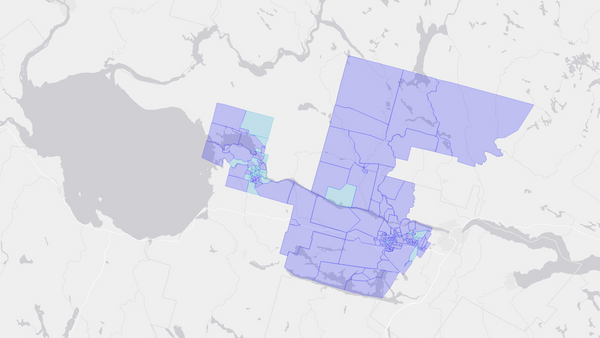
Abitibi—Baie-James—Nunavik—Eeyou, QC — 2008 Federal Election Results Map
Abitibi—Baie-James—Nunavik—Eeyou — 2008 Election Results
📌 The Canadian federal electoral district of Abitibi—Baie-James—Nunavik—Eeyou was contested in the 2008 election.
🏆 Yvon Lévesque, the Bloc Québécois candidate, won the riding with 10,995 votes (39.7% of the vote).
🥈 The runner-up was Jean-Maurice Matte (Conservative) with 8,422 votes (30.4%), defeated by a margin of 2,573 votes.
📊 Other notable candidates: Mark Canada (Liberal, 18%) and Erica Martin (NDP-New Democratic Party, 8%).
Riding information
Auto generated. Flag an issue.Abitibi—Baie-James—Nunavik—Eeyou
Three separate systems of government shared this constituency: the Vallée-de-l'Or regional county municipality in the south, the James Bay and Eeyou Istchee territory in the middle, and the Kativik region covering Nunavik in the far north. Its 767,417 square kilometres of land amounted to more than half the land area of Quebec, yet only 80,894 people lived there in 2006. More than a third were Indigenous — Cree, Inuit, Anishinaabe and Naskapi — and most northern communities could be reached only by air.
Candidates
Yvon Lévesque (Bloc Québécois) — Born at Lac-au-Saumon in 1940, Lévesque worked as an electrician, foreman and site superintendent before spending years as a labour relations adviser and union representative across northwestern Quebec and the James Bay territory. Living at Val-Senneville, he took the riding from Liberal incumbent Guy St-Julien in 2004 and held it in 2006, entering this campaign as the Bloc's voice on northern and Indigenous questions.
Jean-Maurice Matte (Conservative) — Mayor of Senneterre, a forestry and rail town east of Val-d'Or, since 2002, Matte was the best-known municipal figure on the ballot and campaigned for a governing party that had put resource development and northern infrastructure in its pitch.
Mark Canada (Liberal) — Canada, of Rivière-Héva west of Val-d'Or, ran for a party that had held the predecessor riding until 2004.
Erica Martin (NDP) — Martin carried the New Democrat banner across a territory no campaign could physically cover.
Patrick Rancourt (Green Party) — Rancourt, of Vassan, completed the ballot.
About the Riding
The southern end held most of the voters. Val-d'Or, Malartic, Senneterre and the surrounding municipalities of the Vallée-de-l'Or sit on the Abitibi greenstone belt, one of the richest gold-bearing formations anywhere, and mining services, drilling contractors and exploration crews formed the backbone of the local economy. Osisko Mining had spent several years drilling the ground immediately south of Malartic, where an underground mine had produced gold from 1935 to 1965, and was working toward a large open pit. In July 2008 the company began moving roughly 150 houses out of the town's southern neighbourhood to make room for it — the story that dominated local conversation through the campaign.
Forestry told a harder story. Lebel-sur-Quévillon had been built around Domtar's kraft pulp mill, which closed in November 2005 and put 425 production workers out of a job; the company's sawmill stopped the following year. Residents left a town of about 3,000 while the community waited to learn whether anything would restart. Chibougamau and Chapais, further east, carried similar exposure to sawmilling and to copper.
The centre of the riding was Eeyou Istchee, home to Cree communities including Chisasibi, Mistissini, Waskaganish, Wemindji, Eastmain, Waswanipi, Nemaska, Whapmagoostui and Oujé-Bougoumou, whose relations with Quebec and Ottawa rested on the James Bay and Northern Quebec Agreement of 1975 and the Paix des Braves of 2002. The La Grande hydroelectric complex and its reservoirs, built across that territory, supplied a large share of Quebec's electricity.
North of the treeline lay Nunavik's fourteen Inuit villages, among them Kuujjuaq, Inukjuak, Puvirnituq and Salluit. Housing was the most acute federal file in the region: the municipal housing office put the shortfall at 533 units in 2003 and at more than 900 by 2008, with 239 built over that span, and the 2006 census found 49 per cent of Nunavik Inuit living in crowded households. Construction costs several times southern rates, a building season limited by the sealift, the price of food, airstrip and marine infrastructure, policing and health services rounded out an agenda unlike that of any other Quebec riding.