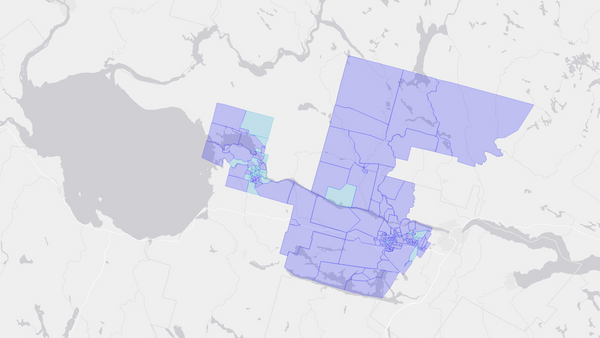
Haute-Gaspésie—La Mitis—Matane—Matapédia, QC — 2008 Federal Election Results Map
Haute-Gaspésie—La Mitis—Matane—Matapédia — 2008 Election Results
📌 The Canadian federal electoral district of Haute-Gaspésie—La Mitis—Matane—Matapédia was contested in the 2008 election.
🏆 Jean-Yves Roy, the Bloc Québécois candidate, won the riding with 11,984 votes (37.5% of the vote).
🥈 The runner-up was Nancy Charest (Liberal) with 11,368 votes (35.6%), defeated by a margin of 616 votes.
📊 Other notable candidates: Jérôme Landry (Conservative, 18%).
Riding information
Auto generated. Flag an issue.Haute-Gaspésie—La Mitis—Matane—Matapédia
Four regional county municipalities — La Haute-Gaspésie, La Mitis, Matane and La Matapédia — made up this eastern Quebec district, just over 16,000 square kilometres of coastline, forest and river valley holding 73,140 residents at the 2006 census. Route 132 strung the settlements along the south shore of the St. Lawrence, from Sainte-Anne-des-Monts and Cap-Chat in the east through Matane and Mont-Joli, while the Matapédia River carried the interior half of the riding southwest toward the New Brunswick line.
Candidates
Jean-Yves Roy (Bloc Québécois) — Born at Saint-Charles-Garnier in 1949 and a teacher by profession, Roy began in public life on the municipal council of Pointe-au-Père in 1981 and served as that town's mayor from 1982 to 1986. He entered the Commons in 2000 for the former riding of Matapédia—Matane, carried the redrawn seat in 2004 and again in 2006, and spoke for the Bloc on fisheries and oceans.
Nancy Charest (Liberal) — A Matane lawyer who took her degree at Université Laval in 1983 and joined the Quebec bar the following year, Charest held the provincial seat of Matane for the Quebec Liberals from 2003 until the general election of March 2007. She was parliamentary assistant to the finance minister and then to the justice minister, and had been working as a consultant to a Mont-Joli forestry firm since the autumn of 2007. This was her first federal campaign.
Jérôme Landry (Conservative) — A Matane municipal councillor and consultant, Landry won the Conservative nomination on 4 March 2007 at a meeting held in the Cégep de Matane, where members preferred him to Laurette de Champlain of Sainte-Luce.
Julie Demers (NDP) — Demers, who lived in Montreal, stood for a party with almost no organizational history in the Bas-Saint-Laurent or the Gaspé.
Louis Drainville (Green Party) — Drainville, of Saint-Joseph-de-Lepage, carried the Green banner across the riding's scattered communities.
Liliane Potvin of Métis-sur-Mer also appeared on the ballot as an independent.
About the Riding
Matane anchored the constituency. Its harbour supported a shrimp fleet whose catch had made the town's name a regional byword, and its ferry terminal carried traffic across the estuary to Baie-Comeau and Godbout, making it the transfer point between the Gaspé and the North Shore. The Cégep de Matane drew students from across the region.
Wind power was the newest local industry. The Le Nordais project, spread between Cap-Chat and Saint-Ulric and finished in 1999, was the province's first large wind farm and sold its output to Hydro-Québec on a twenty-five-year contract. Marmen opened a plant at Matane in 2005 to build turbine towers, and Cap-Chat also held Éole, the largest vertical-axis turbine ever constructed.
Mont-Joli's largest institution was federal. The Maurice Lamontagne Institute, opened in 1987 as the Quebec research centre of Fisheries and Oceans Canada, employed roughly 300 scientists and support staff working on oceanography and aquatic ecosystems — an unusual concentration of federal science jobs for a town that size.
Inland, the Matapédia Valley towns of Amqui, Causapscal and Sayabec lived on lumber, farming and the salmon rivers. That left the riding badly exposed to the forestry slump that deepened through 2007 and 2008 as the American housing market collapsed and mills across Quebec cut shifts. Seasonal work ran through nearly every sector here — the woods, the fishery, tourism — which kept employment insurance eligibility and the number of benefit weeks a standing federal grievance. Out-migration of young people, an aging population and the cost of delivering services across long distances shaped almost everything else, from hospital staffing to highway maintenance.