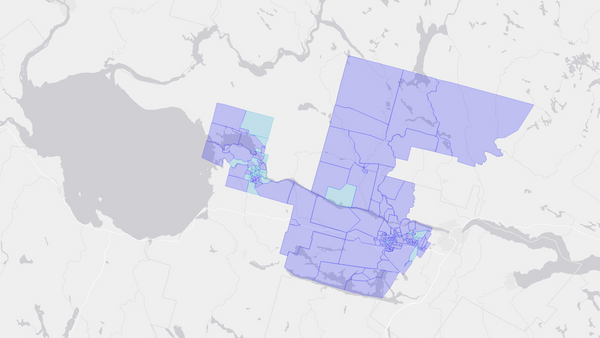
Montmorency—Charlevoix—Haute-Côte-Nord, QC — 2008 Federal Election Results Map
Montmorency—Charlevoix—Haute-Côte-Nord — 2008 Election Results
📌 The Canadian federal electoral district of Montmorency—Charlevoix—Haute-Côte-Nord was contested in the 2008 election.
🏆 Michel Guimond, the Bloc Québécois candidate, won the riding with 21,068 votes (48.9% of the vote).
🥈 The runner-up was Guy-Léonard Tremblay (Conservative) with 11,789 votes (27.3%), defeated by a margin of 9,279 votes.
📊 Other notable candidates: Robert Gauthier (Liberal, 13%) and Jonathan Tremblay (NDP-New Democratic Party, 8%).
Riding information
Auto generated. Flag an issue.Montmorency—Charlevoix—Haute-Côte-Nord
A meteorite that struck roughly 340 million years ago left a crater some fifty-four kilometres across on the north shore of the St. Lawrence, and its rim still frames the middle of this riding. The district begins at the Montmorency sector of Quebec City's Beauport borough, runs east through the Côte-de-Beaupré and Île d'Orléans county municipalities, climbs over the Charlevoix hills, and continues far down the Côte-Nord through the Haute-Côte-Nord county municipality as far as Colombier — several hundred kilometres of shoreline strung together largely by Route 138.
Candidates
Michel Guimond (Bloc Québécois) — Born in Chicoutimi in December 1953 and trained as a lawyer, Guimond served on Boischatel council from 1987 to 1993 and was elected to the Commons that year with the first Bloc Québécois caucus. The name of his seat changed several times as boundaries were redrawn, but he held it through every contest. He chaired the Public Accounts Committee in 1996 and 1997, sat as vice-chair of Procedure and House Affairs, took critic duties for parliamentary affairs, transport and the Auditor General, and served as his party's whip. He was seeking a sixth term.
Guy-Léonard Tremblay (Conservative) — Tremblay, of Château-Richer, ran for the Conservatives.
Robert Gauthier (Liberal) — Gauthier, of Saint-Irénée in Charlevoix, was the Liberal candidate.
Jonathan Tremblay (NDP) — Tremblay, of Beaupré, carried the New Democratic nomination.
Jacques Legros (Green) — Legros, of Sainte-Famille on Île d'Orléans, stood for the Green Party.
About the Riding
Just past the Quebec City line the Montmorency River drops off the escarpment in a fall higher than Niagara, and the Côte-de-Beaupré begins. Its municipalities — Boischatel, L'Ange-Gardien, Château-Richer, Sainte-Anne-de-Beaupré, Beaupré, Saint-Ferréol-les-Neiges and Saint-Tite-des-Caps among them — held roughly 24,000 people on a narrow bench between the river and the mountains. The basilica at Sainte-Anne-de-Beaupré draws pilgrims from across North America, and Mont-Sainte-Anne above Beaupré is one of the province's principal ski areas; forestry has long had a foothold at the eastern end of the coast.
Île d'Orléans, reached by the suspension bridge opened in 1935 from the Montmorency shore, holds six village parishes and some of the oldest working farmland in Quebec — strawberries, potatoes, apples, market gardens and a growing cluster of artisanal food producers — alongside a stock of eighteenth-century houses that led the province to protect the whole island as a heritage district in 1970.
Charlevoix beyond it was named a UNESCO world biosphere reserve in 1988, one of the first inhabited reserves designated in Canada, covering some 460,000 hectares that run from tidal marsh to mountain tundra and shelter about 30,000 residents. Baie-Saint-Paul is its arts town, La Malbaie its resort centre with the Manoir Richelieu and a casino, Clermont its mill town. Forestry, silica mining, agriculture and tourism carry the regional economy.
Farther east, past the ferry across the mouth of the Saguenay, the Haute-Côte-Nord thins out sharply: nine municipalities and about 12,300 people spread over more than 11,000 square kilometres. Forestville is the largest town, Les Escoumins the county seat, and Tadoussac the anchor of a whale-watching industry built on the beluga and rorqual populations at the river confluence. The Innu community of Essipit sits next to Les Escoumins.
Seasonal work defines the riding's labour market — tourism, forestry, fishing and farming all compress employment into part of the year — and employment insurance rules were the federal file with the most direct local consequence. The forestry downturn that had been closing Quebec mills since mid-decade was felt acutely on the Côte-Nord, and softwood lumber and the reliability of the ferry and Route 138 links were standing regional demands heading into the vote.