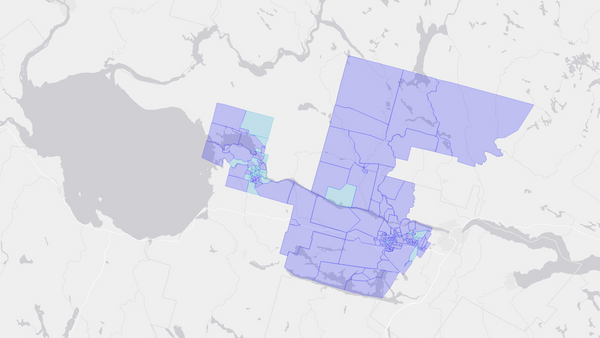
Gaspésie—Îles-de-la-Madeleine, QC — 2008 Federal Election Results Map
Gaspésie—Îles-de-la-Madeleine — 2008 Election Results
📌 The Canadian federal electoral district of Gaspésie—Îles-de-la-Madeleine was contested in the 2008 election.
🏆 Raynald Blais, the Bloc Québécois candidate, won the riding with 14,636 votes (40.1% of the vote).
🥈 The runner-up was Denis Gauvreau (Liberal) with 9,840 votes (27.0%), defeated by a margin of 4,796 votes.
📊 Other notable candidates: Darryl Gray (Conservative, 23%) and Gaston Langlais (NDP-New Democratic Party, 7%).
Riding information
Auto generated. Flag an issue.Gaspésie—Îles-de-la-Madeleine
Few Canadian ridings are strung out over as much coastline as this one. It follows the Baie des Chaleurs east from Avignon through Bonaventure and around Percé to the town of Gaspé, then jumps some 200 kilometres into the Gulf of St. Lawrence to take in the Magdalen Islands, which keep Atlantic time. The regional county municipalities of Avignon, Bonaventure, Le Rocher-Percé and La Côte-de-Gaspé make up the peninsular portion, along with the Mi'kmaq communities of Listuguj and Gesgapegiag.
Candidates
Raynald Blais (Bloc Québécois) — Born at Port-Daniel in 1954 and living at Chandler, Blais spent about a dozen years as a journalist at the regional station CHNC in New Carlisle, then worked as a political assistant. He presided over the Gaspésie–Îles-de-la-Madeleine central council of the Confédération des syndicats nationaux from 1993 to 1995 and again from 1998 to 2000. He first ran federally in 2000, losing to Liberal Georges Farrah in the predecessor riding of Bonaventure—Gaspé—Îles-de-la-Madeleine—Pabok, then won in 2004 and again in 2006. He was the sitting member.
Denis Gauvreau (Liberal) — Gauvreau was the Liberal candidate.
Darryl Gray (Conservative) — Born at Campbellton, New Brunswick, in 1946, Gray was a farmer and teacher living at Escuminac. He sat as the Progressive Conservative member for Bonaventure—Îles-de-la-Madeleine from 1984 to 1993, taking the seat from Liberal Rémi Bujold and holding it in 1988 before losing to Liberal Patrick Gagnon in 1993. He ran once more in Matapédia—Matane in 1997. His 2008 candidacy marked a return to the region's federal politics after eleven years away.
Gaston Langlais (NDP) — Langlais, of Gaspé, stood for the New Democrats.
Julien Leblanc (Green Party) — Leblanc was the Green Party candidate.
About the Riding
The riding's economic history is a sequence of large employers that no longer exist. Murdochville, in the interior above Gaspé, was laid out by Noranda around a copper mine and smelter and incorporated in 1953; mining stopped in October 1999 when the ore ran out, and the smelter, which had carried on with purchased concentrate, closed in April 2002 with the loss of some three hundred jobs. The town has since tried to rebuild around wind energy and outdoor tourism. At Chandler, Abitibi-Consolidated shut the Gaspésia pulp and paper mill in June 1999; a conversion project backed by the province's forestry investment arm, Tembec and the Fonds de solidarité FTQ began in 2002, ran hundreds of millions of dollars past budget and was abandoned in 2004. The failure was still a sore point on the coast four years later.
Fishing remains the constant. The 1992 groundfish moratorium ended the cod economy, and snow crab, shrimp and lobster took its place, but the replacement is more seasonal and more exposed to quota decisions taken in Ottawa. Federal fisheries management and the structure of employment insurance for seasonal workers are the two subjects most reliably raised at the door here, along with the gap many workers face between the end of benefits and the start of the next season.
The Magdalen Islands run on lobster, tourism and the seal hunt, plus the Seleine rock-salt mine at Grosse-Île, opened in the early 1980s with provincial money and owned by the Canadian Salt Company since 1988. Grosse-Île is English-speaking; the rest of the archipelago is francophone. Everything there depends on the ferry and air links, so transport subsidies and freight costs are perennial federal files.
On the mainland, forestry and wood processing supplement the fishery, and a wind-turbine blade plant at Gaspé had begun to put people to work in a new industry. Unemployment ran well above the Quebec average and incomes below it, and the outflow of young people had been draining the peninsula for a generation.